
$FATCAT Turned Watched-Wallet Buys Into a Live Solana Chase, but the Deployer Shadow Never Leaves the Screen
At the 2026-07-09 04:15 UTC reference point, $FATCAT was trading near a $161.6K market cap with about $1.07M in 24-hour volume and roughly $32.0K in visible liquidity after an explosive first session. Two watched wallets getting there early gave the ticker credibility it would not have had on meme aesthetics alone, yet Rugcheck now scores the deployer profile at 80 for creator history of rugged tokens, which means the upside case has to share the room with an unusually loud reputation risk.
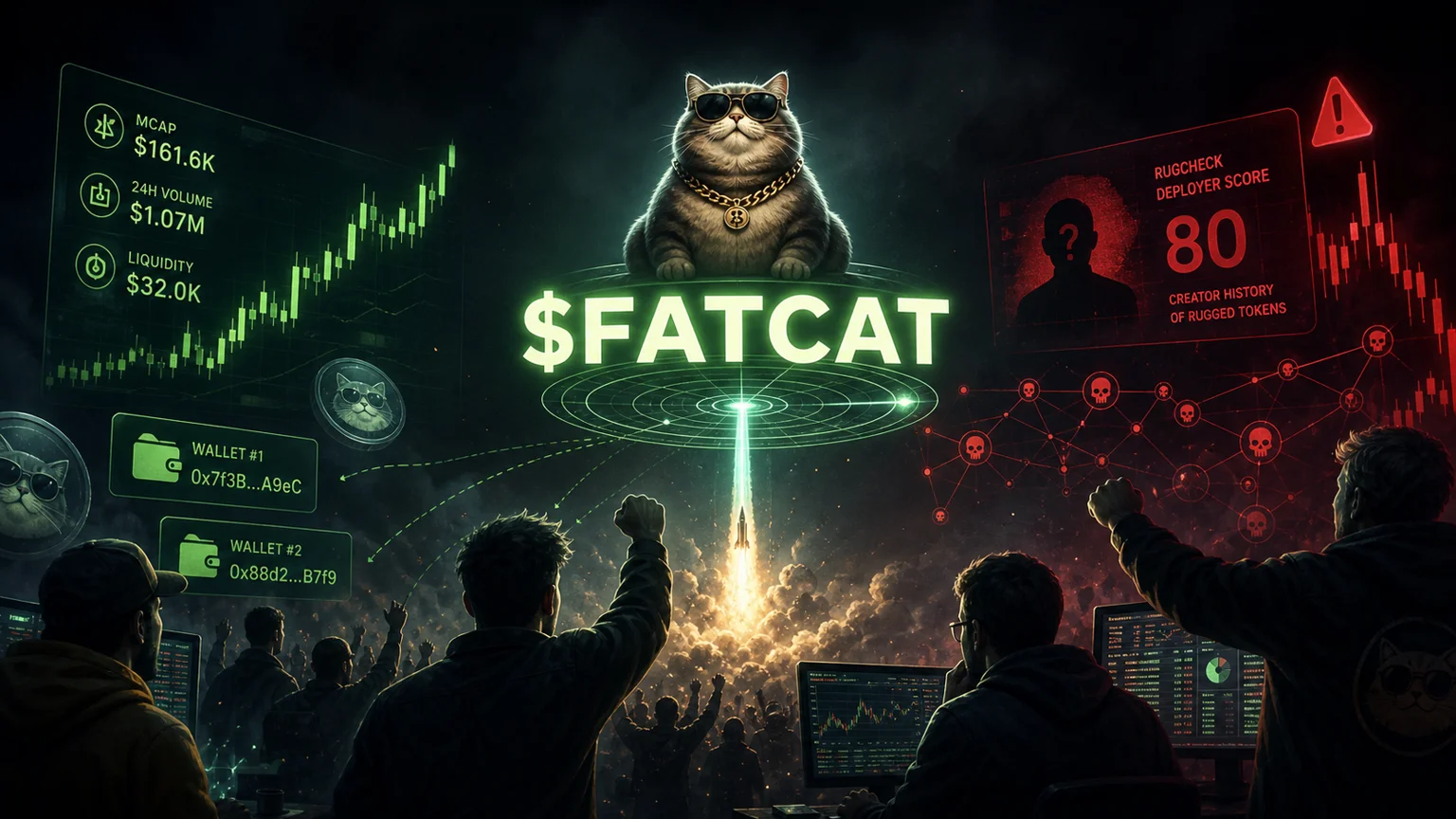
Freeze authority is off and mint authority is off, but Rugcheck scores the deployer at 80 for creator history of rugged tokens and the creator wallet still sits among the top three holders.
The attraction of $FATCAT is easy to understand because the first layer of the story is exactly the kind of evidence fast traders respect. The ticker did not wake up only because the meme was cute. Two watched wallets were already involved before the broader crowd fully arrived, and by the 2026-07-09 04:15 UTC reference point the pair had churned through roughly $1.07M in 24-hour volume on a market cap near $161.6K. That is the sort of mismatch that makes degens feel they are looking at a live chase instead of a lonely meme trying to post its way into relevance.
The problem is that this board makes you hold two thoughts at once. The first is that real money clearly touched it early enough to matter. The second is that the deployer profile now throws off a much darker signal than the price action. Rugcheck is not merely showing a messy cap table or a routine launchpad mess. It is scoring the creator at 80 and explicitly flagging a history of rugged tokens. That does not automatically doom this board in the next ten minutes, but it changes the burden of proof. $FATCAT no longer gets judged only on velocity. It gets judged on whether the market is outrunning a reputation that has already burned traders before.
- → $FATCAT turned early watched-wallet participation into more than $1.07M of 24-hour Solana turnover and a 415% daily move, which is why the board graduated into a real chase instead of a cute one-line meme.
- → Visible liquidity around $32.0K is enough to keep the chart tradeable for now, but it is still thin enough that emotional exits can hit much harder than the market cap suggests.
- → Freeze authority is off and mint authority is off, yet Rugcheck still scores the deployer profile at 80 because of creator history of rugged tokens and because the creator wallet still ranks among the top holders.
The Smart-Money Optics Are Easy to Understand
A lot of fresh memes ask traders to believe the chart before any serious wallet has bothered to validate it. $FATCAT got the opposite gift. The watched-wallet angle gives the token a starting narrative that is much stronger than generic social hype, because it implies at least some money was willing to front-run the mass reaction. In trench terms, that matters. Traders will forgive a ridiculous ticker if they think sharper wallets already signed the first line of the story.
The cat meme itself helps because it does not need explanation. This is not some elaborate lore coin requiring a thread and a Discord sermon before anybody understands the joke. It is a fat cat. That is enough. The combination of dead-simple meme packaging and early wallet validation is what made the board move from novelty into opportunity. If the chart had looked this explosive without the wallet context, it would read like random launchpad chaos. With that context, the board at least earns a real second look.
What the On-Chain Data Shows
The contract permissions themselves are not screaming danger. Freeze authority is off. Mint authority is off. The main pump-fun liquidity pool is fully locked according to the Rugcheck read, which removes one of the ugliest immediate failure modes fresh Solana traders watch for. That is the part bulls will point to first, and they are not wrong to do it. If someone only skimmed the permission layer, they would say $FATCAT looks mechanically cleaner than a lot of other same-session chases.
The trouble starts the moment the creator history enters the frame. Rugcheck is not being subtle here. The report tags creator history of rugged tokens as a danger-level risk and pushes the normalized score to 80. That is a very different read from a token whose main problem is simply that it launched too fast. Add the fact that the creator wallet still accounts for 4.31% of supply and sits inside the top-three holder cluster, and the market has to treat this as an active trust problem rather than a cosmetic warning label.
The holder map is not catastrophically tight, but it is tight enough to matter. The top wallet holds 20.75%. The main pool account holds about 9.91%. The creator wallet adds another 4.31%. Taken together, the top three control roughly 35.0% of supply. That is lighter than some obvious death-trap boards, yet it is not broad enough to let traders dismiss the ownership question. Holder concentration, freeze authority, and mint authority all have to be read together here: the permissions look fine, but the ownership and deployer history keep the market from upgrading the story into a carefree green setup.
The Deployer History Is the Entire Catch
This is what separates $FATCAT from the cleaner animal memes that have run recently. A lot of those boards ask a simple question: is the meme good enough and the pool deep enough to support one more audience? This one asks a harder question: can the market keep buying despite a creator profile that already carries bad memory? Rugcheck listing roughly 46 creator-linked launches is not background noise. It reframes every fresh candle. On a hot board, serial deployment can look like hustle. After a danger-level history flag, it looks more like precedent.
That does not mean the market is obligated to care right away. Meme traders routinely ignore ugly provenance while a chart is vertical. In the short term, velocity can overpower reputation. The reason this still belongs in an article instead of a blacklist is that the watched-wallet flow and the aggressive turnover are real enough that the board may continue higher before morality or caution catches up. But the reputation issue changes how any further upside should be interpreted. It is no longer enough for $FATCAT to be loud. It has to prove that fresh demand can stay strong even after traders understand who built it.
Can Volume Outrun the Reputation?
There is a path where the market keeps bidding anyway. The cap is still small, the meme is broad enough to travel, and the wallet-validation story gives latecomers something more concrete than vibes to cling to. If the chart keeps printing heavy turnover while liquidity thickens beyond the current $32.0K zone, the token could still force traders to respect the move in spite of the stain on the deployer profile. Meme markets do not always reward the morally tidy board. They reward the one that still has a crowd.
The bear case is that the exact same ingredients making the upside look explosive are what make the downside feel predatory. Thin liquidity, a serial deployer shadow, and a creator wallet still sitting in the top cluster are not details you want to discover only after momentum cools. That is why the smartest read on $FATCAT is neither blind disbelief nor blind faith. It is conditional respect. Respect the wallet-confirmed flow. Respect the size of the move. Then keep one eye on the fact that this board is trying to earn trust while carrying a biography the market would usually treat as disqualifying.
The clean contract permissions on $FATCAT do not erase the bigger reputation problem. When a board carries a danger-level creator-history warning, every extra wave of volume has to answer a harder question than usual: is the market discovering a winner, or just postponing the moment provenance matters?
🟡 Speculative — $FATCAT has enough real momentum to stay on the radar because watched-wallet buys showed up early, the board already processed more than $1.07M in turnover, and the core permission checks still look clean with freeze authority off and mint authority off. The yellow badge stays firm because Rugcheck scores the deployer profile at 80 for creator history of rugged tokens, the creator wallet still ranks among the largest holders, and the pool remains thin enough that trust can evaporate faster than the chart can explain itself.
What is $FATCAT?
$FATCAT is the Solana meme token fatcat, trading under contract G8bNZABJLB6A1iKyuQdJWXGtgo6UxwQ2DC7gZXWQpump.
Why is $FATCAT getting attention on July 9?
Because watched-wallet participation showed up early and the pair pushed through roughly $1.07M of 24-hour turnover by the 2026-07-09 04:15 UTC read, which turned a simple cat meme into a live momentum chase.
What does the on-chain read look like for $FATCAT?
Freeze authority is off, mint authority is off, and the main pump-fun pool appears fully locked. The bigger warning is Rugcheck scoring the deployer profile at 80 for creator history of rugged tokens while the creator wallet still holds about 4.31% of supply.
Why is the rating speculative instead of clean?
Because the price action and wallet flow are strong, but the creator history and remaining creator ownership keep the trust profile too messy for a green read.
Where can traders verify the $FATCAT contract?
The easiest checks are on DexScreener using pair ecMLugdZenwkrb3hcBRdPyPvFUMV9ZxfhVoMBRJHtAK and on Solana explorers using contract G8bNZABJLB6A1iKyuQdJWXGtgo6UxwQ2DC7gZXWQpump.