$TROLL Is Borrowing a Benchmark Meme's Identity, but the Real Trade Sits Inside the Unlocked LP Risk
A fresh chinapumpwxc mention helped this Solana $TROLL board print more than $566K in 24-hour turnover around 2026-06-27 10:15 UTC, yet the on-chain read says traders are not buying the old benchmark troll coin at all. They are buying a copycat contract with fully unlocked liquidity, a Rugcheck score of 54, and just enough flow to keep the trap believable.
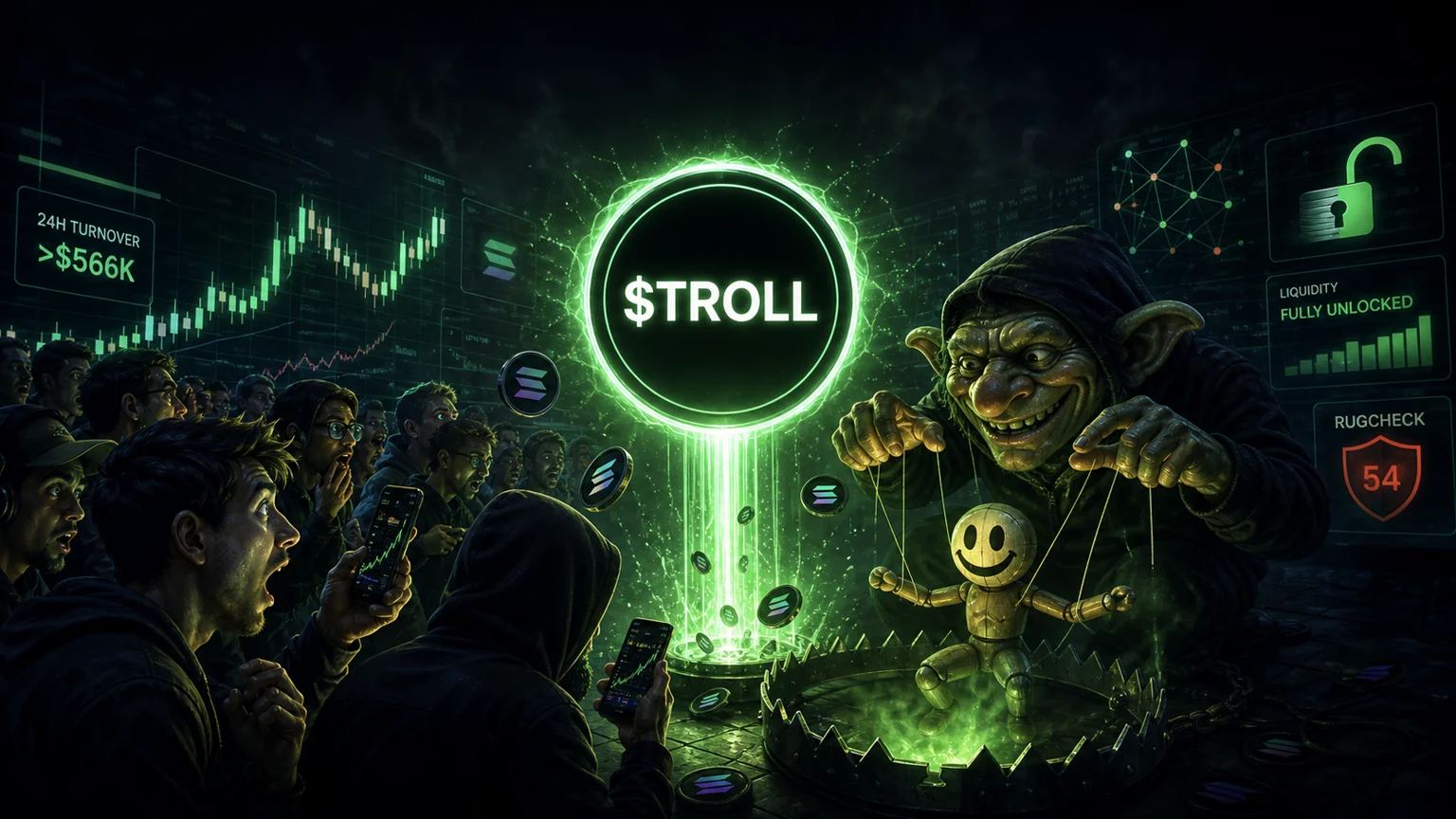
The top holder map looks relatively distributed, but the token carries a Rugcheck score of 54 because liquidity is fully unlocked and the symbol directly shadows an established $TROLL contract.
A lot of Solana meme trades are hard because the board is ugly. This one is hard because the board is deceptively easy to understand. At 2026-06-27 10:15 UTC, this $TROLL contract was sitting near a $422K market cap with roughly $56.6K in liquidity and about $567K in 24-hour turnover. Those numbers are not random-wallet noise. They are big enough to create the feeling that a real market is forming. Then chinapumpwxc threw fresh attention onto the ticker and gave the board exactly what every copycat contract wants: a short burst where traders stop checking what they are actually buying and start reacting to the symbol alone.
That is the whole editorial angle. The opportunity here is not about rediscovering the old internet benchmark troll coin that already has years of meme memory attached to it. The opportunity, if one exists, is about whether a new contract can successfully rent that memory long enough to pull in enough secondary flow before the market notices the structure underneath it. There is a difference between a benchmark meme pulling a fresh bid and a new contract wearing a benchmark meme's name tag. This board is the second one, and the distinction matters more than the candle.
- → This Solana $TROLL contract processed roughly $567K in 24-hour volume at the 2026-06-27 10:15 UTC check, which proves there is real rotation here and not just a dead ticker being spammed into existence.
- → The top holder map is cleaner than many same-day meme launches, with only about 10.3% of supply across the top three visible wallets and both freeze and mint authority disabled.
- → The real problem is structural, not cosmetic: Rugcheck scores the token at 54, flags the LP as fully unlocked, and explicitly labels it a copycat of the better-known $TROLL contract.
Why the Copycat Setup Is Working Anyway
Copycat contracts only work when they borrow something traders already know how to sell to each other. $TROLL is perfect for that job because the original benchmark meme already trained CT to associate the ticker with old-internet identity, chaotic humor, and previous monster reprices. A new contract does not need to build all of that from scratch. It only needs to look close enough, move fast enough, and catch one recognizable social nudge so the first wave of buyers can tell themselves they are not aping a random launch. They are aping a familiar lane.
That explains why the board could still clear nearly 6,400 combined buys and sells in the full 24-hour window even while the day finished red. There were 2,196 buys against 4,245 sells, which is the kind of tape that tells you the first crowd is already distributing stock into the second crowd. If the symbol were weaker, that imbalance would have killed the trade already. Instead, the copycat identity is acting like a synthetic narrative cushion. Every dip can be repitched as a reload because the meme brand is doing emotional work that the contract itself did not earn.
The sell pressure is why this does not read like a clean runner even though the liquidity stack is not microscopic. Roughly $56.6K in pool depth is enough to keep the chart alive and enough to let fast traders operate without total slapstick slippage. It is not enough to make the board safe, and it is definitely not enough to ignore the way copycat trades usually end. The flow can stay active for hours or even a session when the ticker is familiar. Once the market decides the borrowed identity is no longer worth paying for, that same moderate pool turns into an exit funnel.
What the On-Chain Data Shows
This is where the chart and the chain stop telling the same story. On one hand, the holder map looks better than the average low-cap Solana meme. The top visible holder is the Raydium CLMM pool itself at about 6.73% of supply, followed by wallets near 1.81% and 1.79%. Add the top three together and you only get roughly 10.3%. That is unusually distributed for a board in this size range. Freeze authority is off. Mint authority is off. The creator wallet balance is tiny at roughly 0.06% of supply. If you only skimmed those data points, you would think the structure was relatively sane.
Then the real red flag shows up: the liquidity is fully unlocked. Rugcheck is not being subtle about it. The main risk on the token is not hidden supply inflation or an absurd top-wallet dictatorship. It is the fact that the pool can still be pulled. That changes how every bullish number should be read. Volume is no longer a sign of broadening confidence. It is a timer. Liquidity is no longer a comfort blanket. It is the amount of capital sitting in the place that can disappear first. In other words, the on-chain profile is not broken in the familiar meme-coin way. It is fragile in the exact way copycat traders should fear most.
Rugcheck also flags the token as a copycat of the verified $TROLL contract and detects a cluster of insider-linked transfer networks on the graph. That does not guarantee a rug by itself, but it tells you the social setup and the on-chain setup are pulling in opposite directions. The social layer says benchmark meme, old internet, cycle leader memory. The chain says new contract, low LP provider count, and open-ended liquidity risk. Those are not small wrinkles around an otherwise clean read. They are the whole read.
Why the Liquidity Trap Matters More Than the Meme
The easiest mistake on a board like this is assuming the biggest risk must be concentration because that is what usually ruins Solana launches. Here, concentration is almost the decoy. The visible wallets are not what makes this setup dangerous. The danger is that traders can look at a cleanish holder map and talk themselves out of checking the pool mechanics. That is how liquidity traps get paid. The trade feels more legitimate than the usual trash because it does not scream scam from the top-holders table. Instead it lets the ticker, the volume, and the borrowed meme history do the distracting.
This is also why the copycat angle matters editorially. If the board had launched under a different symbol with the exact same liquidity settings, the market probably would have treated it like a routine low-cap gamble. Because it launched as $TROLL, the conversation is different. Traders can pretend they are buying cultural memory when they are really buying a fresh contract with removable liquidity. That symbolic confusion is the product. The contract is not merely adjacent to the narrative. The contract is monetizing the narrative mismatch itself.
There is still a tradeable bull case, and it would be dishonest not to say it clearly. Copycats can run hard when the market is tired, when wallets want an immediately legible symbol, and when a recognizable CT handle adds just enough oxygen for the second wave to show up. With a sub-$500K board and six-figure daily turnover, this contract does not need institutional sponsorship. It only needs short-term belief. If the flow keeps treating the ticker as the point, the board can absolutely squeeze higher before the structure punishes late buyers. That is what makes the setup dangerous rather than irrelevant.
But danger cuts both ways. A board that depends on symbolic confusion has no durable moat once traders slow down enough to inspect the contract. The original benchmark meme already exists. The copycat premium only lasts while speed beats diligence. As soon as the market begins pricing the distinction correctly, the liquidity question becomes existential. Cleaner holder distribution helps less than people think when the pool itself can still be the rug vector. That is why the decisive number on this board is not the top-three concentration. It is the unlocked LP status sitting underneath a very tradable-looking surface.
🟡 This $TROLL contract stays speculative because the board is active enough to matter and the holder map is cleaner than most low-cap Solana launches, but the structural risk overwhelms the good optics. Rugcheck scores it at 54, flags the token as a copycat, and shows the LP as fully unlocked. Traders can absolutely extract another move from a familiar meme symbol if attention stays hot. The mistake would be treating borrowed benchmark identity like genuine quality. On this board, the meme sells the click while the liquidity terms decide the ending.
What is this Solana $TROLL token?
It is a Solana meme token trading under contract address DKRMFoL2BqEiKX6t83ucwyQQau3K2Mt31QEd7yB2fG3F. At the 2026-06-27 10:15 UTC reference point, it was trading near a $422K market cap with roughly $56.6K in liquidity.
Why is the copycat warning so important here?
Because the ticker is borrowing recognition from the better-known benchmark $TROLL meme. That can create short-term flow, but it also means buyers may be reacting to the symbol faster than they are checking the contract they are actually buying.
Does the token look clean on-chain?
Parts of the structure look cleaner than average for a low-cap meme. Freeze authority is off, mint authority is off, and the top three visible holders only control about 10.3% of supply. The problem is that Rugcheck still scores the token at 54 because the LP is fully unlocked and the contract carries copycat risk.
What is the main risk from here?
The main risk is that traders keep focusing on the familiar $TROLL symbol while ignoring the liquidity terms. If attention cools or buyers realize the contract is not the benchmark meme they thought they were chasing, the unlocked LP risk becomes the number that matters most.