Last Bull Standing ($BULL) Has Solana's Attention, but the Holder Map Already Looks Like a Rug-Risk Warning
$BULL exploded into the June 6 UTC selection after a tradinator33 call and an eye-watering 7,984% daily move, but the on-chain file is harder to ignore than the momentum. One wallet controls 96.62% of supply, Rugcheck scores the token at 66, and the liquidity lock picture still leaves almost no room for a clean read.
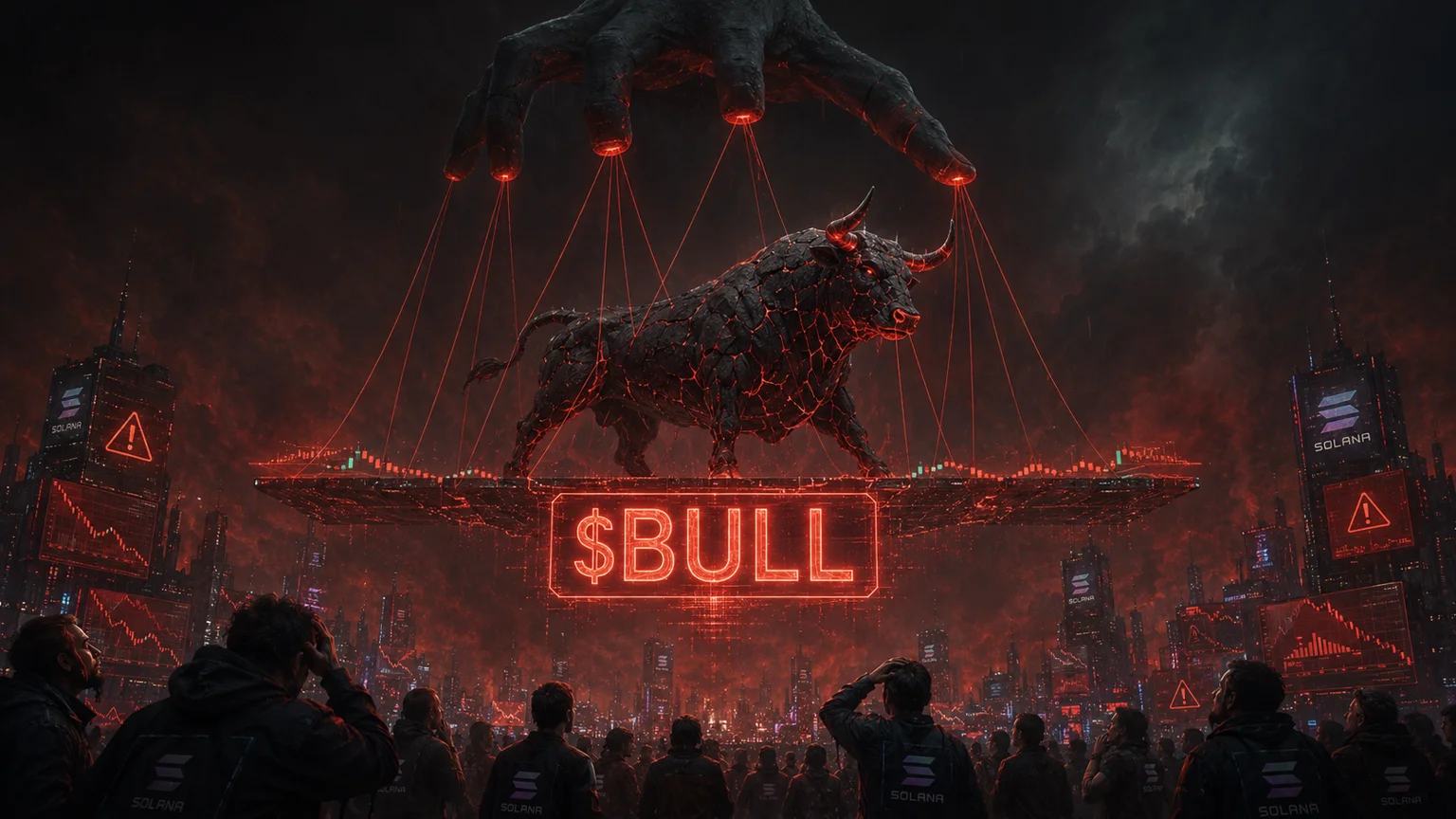
$BULL carries a Rugcheck score of 66, a 96.62% top wallet, and explicit unlocked-liquidity risk, which turns the chart into a structure warning before it becomes a clean momentum continuation.
$BULL has the kind of chart that can make discipline feel old-fashioned. A token called Last Bull Standing printed roughly $1.38 million in 24-hour turnover and a 7,984% daily burst before most Solana traders had time to decide whether the joke was clever, disposable, or both. That alone is enough to create urgency. Add in a confirmed CT mention from tradinator33 and the board immediately starts looking like one of those setups that dares the crowd to ignore it for even one hour. In this corner of the market, that combination usually buys a token a grace period where traders are willing to overlook a lot just to avoid missing another vertical move.
The problem is that $BULL does not ask for a small overlook. It asks for the market to look at one of the most uncomfortable holder maps in the current Solana queue and still chase anyway. The contract file shows freeze authority disabled and mint authority disabled, which keeps the token from reading like the dumbest possible permissions trap. But everything after that gets ugly fast. Rugcheck scores the token at 66. The largest visible wallet controls 96.62% of supply. The top three visible wallets hold about 98.24% combined. The saved risk flags explicitly warn that a large amount of liquidity is unlocked. That is not a normal concentration issue. That is the kind of concentration profile that changes the entire meaning of the price action.
- → $BULL forced its way onto the June 6 UTC board with roughly $1.38 million in 24-hour turnover and a 7,984% daily price move, so the raw attention signal is real whether traders like the structure or not.
- → The setup stops reading clean the moment the ownership file opens. One visible wallet controls 96.62% of supply, the top three hold about 98.24% combined, and Rugcheck scores the token at 66.
- → Freeze authority is disabled and mint authority is disabled, but that is not enough to rescue the read when unlocked-liquidity risk and near-total supply concentration are both already sitting in the file.
The Chart Is Loud Because the Float Is Tiny
A board can look explosive for bullish reasons or for mechanical ones, and $BULL leans far too hard into the second explanation to ignore. When almost the entire visible supply sits in effectively no hands at all, every burst of activity becomes harder to interpret as open-market discovery. It can still create opportunities. It can still create fear of missing out. But it does not create trust. That matters because a 7,984% daily move sounds like proof of overwhelming demand until the ownership file tells a different story. A token with a freely distributed float needs a crowd to print that kind of candle. A token with this kind of holder map can print an outrageous move because there is barely any real float available to absorb the chase.
What the On-Chain Data Shows
The easiest thing to say about $BULL is that the contract permissions are not the main villain. Freeze authority is disabled. Mint authority is disabled. Those checks matter because they remove two of the simplest ways a fresh Solana meme coin can ambush holders. If that were the full story, $BULL might still live in the speculative zone rather than the danger zone. But the permissions file is only one part of the on-chain read, and in this case it is nowhere near the most important one.
The dominant fact is still the holder map. The largest visible wallet sits at 96.62%. The second holds 1.55%. The third owns just 0.07%. That means the market is not even dealing with a broad cluster of whales. It is dealing with a single address that effectively defines the token's life. When one wallet carries that much of the visible supply, price can no longer be treated as a clean vote from the market. It becomes a function of whether that wallet is choosing to sit still, sell slowly, or let the crowd keep bidding a tiny remainder. There is almost no version of that setup that deserves a friendly editorial spin.
The risk file compounds the problem. Rugcheck scores $BULL at 66, which already pushes the token into a higher-alert bracket than the cleaner pump.fun boards currently fighting for attention. The saved warnings are not subtle. They flag a large amount of unlocked liquidity, top-10 ownership above 70%, single-holder ownership, and high ownership concentration above 80%. That stack of warnings matters because each one would be enough on its own to keep a launch from looking healthy. Together they create a picture where the chart almost has to be discounted, because the underlying market structure is weak enough to make any tape look better than it really is for short bursts.
Why the Unlocked-Liquidity Flag Matters as Much as the Top Wallet
A lot of traders will correctly notice that $BULL's biggest issue is concentration and stop there. That is understandable, but it is still incomplete. The unlocked-liquidity warning is what turns concentration from a red flag into a full structural threat. Thin or controllable liquidity means the market depth can change abruptly, not just the ownership mix. In other words, the same setup that allows a token to squeeze violently on the way up can also let the floor disappear faster than the crowd expects on the way down. Traders sometimes tolerate one of those problems if the other looks manageable. $BULL is carrying both at once.
That is also why calling this a momentum-versus-structure test may even be too generous. For a real test to exist, both sides need credible weight. Here the momentum case is mostly social proof and velocity. The structure case is hard data, and the hard data is brutal. The token does not just have a concentrated cap table. It has a cap table so concentrated that the broader market is almost an accessory to the move rather than its author. Add liquidity flexibility on top, and the setup starts to look less like a daring continuation trade and more like a board where the most important decisions are still being made somewhere the crowd cannot influence.
$BULL would need a drastic redistribution of supply, a materially safer liquidity picture, and follow-through that survives those changes before the setup could graduate out of the warning bucket.
This Is a Warning Before It Is a Setup
There will still be traders who make money on $BULL. That is not the same as saying the board deserves trust. Meme coin markets can reward speed inside terrible structures because terrible structures are often what create the fastest candles. The editorial question is different. It is whether the token looks like something readers should understand as a live opportunity or as a chart whose biggest lesson is hidden underneath the excitement. On that question, $BULL is straightforward. The main story is not that the ticker is running. The main story is that the run is happening on top of a holder map and liquidity file that make the move feel rented rather than earned.
That is why the fair label is warning, not admiration. A token can have real attention and still fail every meaningful structure check that matters after the first screenshot. $BULL has already crossed that line. The board may continue to squeeze because the visible float is so tight, or because CT keeps feeding it, or because traders decide they can outrun the risk for one more leg. None of those outcomes would change the file. Right now $BULL reads like one of those tokens that looks strongest precisely because the market underneath it is weakest.
🔴 $BULL is a rug-risk warning, not a clean momentum continuation. The attention is real, the daily move is enormous, and the CT spark helps explain why traders noticed it so fast, but the structure underneath the chart is far too compromised for anything better than a red label. One wallet controls 96.62% of supply, the top three visible wallets hold about 98.24% combined, Rugcheck scores the token at 66, and the file explicitly warns that a large amount of liquidity is unlocked. Freeze authority and mint authority being disabled are not enough to outweigh that. This is a board where the strongest candles come attached to the weakest market foundation.
FAQ
What is $BULL on Solana?
$BULL is the ticker for Last Bull Standing, a Solana meme token trading under contract address FDDX7jvJgQcxxSuSMan8AizT2RfHMuYKhKzHBbDwgLcs.
Why did $BULL get attention so quickly?
The token landed in the June 6 UTC selection after a confirmed CT mention, roughly $1.38 million in 24-hour turnover, and a 7,984% daily price burst, which is enough to force short-term trader attention.
What is the biggest on-chain problem with $BULL?
The holder map. One visible wallet controls 96.62% of supply and the top three visible wallets hold about 98.24% combined, which means the chart cannot be treated as a broad-market vote.
Do the contract permissions look safe?
Freeze authority is disabled and mint authority is disabled, which removes two obvious permission risks, but the token still carries a Rugcheck score of 66 and several major structure warnings.
Why does the unlocked-liquidity flag matter here?
Because it means the market depth can change abruptly. Combined with near-total supply concentration, that makes it much easier for the token to lose support just as violently as it gained attention.