$DIH Printed the Fast Solana Volume, but the Creator History Turns This Dog Costume Into a Rug-Risk Warning
At the 2026-06-12 04:15 UTC reference read, $DIH was trading near an $80.2K market cap on roughly $1.57M in 24-hour turnover, yet the sharper story sat underneath the chart: Rugcheck scored the board at 80 and tied the deployer to a long trail of prior token launches.
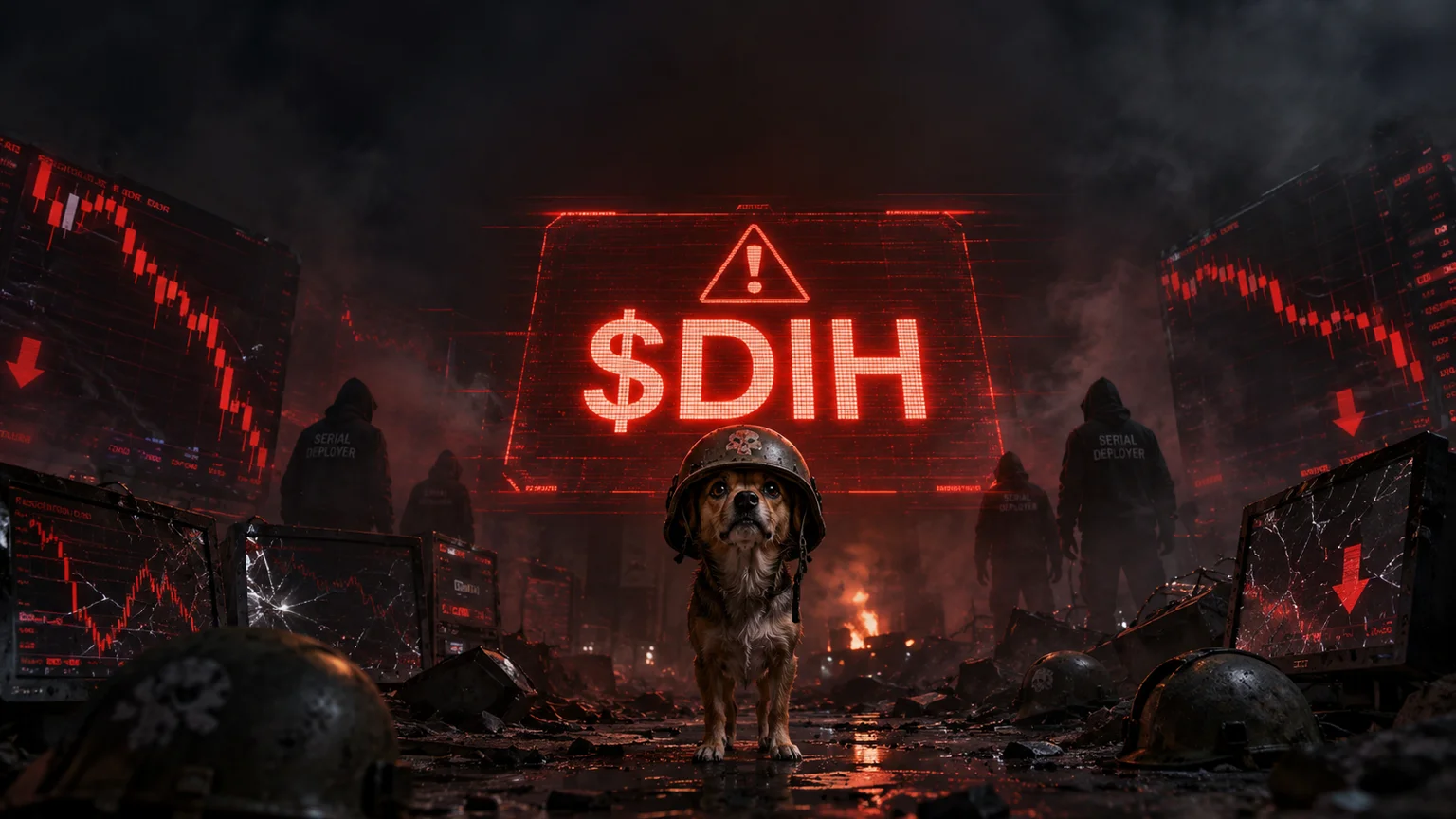
Rugcheck scored $DIH at 80, freeze authority was disabled, mint authority was disabled, and the top three visible wallets still controlled about 37.9% combined. The bigger problem is the deployer history: the same creator wallet was linked to 46 prior token launches, including rugged projects.
$DIH had the kind of opening board that can fool traders into thinking the hard work is already done. At the 2026-06-12 04:15 UTC reference read, the Solana token still showed roughly $1.57M in 24-hour turnover on an $80.2K market cap, which is more than enough activity to put it on radar for anyone scanning fast movers. But the tape was already telling a second story. The latest hour had chopped 61.73% off the move, which means the crowd was no longer debating whether the meme had attention. It was debating whether the first burst had already turned into a handoff.
Dog memes remain a permanent language on Solana, and a costume tweak like a helmet is usually enough to give a launch just enough recognisable identity for traders to try a quick sprint. The problem is that familiar meme packaging only helps if the structure behind it is not rotten. In $DIH, the structure is exactly where the story gets ugly. Rugcheck did not post a nervous yellow score. It printed an 80, and the reason was not cosmetic. The deployer wallet was tied to 46 prior token launches, including rugged names. That turns the board from a simple momentum read into a credibility test the token has not passed.
- → $DIH still held roughly $1.57M in 24-hour turnover at the 2026-06-12 04:15 UTC reference read, but the latest hour had already cratered 61.73%, which is a brutal sign this board may have spent its easiest demand almost immediately.
- → The contract permission layer was not the issue because freeze authority was disabled and mint authority was disabled, yet Rugcheck still scored the token at 80 due to creator-linked risk rather than simple admin toggles.
- → The deployer wallet was associated with 46 prior token launches, and the top three visible wallets still controlled about 37.9% of supply, so traders are not just betting on a meme here. They are betting that a known repeat launcher behaves better this time.
Why the Chart Looked Better Than the Trust Profile
Small Solana launches regularly create the illusion of legitimacy through speed. If enough buys hit early, the chart starts doing social proof on its own. Screenshots get cleaner, group chats get louder, and each new buyer feels less like a first mover and more like someone confirming what the market already decided. $DIH generated that effect for a short window. A 196% daily move with more than fourteen thousand buys is not a dead launch. It is the kind of traffic pattern that attracts opportunists who assume the only real question is whether they can grab the next candle before everyone else does.
The issue is that traffic can only carry a board so far when trust never catches up. A token does not need to be literally rugged to become a bad trade. Sometimes it only needs the market to realise that the people behind it have a worse history than the meme implies. Once that recognition starts spreading, every bounce becomes suspect because traders are no longer asking whether momentum will continue. They are asking who is using the bounce to escape. That is the lens $DIH forces on itself once an 80 Rugcheck score and a creator history tied to rugged projects are part of the read.
What the On-Chain Data Shows
The first read is mixed in a way that can trap impatient buyers. Freeze authority was disabled and mint authority was disabled at the reference snapshot, so the simplest contract-switch nightmares were not live. That is the one part of the setup that looks cleaner than the final rating suggests. If the story stopped at permissions, traders could argue that $DIH was just another aggressive dog meme trying to stabilise after a violent opening session. But on-chain review never stops at one checkbox, and this board gets much worse once the creator history enters the frame.
Rugcheck scoring the contract at 80 is the headline because it tells you the risk is reputational and behavioural, not merely technical. The deployer wallet was linked to 46 prior token launches. That kind of serial output does not automatically prove every future launch is dirty, but it absolutely changes how the market should interpret strength. A repeat launcher with that much prior activity has already shown a pattern of producing boards faster than long-term trust can form around them. When that same profile is also flagged for rugged history, the burden shifts hard onto the token to prove it is not just another disposable board wearing a cute theme.
The holder map does not rescue the setup either. The largest visible wallet held 20.69% of supply, the next one controlled 10.99%, and the top three visible wallets combined for about 37.9%. That is not the kind of concentration that guarantees an instant collapse, but it is enough to keep the board sensitive to a small number of decisions. In practical terms, it means the market can still get pushed around even after thousands of buys have come through. The liquidity profile adds to that fragility. Roughly $21.6K in liquidity is enough to make the board tradable, not enough to make it forgiving when confidence breaks.
Why Creator History Matters More Than a Cute Meme
Meme traders often over-focus on whether a contract can be frozen or minted and under-focus on whether the people launching it have any incentive to build something other than a short-lived liquidity event. That is backward. Admin permissions tell you whether the machine has obvious trap doors. Creator history tells you how often the operator has used the machine to produce disposable boards. In $DIH, the second question is louder. A wallet tied to 46 prior launches is not a blank slate. It is a serial operator profile, and in this case the record attached to it is bad enough that the market should assume every rally needs extra scrutiny.
That does not mean the token cannot bounce. Some of the most dangerous boards are the ones that keep bouncing just enough to renew hope. What it means is that any upside has to be discounted by motive. If traders are dealing with a creator who already has a history of rugged projects, then the board no longer deserves the benefit of being read like a fresh community experiment. It has to be read like a repeat product from a wallet that already taught the market how it behaves when attention arrives.
The Fast Collapse Is Already Part of the Story
The 61.73% one-hour drawdown is not a tiny wobble inside a healthy launch. It is the chart telling you that supply hit harder than new demand could comfortably absorb. In a clean runner, sharp pullbacks can happen, but they usually come with some evidence that buyers are still defending structure. Here, the size of the retrace lands differently because it sits on top of the creator concerns. Instead of looking like ordinary volatility, the drop starts to read like the market processing information and repricing trust downward in real time.
That is what makes the board dangerous for late arrivals. On paper, traders can still point to a 196% day and argue there is life left. In practice, they would be stepping into a board where the first momentum burst already faded, liquidity is shallow, the holder map is still concentrated enough to matter, and the deployer profile gives nobody a reason to assume patient stewardship. A token can rip again under those conditions. It can also use them to produce a final trap for anyone who mistakes surviving volume for restored trust.
Verdict
🔴 Shill — $DIH earned attention because the reference read still showed roughly $1.57M in 24-hour turnover on an $80.2K market cap, but the board fails the credibility test that matters more than raw traffic. Rugcheck scored the token at 80, the deployer wallet was tied to 46 prior launches including rugged projects, the top three visible wallets still controlled about 37.9% of supply, and the latest hour had already erased 61.73% of the move. Freeze authority and mint authority being disabled keep the contract from looking cartoonishly broken, yet that is nowhere near enough to outweigh the creator history. This is not a clean dog meme catching a second look. It is a rug-risk warning wrapped in a fast chart.
FAQ
What is $DIH on Solana?
$DIH, short for Dog in helmet, is a Solana meme token trading under contract address Gh5tgNMDbWTMsUZa1YVoocz5Q2URzFMtzGp3WKfGpump. At the 2026-06-12 04:15 UTC reference read it was hovering near an $80.2K market cap with roughly $1.57M in 24-hour turnover.
Why is the article angle a rug-risk warning instead of a normal launch radar read?
Because the on-chain profile points to operator risk rather than a simple fresh launch. Rugcheck scored the token at 80 and linked the deployer wallet to 46 prior token launches, including rugged projects.
Did the contract itself have obvious authority problems?
At the saved reference read, freeze authority was disabled and mint authority was disabled. That removes two basic contract concerns, but it does not cancel the much bigger creator-history issue.
How concentrated was the holder map on $DIH?
The largest visible wallet held 20.69% of supply, the second held 10.99%, and the top three visible wallets controlled about 37.9% combined. That is concentrated enough to keep the chart sensitive to a small number of wallets.
What is the main trading risk after the big one-hour drop?
The main risk is that any bounce gets mistaken for repaired trust. With shallow liquidity, a weak holder map, and a creator tied to rugged history, even strong-looking rebounds can become exit liquidity rather than a durable recovery.