
$PUMPFUNLIFE Ripped 618% in Three Hours, but the Real Test Starts After the First Wallet Win
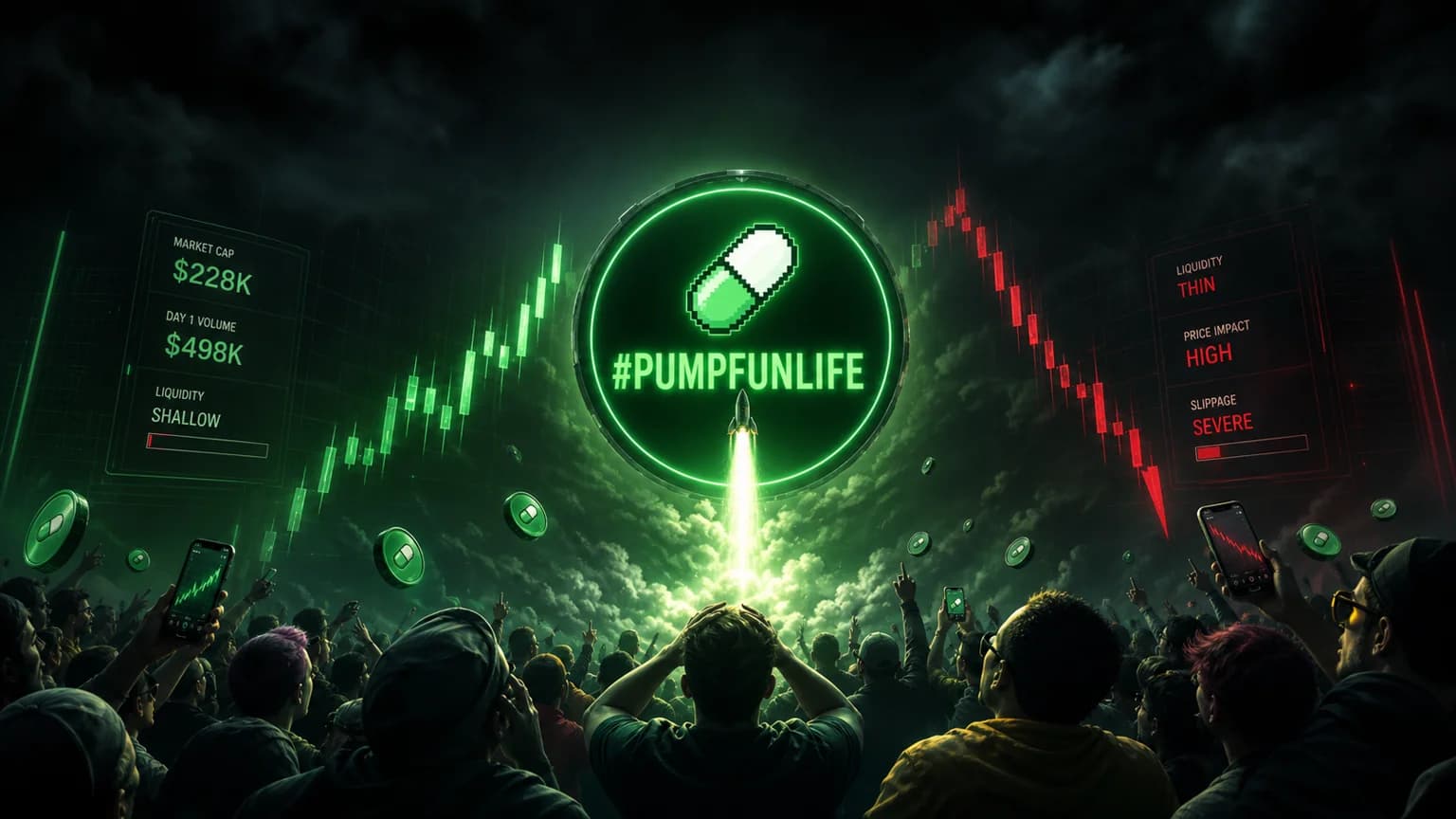
PumpfunLife exploded to a $228K market cap on nearly $500K of day-one turnover, yet the shallow liquidity and fast vertical move leave late buyers staring at a much harsher second act.
Rugcheck shows no freeze authority, no mint authority, and only 16.5% of supply across the top three holders, so the main threat is exhaustion after a vertical move rather than an obvious contract trap.
The cleanest way to read $PUMPFUNLIFE is not as a victory lap but as a stress test. In under three hours the Solana meme coin went from just another fresh pair to a chart that printed a 618% move, almost $500K in turnover, and enough noise to pull in traders who love anything vertical. That kind of start matters, especially when a watched wallet showed up before the symbol widened out. But speed cuts both ways. A move this sharp can mean real demand found the ticker early, or it can mean the first cycle of buyers already consumed most of the easy upside while the harder, riskier money arrives late.
- → $PUMPFUNLIFE reached a $228K market cap with $496.5K in turnover inside its first three hours.
- → The pool only held about $36.4K of liquidity, which means exits can get ugly fast if momentum cools.
- → The contract profile looks cleaner than the average Solana sprint, so the main read is exhaustion risk rather than an obvious rug setup.
Why $PUMPFUNLIFE Caught a Bid
There are plenty of day-one Solana launches that print a short green candle and disappear. $PUMPFUNLIFE did more than that. The token pushed enough early volume to matter, and the tape was active enough to avoid looking like a ghost pool being bounced by a tiny clique. Nearly $209.9K of that turnover came in the last hour alone, which tells you the move did not happen on stale prints from the open. Something actually accelerated the name. The best explanation from the available data is simple: one watched wallet stepped in early, the market noticed that activity, and the symbol became a fast reflex trade for anyone scanning for momentum before the window fully crowded.
That does not automatically turn the token into a clean runner. It does explain why it earned attention. At a sub-$250K market cap, buyers do not need a massive narrative to force a repricing. They need a believable reason to think the next wallet will pay higher. $PUMPFUNLIFE had exactly that for a brief stretch: a tiny enough market cap to move violently, enough visible liquidity to look tradable, and enough turnover to create the illusion that depth might keep improving if the bid held. The problem is that this phase is usually the easiest part of the trade. Once a token has already delivered the first headline number, the next buyers are not paying for discovery. They are paying for continuation.
What the On-Chain Data Shows
This is where $PUMPFUNLIFE gets more nuanced. The holder map does not scream immediate disaster. Rugcheck scored the token at 1, the freeze authority is off, and the mint authority is also off. Those two authority checks matter because they remove the easiest contract-level ways for a dev to trap holders or expand supply into the bid. The top holder sits at 10.56%, while the next two wallets hold 3.13% and 2.84%, leaving top-three concentration at 16.5%. For a token that is not even three hours old, that distribution is notably less toxic than the usual microcap launch where one wallet owns the room and every buyer is pretending not to notice.
The cleaner holder spread does not eliminate risk; it changes the type of risk. Traders looking at this chart should worry less about a blunt contract trap and more about whether the liquidity can survive the next round of selling. A $36.4K pool against a $228K market cap is workable while buyers are aggressive, but it is not forgiving if momentum stalls. Even a handful of profit-taking wallets can shove price lower when the pool is this thin. That is why the mint and freeze settings matter here. Since those switches are off, the bear case shifts from hidden contract danger to open market mechanics: slippage, air pockets, and the speed at which a vertical move can reverse once the first wave stops pressing.
The contract profile is cleaner than the average first-day Solana launch.
The weaker point is the pool depth relative to how far the chart already stretched.
That makes $PUMPFUNLIFE a momentum durability question, not a blind trust exercise.
Who Is Actually Holding the Risk
The easy mistake after a chart like this is to focus only on the wallets that bought early and ignore the wallets now inheriting the risk. Early entrants had the luxury of uncertainty working in their favor. They could buy a low-float Solana launch before the crowd had a consensus. Late entrants are buying after the repricing already happened. In practical terms, they are the ones financing the next leg or becoming the exit door. That distinction matters because the token's numbers are now much less forgiving. A buyer chasing the third hour of a 618% burst is not asking whether the token can run. They are asking whether enough new money exists to keep supporting a move that is already obvious.
This is also where the dev profile becomes useful. There is no freeze authority hanging over the chart, no mint authority waiting to wreck supply, and no serial deployer footprint from the available profile data. That is constructive, but it is not a green light. A token can have a clean-looking dev setup and still punish late entries if the first momentum cycle already peaked. The top-three holder number being just 16.5% helps because it lowers the odds that one insider cluster can instantly crush the bid. Still, the pair itself remains young, the market cap remains tiny, and a pool of this size can turn from supportive to hostile in minutes if the fastest hands start realizing gains.
Can the Bid Survive a Second Wave?
That is the only question that matters now. The first wave already happened. The second wave is where day-one winners separate from day-one traps. For $PUMPFUNLIFE, the bullish case is straightforward. Volume is not trivial, the buy ratio sits above 56%, and the contract checks are cleaner than average. If the next set of buyers shows up while the pool keeps thickening, the token can convert a first-hour burst into a more durable intraday story. The bear case is just as straightforward. The chart already did the flashy part, and flashy parts attract the weakest capital. If turnover cools even slightly while profit-takers keep leaning on the pool, the same thin liquidity that made the upside so dramatic can make the unwind brutal.
That is why the best editorial angle here is post-pump exhaustion, not automatic breakout celebration. $PUMPFUNLIFE has done enough to deserve the radar. It has not done enough to remove the core trading danger. Traders should watch whether liquidity grows with attention, whether buyers keep showing up after the first adrenaline spike, and whether the token can absorb selling without immediately giving back the move. If those things improve, the story upgrades from a sharp day-one blast into a cleaner runner. If they do not, this becomes another reminder that the first green candle is often the easiest money anyone will make on a fresh Solana meme.
🟡 $PUMPFUNLIFE is a speculative launch-radar name with a cleaner-than-average contract profile, but the chart already spent a lot of energy in a short window. The holder map, freeze authority, and mint authority checks look better than the usual day-one rush. The harder part is whether a $36.4K pool can carry a token that already sprinted 618%. That makes this one worth tracking, not blindly trusting.
Why is $PUMPFUNLIFE being watched after only a few hours?
Because the token reached roughly $228K in market cap and generated almost $500K in turnover in under three hours, which is enough activity to matter on the Solana meme tape.
What is the main risk on $PUMPFUNLIFE right now?
The biggest risk is post-pump exhaustion. The contract checks look relatively clean, but the liquidity pool is still thin compared with how far price already moved, so a fast reversal can happen if momentum fades.
Does the on-chain profile show obvious contract danger?
The available data shows no freeze authority, no mint authority, and only 16.5% concentration across the top three holders. That lowers the obvious contract-risk profile, but it does not remove market-structure risk for late buyers.