
$50's Watched-Wallet Spark Now Faces a Real Follow-Through Test
At the 2026-07-12 16:04 UTC selection snapshot, $50 had already pushed nearly $957K in 24-hour turnover with about $27.5K in liquidity less than an hour after launch, helped by two tracked-wallet buys. By 2026-07-12 16:15 UTC, the board was still alive near a $121.9K market cap, but the one-hour tape had already cooled hard enough to turn the setup from pure momentum into a survival test.
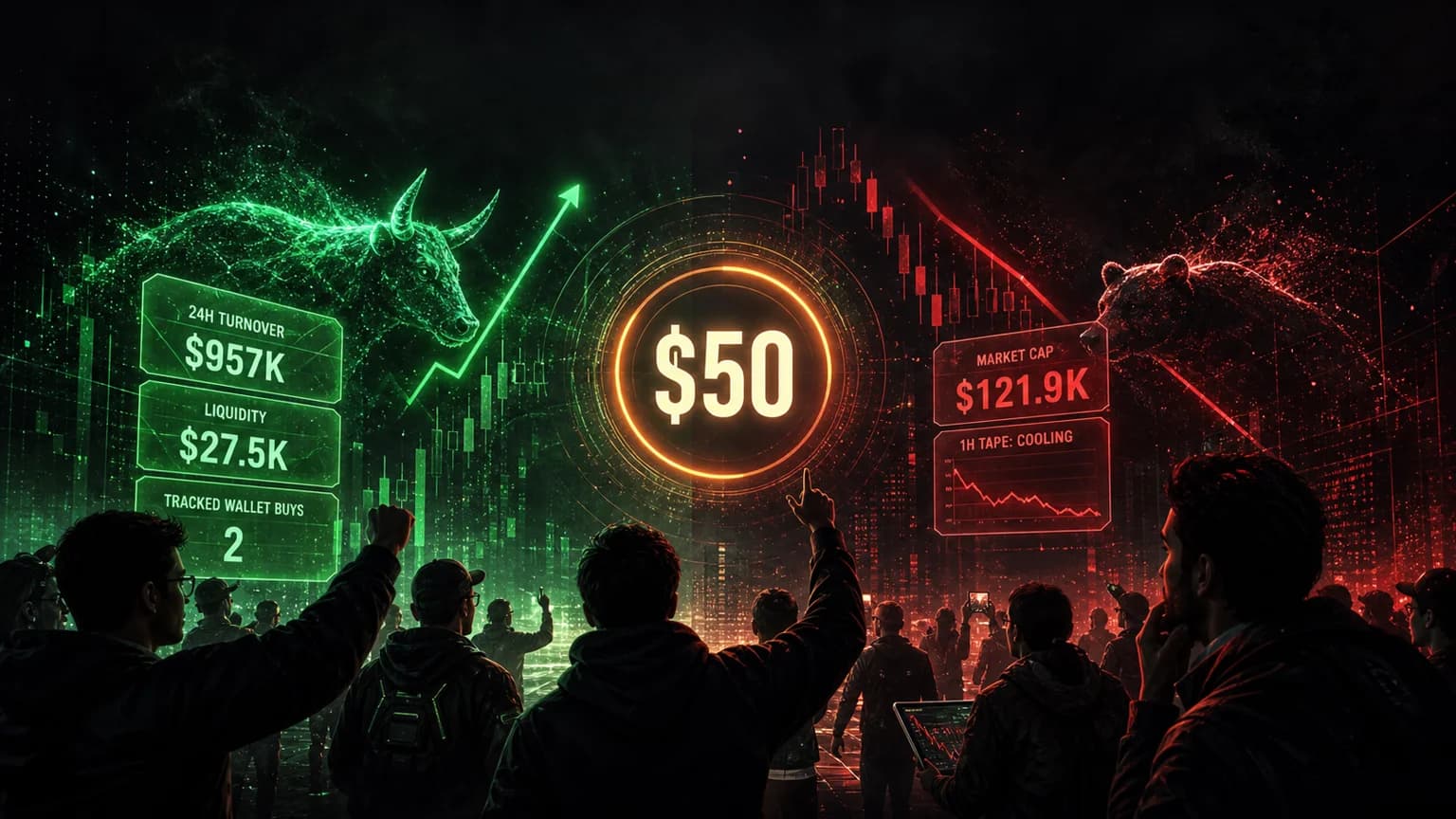
$50 has freeze authority disabled, mint authority disabled, a Rugcheck score of 1, and a creator wallet currently at zero balance, but the board is still thin enough that momentum has to keep replacing itself quickly.
$50 is exactly the kind of launch that tempts traders into thinking the hard part is already over. The name is stupid in the correct way, the board is instantly readable, and the first read came with a better catalyst than the average random-number meme because two tracked wallets showed up early enough to make the tape feel watched instead of purely accidental. At the 2026-07-12 16:04 UTC selection snapshot, the token had already logged roughly $957K in turnover against just $27.5K in liquidity while still less than an hour old. That is enough velocity to put almost any fresh Solana board on a lot more screens.
The problem is that the easy part of the story may already be behind it. By 2026-07-12 16:15 UTC, DexScreener's main pair still showed about $1.08M in 24-hour volume and a live market cap near $121.9K, but the one-hour change had already rolled to negative 33.3%. That does not mean the launch is dead. It means the article is no longer about a clean breakout. It is about whether the watched-wallet impulse was the start of a broader bid or merely the ignition source for a board that already spent its loudest hour.
- → $50 found instant attention because two tracked wallets bought early and the token ripped to roughly $957K in turnover on about $27.5K of liquidity in its first visible hour.
- → The contract read is cleaner than average for a same-day Solana launch: freeze authority is disabled, mint authority is disabled, the creator wallet currently shows zero balance, and Rugcheck scored the token at 1.
- → The next read is follow-through, not novelty, because the live board was already down 33.3% over the latest hour by 2026-07-12 16:15 UTC even as cumulative volume stayed above $1.08M.
Why $50 Worked So Fast
A lot of launch boards ask traders to imagine a narrative that does not really exist yet. $50 did not have that problem. The pitch is immediate: the ticker is the joke, the joke is the pitch, and the pitch is simple enough to travel. That matters in the first two hours of a Solana launch because meme boards move when the market can explain them in one sentence. $50 is one of those names. It is sticky, it screenshots well, and it plays directly into the part of the market that likes low-friction irony more than technical novelty.
The other reason it moved is that the board got a social proof substitute before it had time to earn one naturally. Two tracked-wallet buys do not guarantee durability, but they do change how traders interpret a fresh chart. Instead of asking whether anyone serious has touched the token yet, people can ask whether they are late to something sharper money noticed first. A silly meme with watched-wallet confirmation trades very differently from a silly meme floating on random retail clicks.
The Numbers Still Matter More Than the Joke
The cleanest way to understand $50 is to look at the mismatch between churn and depth. More than $1M in turnover against less than $28K in liquidity is enough to build a very loud chart without building a very strong market. That is not a moral judgment. It is how these launches work. Thin pools make moves feel bigger because every fresh buyer is stepping onto a narrow platform. When the crowd is all buying the same joke at once, price can print vertical before the market has proven it can handle even a modest wave of exits.
That is why the negative one-hour print matters more than the huge six-hour number. A 294% six-hour move tells you the board was capable of grabbing attention. A negative 33.3% one-hour move tells you the market is already asking harder questions. Traders who arrived late to the first burst are no longer buying pure excitement. They are buying the hope that the second wave will show up before the first wave loses patience. In practice, that turns $50 into a timing trade where reaction speed matters more than conviction language.
What the On-Chain Data Shows
The most important positive in the on-chain profile is that the obvious mechanical traps are absent. Freeze authority is disabled, which means there is no visible transfer kill switch hanging over holders. Mint authority is disabled too, so there is no easy dilution scare waiting in the wings. Rugcheck scored the token at 1, which is about as clean a first-pass score as a fresh Solana meme board can ask for. The creator wallet also shows zero balance at the current read, removing one of the fastest reasons traders usually downgrade a same-day launch.
Holder structure is not perfect, but it is also not screaming immediate disaster. The top three visible holders from the enriched selection account for about 14.9% of supply, with the largest visible wallet at 9.54%. That is a lot more manageable than the single-wallet nightmares that often sit on fragile meme launches. The nuance is that decent holder spread does not magically create depth. A board can look cleaner on the supply side and still trade poorly if the liquidity stays thin and the market is mostly tourists chasing the first screenshot.
There is also no obvious serial-deployer overhang in the available selection data. The creator profile came through with zero prior creator-token history in the enriched handoff, and the risk list was empty at the time of selection. That does not make $50 safe. It just changes the burden of proof. The bear case here is not a glaring authority trap or a cartoonishly ugly holder map. The bear case is much more common: a meme that was tradable because it was early, then fragile because there was never enough structural depth to keep the first adrenaline spike alive.
Why the First Burst May Already Be Fading
The watched-wallet angle is a great ignition source, but it is not the same thing as a durable narrative. Wallet-following works best when it creates a handoff from insiders or sharp early eyes into a broader cultural wave. That second step is the one $50 still has to prove. If traders keep finding the joke funny and the chart stabilizes above the first heavy pullback, the initial wallet interest can look like a meaningful early tell. If the tape keeps leaking while volume fragments across tiny follow-on pools, those first buys will read more like a launch accelerant than a long-form thesis.
The signal has shifted from 'who bought first?' to 'who is willing to defend the board after the first fade?' On launches this thin, that transition decides whether the chart becomes a reload or a memory.
What Needs to Happen Next
For $50 to matter beyond the first burst, two things probably need to happen quickly. First, liquidity has to expand with the attention instead of staying stuck in the high-$20K range while volume churns through it. A board can survive violent candles when depth is improving because that signals new money is building a thicker market rather than just replaying the same chips. Second, the joke has to keep recruiting. Number memes live and die on repeatability. If traders stop repeating the cashtag, the chart is forced to survive on pure technical defense, which is harder for a one-hour-old board.
The bullish case is simple: the first fade was a normal hot launch reset, the watched-wallet spark brought enough attention to create a real holder base, and the next push reclaims momentum because the meme is dumb enough to keep spreading. The bearish case is just as simple: the first tracked-wallet impulse front-loaded the best part of the trade, the market cap stayed small because the broader crowd never fully committed, and the board now slowly leaks as faster traders rotate to the next joke with a cleaner slope. Both versions are plausible from the current tape.
$50 deserves the speculative tag because the first catalyst was real, the contract profile is cleaner than average, and the market already proved it can pull serious volume for its size. The reason it does not earn a cleaner label is that the chart has already shifted from ignition to defense. A launch that prints more than $1M in turnover and then gives back a third in the latest hour is telling traders to stop reading the meme and start reading the tape. If the board stabilizes and depth improves, the tracked-wallet entry can still look smart in hindsight. If liquidity stays thin and the next bounce never really develops, the best part of the move may already be behind it.
What is $50 on Solana?
$50 is a fresh Solana meme token called '$50 is all you need' trading under the $50 cashtag. It is a culture-first meme board, so the setup depends on spread, order flow, and market structure rather than utility.
Why are traders watching $50 right now?
Traders are watching $50 because two tracked wallets bought early and the token immediately printed outsized turnover for a very young board. That is usually enough to keep wallet-followers and fast Solana traders interested.
Does $50 have obvious on-chain red flags?
The first-pass read is cleaner than many same-day launches: freeze authority is disabled, mint authority is disabled, the creator wallet currently shows zero balance, and Rugcheck scored the token at 1. Trading risk still stays high because thin liquidity can turn a clean contract into a brutal chart.
What is the main risk with $50 after the first pump?
The main risk is that the first watched-wallet burst was the best part of the trade and the broader crowd never arrives in enough size to keep the board liquid. The key read is whether liquidity expands and price stabilizes after the first heavy fade.