zCrash Turned a Trading-Term Joke Into a Violent Solana Burst, but $7.5K of Liquidity Changes the Read
ZCRASH ripped to roughly $43.1K on about $502.9K in turnover within its first five hours, proving the meme was good enough to pull real traffic into a tiny board. The issue is that a market this small can look louder than it really is when liquidity is thin and just 102 holders are carrying the move.
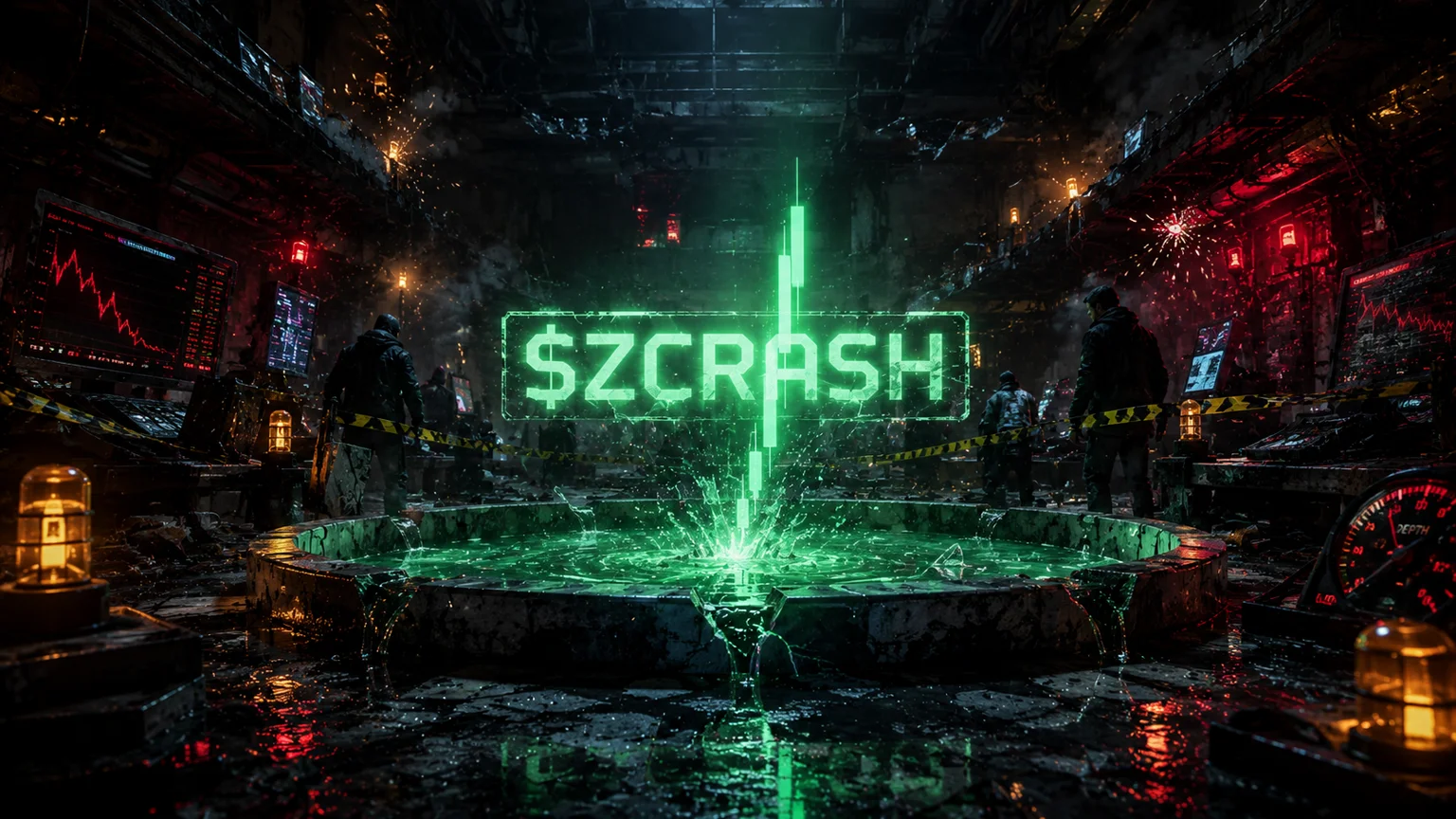
Mechanically the token looks cleaner than many pump.fun microcaps. Freeze authority is disabled, mint authority is disabled, and Rugcheck scored the token at 16. The problem is structural: top-three concentration is still about 46.4%, liquidity is only around $7.5K, and the holder base is just 102 wallets, which leaves the board vulnerable to abrupt air pockets.
zCrash is exactly the kind of joke Solana can move on before anyone has time to ask whether the board should exist. The name borrows a trading-platform pain point every degen understands, wraps it in a pump.fun launch, and lets the market do the rest. By 2:00 AM UTC on June 5, the token was roughly five hours old, trading near a $43.1K market cap, and showing about $502.9K in turnover. On paper that sounds like a tiny coin with oversized attention. In practice it is a lesson in how much noise a micro-float can generate when a meme is instantly legible and the liquidity pool is too small to keep price honest.
That does not mean the move was fake. zCrash clearly attracted real speculation. The board logged 16,046 transactions, carried a medium organic score above 62, and showed more buys than sells in the saved snapshot. Those are not dead numbers. What they do not tell you by themselves is whether the market being formed underneath the joke is sturdy enough to survive beyond the first vertical move. That is the part traders miss when a microcap chart starts printing percentages big enough to overwhelm common sense.
- → ZCRASH hit roughly $43.1K on about $502.9K in turnover within its first five hours, which means the board drew far more activity than its size would normally imply.
- → The tape was active rather than empty. Saved flow data showed 938 buys against 639 sells, 16,046 total transactions, and an organic score around 62.3 labeled medium.
- → The main issue is structural. Freeze authority is disabled, mint authority is disabled, and Rugcheck scored the token at 16, but liquidity is only about $7.5K, holders are just 102, and the top three visible wallets control roughly 46.4% combined.
Why the Joke Was Strong Enough to Pull a Crowd
The meme worked because it compressed shared trader frustration into one word. Every degenerate Solana participant has lived through an app freeze, a failed swap, a chart glitch, or a platform meltdown at exactly the wrong moment. zCrash translates that annoyance into a ticker with almost no explanation cost. That is powerful in an environment where attention is won in seconds. People did not have to debate what the token meant. They only had to decide whether the joke could become a trade.
Early evidence says enough people made the same decision at once. More than half a million dollars in turnover on a board barely above $43K in market cap shows the float was getting recycled over and over again. That is how small memes create the illusion of inevitability. Every fresh buyer sees velocity, assumes the crowd is forming faster than it is, and pays up for a chart that looks stronger precisely because the pool is so narrow. In larger markets, that kind of turnover might still leave price in a debate. In a board this tiny, it can generate a dramatic candle almost by default.
The Tape Looks Bigger Than the Actual Market
The headline number on zCrash is the mismatch between turnover and depth. Roughly $502.9K in volume against only about $7.5K in liquidity is not a sign of a mature market. It is a sign that even modest demand can throw price around violently. That matters because traders often read volume as confirmation without asking what kind of pool is carrying it. On a token this small, high turnover can be evidence of genuine curiosity and evidence of fragility at the same time.
The 2,158% move in the saved 6-hour view should be interpreted through that lens. Yes, the market clearly liked the joke. Yes, buyers were willing to chase it. But a move that steep on only $7.5K of liquidity is also the definition of a board that can reverse faster than people expect. If even a few early wallets decide the punchline has already paid, the exit can be much more violent than the entrance. That is the hidden cost of tiny-pool momentum: the chart trains people to respect strength right before it reminds them how little depth there actually was.
The holder count reinforces the same point. Just 102 holders is enough to say the board spread beyond a private cluster, but not enough to call it broadly owned. A token can look socially alive on that wallet base if the meme is fast and the churn is high. It still does not take much concentration or a few coordinated exits to change the entire shape of the chart. zCrash feels crowded mainly because the room itself is tiny.
What the On-Chain Data Shows
From a contract-permission standpoint, zCrash is not waving the most obvious red flags. Freeze authority is disabled, which means the developer does not retain a direct transfer kill switch. Mint authority is disabled too, so the market is not staring at an open-ended inflation risk on the first read. Rugcheck scored the token at 16, which keeps it closer to mechanically acceptable than mechanically alarming. That is important because it narrows the risk story. The real problem here is not some hidden authority setting waiting to detonate. It is the shape of the market itself.
That shape still looks tight. The largest visible wallet held 21.08%, followed by 16.72% and 8.6% for the next two visible holders. Combined top-three concentration near 46.4% is not fatal on its own, but it is a heavy number when paired with only 102 holders and a liquidity pool below $8K. Concentration becomes more dangerous as depth falls because large wallets do not need to do much to destabilize the book. A distributed holder map can sometimes rescue a thin pool. A concentrated holder map usually magnifies the danger.
There is one constructive note buried in the profile: the saved data did not show the deployer still carrying a visible balance, and creator token count was zero. That removes the need to invent a dramatic operator subplot when the stronger editorial judgment is to focus on mechanics. zCrash does not need a suspicious dev-wallet narrative to be risky. The risk is already there in the combination of limited depth, moderate concentration, and an opening move big enough to tempt late buyers into paying for a joke after most of the easy upside has already printed.
Where the Liquidity Trap Starts
The trap begins the moment traders confuse attention with sturdiness. zCrash absolutely won attention. It has a good meme, a live chart, and enough transaction count to avoid looking completely synthetic. But the board is still too small to absorb conviction errors gracefully. When the pool is only about $7.5K deep, buyers are not just betting that more people will like the joke. They are betting that enough people will keep liking it in the correct order so exits remain possible. That is a much narrower bet than the green candles make it look.
This is why liquidity traps are so seductive in meme markets. The early chart behaves like proof of concept. The actual structure behaves like a warning label. Both can be true at the same time. zCrash may still find another leg if the meme keeps spreading and if the tiny holder base broadens faster than profits hit the tape. But until the pool deepens and ownership disperses, the board is effectively asking new buyers to finance continuation in a market that remains one sharp exhale away from disorder.
🟡 ZCRASH earns a speculative read because the move is real enough to watch but too structurally fragile to trust. Roughly $502.9K in turnover, more buys than sells, disabled freeze authority, disabled mint authority, and a Rugcheck score of 16 keep the meme from reading like an obvious contract trap. What blocks a cleaner call is the market underneath it: only about $7.5K of liquidity, around 102 holders, and top-three concentration near 46.4% create the kind of thin-float setup that can punish anyone who mistakes velocity for stability.
FAQ
What is ZCRASH on Solana?
ZCRASH is a Solana meme token trading under contract address CeYDoTwBmHkAxoEGj7ViJJ4aPCa24yx7byKoJ4eupump, built around a trading-platform crash joke that spread quickly on pump.fun.
Why did ZCRASH move so fast?
The meme was instantly understandable and the float was tiny. At the saved June 5 snapshot taken at 2:00 AM UTC, the token had already processed about $502.9K in turnover while sitting near a $43.1K market cap.
Does ZCRASH have obvious contract-permission danger?
The saved profile showed freeze authority disabled and mint authority disabled, so the immediate concern is not an obvious permissions trap.
What is the biggest risk with ZCRASH?
Liquidity and concentration. The board had only about $7.5K of liquidity, roughly 102 holders, and top-three visible wallet concentration near 46.4%, which makes sharp reversals much easier.
What would make the ZCRASH setup look stronger?
Deeper liquidity, more holders, and proof that the token can keep active trade without the same concentrated wallets controlling too much of the near-term supply.