$SCATMAN Turned an OpenAI Feud Meme Into a Solana Sprint, Then Gave Most of It Back in One Hour
At the 2026-07-12 19:15 UTC read, $SCATMAN still carried more than $2.18M in turnover on Solana, but the market cap had already compressed to roughly $68.7K and the latest one-hour candle was down 58.9%. If traders decide the joke still has another cycle in it, this kind of air-pocket tape can create a sharp re-entry bid. If they do not, the same liquidity math that made the launch feel explosive will keep turning every bounce into a trap.
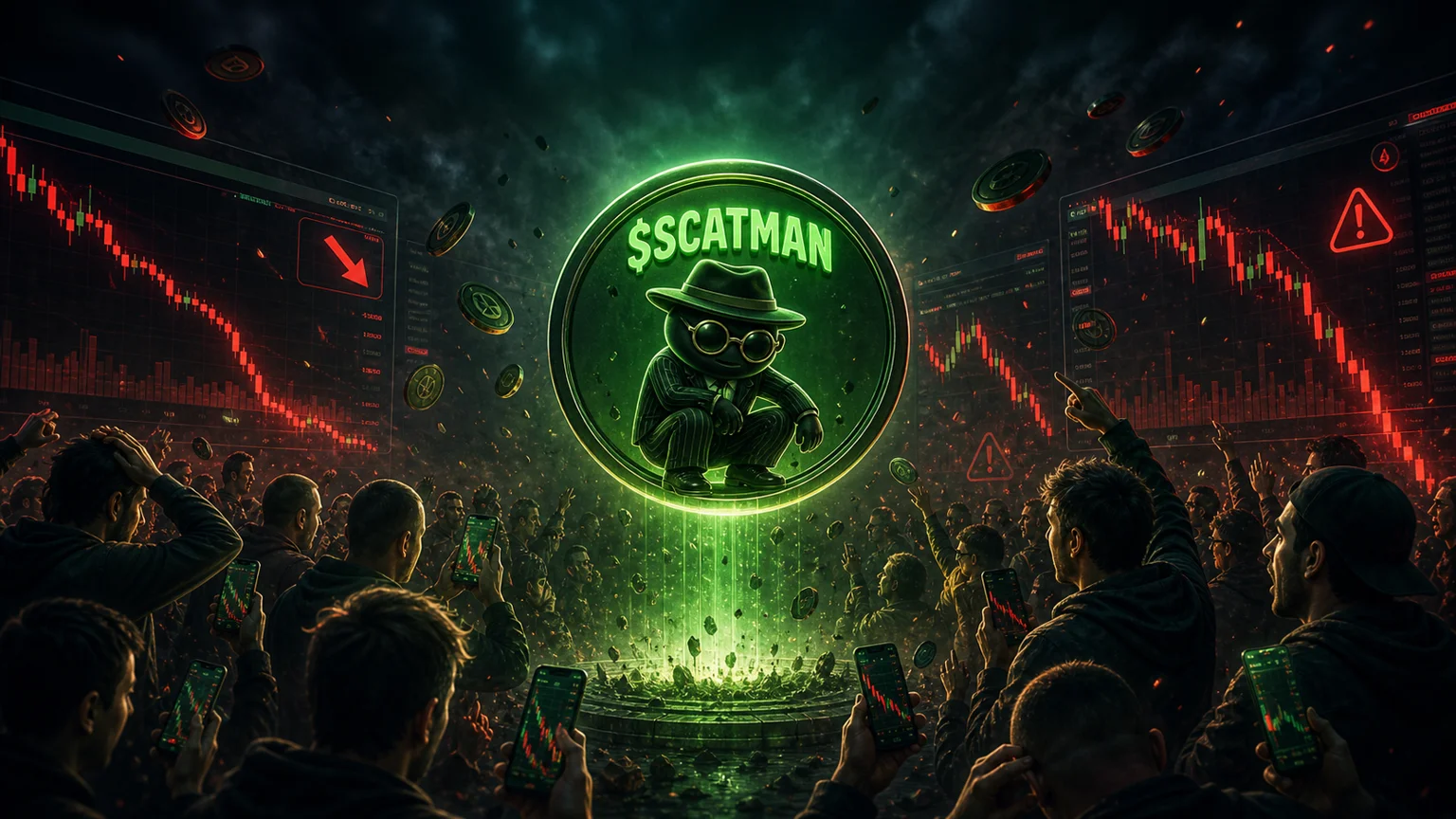
$SCATMAN has freeze authority disabled, mint authority disabled, a Rugcheck score of 1, and no visible creator balance, but the main pool is still only about $22.2K deep and Rugcheck flagged multiple transfer-linked insider networks around the launch, so any bounce still trades like a fragile momentum board.
$SCATMAN had the kind of opening every fresh Solana culture board dreams about. The joke was instantly legible, the timing was perfect for anyone still monetizing the Elon Musk versus Sam Altman feud, and the first tape looked loud enough to bully its way onto every fast trader's watchlist. At the 2026-07-12 19:15 UTC read, the token still showed roughly $2.18M in 24-hour turnover, which is an enormous amount of churn for a board that had only been alive for a short session. The problem is that the market cap by then sat closer to $68.7K than to the imagination people had during the first vertical move.
That is why the right editorial angle here is liquidity trap, not breakout glory. Plenty of Solana launches can print a huge cumulative volume number while quietly becoming less tradable with every candle. $SCATMAN is starting to look like one of them. The token was still up 119% on the day at the latest read, yet the one-hour line had already collapsed 58.9%. That is the shape of a board where late buyers are no longer paying for upside so much as paying to find out whether anyone else still wants the meme badly enough to defend it.
- → $SCATMAN pulled roughly $2.18M in turnover in its first session, which proves the Scam Altman meme found real attention on Solana even after countless low-effort feud tickers tried the same lane.
- → The visible contract shell is cleaner than the chart, with freeze authority disabled, mint authority disabled, a Rugcheck score of 1, and no current creator balance, so the mechanical risk is not the first thing scaring traders here.
- → The real problem is tape quality: the token had already fallen 58.9% over the latest hour while sitting on only about $22.2K of liquidity, which is exactly how a high-volume board turns into a bounce-chasing trap.
Why the Meme Got Real Money First
The obvious reason $SCATMAN worked at all is that the phrase already existed in trader culture before the contract showed up. Meme tokens move fastest when they do not need to explain themselves. Scam Altman is one of those lines that already lives inside a wider internet argument. Anyone who has watched the OpenAI soap opera, Musk's trolling, or the broader AI power struggle understands the joke in half a second. That matters in fresh-launch conditions because understanding speed is distribution speed. If a token can be repeated without setup, it can travel before anyone has time to ask whether the chart deserves it.
The first burst also benefited from simple board optics. More than 20,000 buys against roughly 16,900 sells on the main pair is not fake silence dressed up as price action. It is a real two-way market with a lot of hands touching it. That can create the illusion of strength even when structure is thin underneath, because traders see millions in turnover and assume somebody important will keep the floor alive. Sometimes that assumption becomes self-fulfilling. Sometimes it becomes the exact trap. The difference is whether the board can convert early attention into deeper liquidity before the first adrenaline cycle burns off.
The Part of the Tape That Now Matters
The number to respect is not the daily gain. It is the mismatch between churn and stability. Roughly $2.18M of turnover with only about $22.2K of liquidity tells you the board was being traded aggressively without building much of a cushion. A board like that can feel immortal on the way up because every fresh buy hits a narrow pool and exaggerates price response. But it also means the market does not have to absorb much selling pressure before the whole slope changes. That is how a launch can look dominant on a screenshot and wounded on a one-hour chart at the exact same time.
The 58.9% one-hour drawdown is what turns this from a simple culture-meme win into a more interesting test. A mild pullback would have suggested the first profit-taking wave got recycled. This is not mild. It is a real compression of belief. Traders are no longer deciding whether the joke is good enough to buy; they are deciding whether the liquidity under the joke is good enough to trust. That is a harder question, and Solana boards this young usually fail it unless the market discovers a second reason to care.
What the On-Chain Data Shows
At the contract level, $SCATMAN reads much better than the price action. Freeze authority is disabled, so there is no visible transfer kill switch sitting over holders. Mint authority is disabled too, which removes the simplest supply-dilution horror story. Rugcheck scored the token at 1 and the creator wallet currently shows zero balance. Those are all positives, and they matter because they strip away the easiest excuses for the collapse. This is not a board failing because the shell immediately looked toxic. It is a board failing because market structure can still be brutal even when the contract looks clean.
The holder map is workable but not innocent enough to cancel that risk. The top visible wallet controls about 15.52% of supply, with the next two visible holders around 2.28% and 2.25%, leaving top-three concentration at 20.1%. Those are not catastrophic numbers for a fresh launch, and they compare well with some same-hour disasters that carry a single-wallet cliff. But concentration is only half the story. Rugcheck also detected multiple transfer-linked insider networks around the launch. That does not automatically prove coordinated dumping, yet it does tell traders the board was not born in a vacuum. When a fragile pool meets networked early distribution, every relief bounce deserves a little more suspicion.
The useful nuance is that on-chain caution here comes from structure, not from one screaming red switch. Holders need to watch wallet concentration, insider-linked flow, and pool depth together. A token can keep freeze authority disabled and mint authority disabled while still becoming miserable to trade if too much supply is clustered around launch-connected hands and too little real liquidity is available to absorb their decisions. That is the setup $SCATMAN is now testing in public.
Why a Bounce Can Still Happen
None of this means the board is finished. In fact, liquidity-trap launches often produce the sharpest reflex moves because the first washout clears out traders who only wanted a straight line. If the broader market still likes the meme and the remaining holders stop forcing exits into a shallow pool, a token like $SCATMAN can squeeze hard off an ugly base. The cultural setup is still there. Traders still understand the joke. The daily volume is large enough that the board remains visible. Visibility matters because forgotten launches die quietly, while remembered ones at least get a chance to audition for a second cycle.
The question is no longer whether $SCATMAN can attract clicks. It already did. The question is whether enough real buyers want exposure after a 58.9% one-hour flush to keep a $22.2K pool from becoming an exit door again.
That is also why the next move needs to look different from the first one. Another frantic spike on the same thin depth would only recreate the problem. The constructive version would be steadier turnover, a cleaner handoff across more wallets, and evidence that liquidity can rise while volatility cools. If those things show up, the market can reframe this from failed sprint to repriced culture board. If they do not, the chart will keep functioning like a trap that punishes anyone who mistakes cumulative volume for actual support.
Verdict
🟡 Speculative — $SCATMAN earned attention the honest way for a meme board, with a sticky culture hook and more than $2.18M in turnover, but the current read is dominated by liquidity stress rather than momentum health. Freeze authority is disabled, mint authority is disabled, the creator wallet is empty, and Rugcheck scored the token at 1, yet a 58.9% one-hour drop against only about $22.2K of liquidity plus multiple launch-linked insider networks means this board still trades like a trap until the structure improves.
FAQ
What is $SCATMAN on Solana?
$SCATMAN is a Solana meme token named Scam Altman, trading under contract address Cit4M38LLvYFX2EGFFyit83WEZ1GFN8PA3nF57mu4mgA. The meme is built around the Musk-versus-Altman internet feud and the phrase is instantly recognizable to crypto traders.
Why is $SCATMAN being called a liquidity trap?
Because the token generated roughly $2.18M in turnover while the main pool stayed only about $22.2K deep and the latest one-hour candle fell 58.9%. That is the kind of imbalance that can make every bounce feel tradable until sellers hit a market with too little real cushion.
Does $SCATMAN have obvious contract risks?
The first-pass shell actually looks cleaner than the chart. Freeze authority is disabled, mint authority is disabled, the creator wallet currently shows zero balance, and Rugcheck scored the token at 1. The bigger concern is holder structure, insider-linked launch flow, and shallow liquidity rather than a visible admin switch.
What would improve the $SCATMAN read from here?
A stronger read would require liquidity to deepen, a more stable holder handoff, and price to stop reacting violently to every burst of selling. If the board can build structure after the first flush, traders can start thinking about a second cycle instead of another trap.