$WORK Turned $310K of Solana Churn Into an Organic Volume Anomaly, but the Holder Handoff Is Still Incomplete
At the 2026-06-22 13:15 UTC read, $WORK was trading near a $186.5K market cap after about $310.6K in 24-hour volume with roughly $34.8K in liquidity. The meme clearly found early traction, yet the visible holder map still leans top-heavy enough that the next phase depends on whether fresh buyers can take the board away from its first cluster of winners.
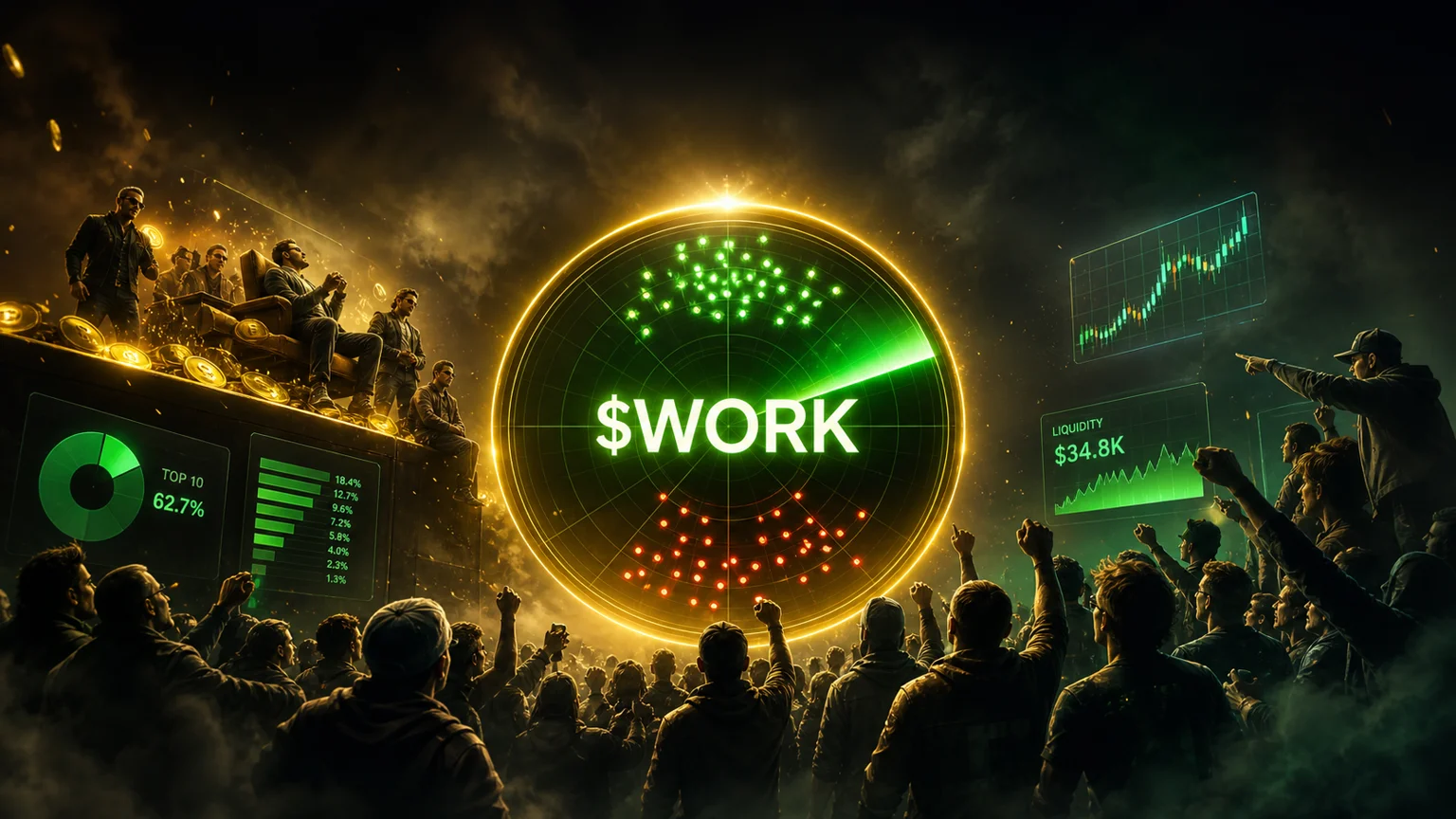
$WORK keeps the contract permissions simple with freeze authority off and mint authority off, but the market structure is not fully clean. Rugcheck scored the token at 50, flagged a low holder count in the visible report, and showed a top wallet above 21% plus top-three concentration near 34.5%, which means the board still needs a wider handoff before the move looks durable.
Most fresh Solana meme boards ask traders to believe two things at once. First, that the meme is sticky enough to travel past the launch circle. Second, that the market structure is healthy enough to survive once the first buyers start ringing the register. $WORK, the token behind The Daily Worker, earned attention because the first part is clearly working. At the 2026-06-22 13:15 UTC read, the board was trading around a $186.5K market cap after roughly $310.6K in 24-hour volume with about $34.8K in liquidity. That is a meaningful amount of churn for a token that had only just come online. It tells you real money noticed the story quickly.
The harder question is whether the second part is keeping up. The tape is strong enough to call this an organic volume anomaly because turnover already exceeds the full diluted valuation and the move still held a 425% 24-hour gain at the saved read. But the board does not yet look fully distributed. The top visible wallet still controls 21.38% of supply, the next-largest wallet holds another 10.34%, and the visible top-three tally comes to about 34.5%. That does not automatically kill the setup. It does mean the next chapter is less about whether people noticed $WORK and more about whether the market can pass the story from the earliest winners to a broader crowd without turning the chart into a hostage situation.
- → $WORK processed about $310.6K in 24-hour volume against a roughly $186.5K market cap, which is exactly the kind of turnover imbalance that puts a fresh Solana launch on serious trader radar.
- → The contract shell stayed simple on first read with freeze authority off and mint authority off, but Rugcheck still scored the token at 50 and flagged a low visible holder count in its report.
- → The setup remains speculative because the biggest visible wallet still sits above 21% of supply and the top-three cluster is around 34.5%, so the bull case still depends on a broader handoff than the board has shown so far.
Why $WORK Caught Attention So Fast
The easiest boards to dismiss are the ones whose only accomplishment is surviving their own launch. $WORK did more than that. The market was still paying up even after the first burst, and the main Meteora pair carried enough depth to avoid looking like a total ghost board. Roughly $34.8K of liquidity is not deep in absolute terms, but it is enough to matter at a sub-$200K market cap. More importantly, the ratio between liquidity, market cap, and turnover is telling you the token did not reach this read on a couple of sleepy prints. The board had to stay active for long enough that traders kept coming back to it.
$WORK already cleared the awareness hurdle. The Daily Worker branding is direct, easy to repeat, and built around a meme concept that needs almost no explanation once traders see it. In this market, that counts as real fuel. A board that is simple to quote and easy to screenshot can circulate faster than one that demands people understand lore before they understand the joke.
What the On-Chain Data Shows
For Solana launches, the first thing to check is whether the contract shell is obviously broken. $WORK passes that simple test. Freeze authority is off. Mint authority is off. There is no immediate permissions-level horror show hiding under the ticker. That matters, because a lot of weak boards can be rejected before the conversation even starts. Here, the real debate has to happen at the market-structure level instead. A token can have a plain shell and still trade like a trap if ownership never broadens enough to support the narrative it is trying to sell.
That is where the $WORK read gets more mixed. Rugcheck scored the token at 50 and surfaced a low-holder warning in the visible report, which is not the kind of profile that supports a blind green light. The top visible wallet at 21.38% is not cartoonishly fatal, but it is big enough to matter every time the board squeezes higher. Add the next wallet at 10.34% and a third at 2.75%, and the first cluster of holders still has a meaningful say in what kind of market this becomes. That is the precise reason the rating stays speculative. The tape is lively, the shell is straightforward, but distribution still has work to do.
The creator wallet is also worth watching even though it is not a giant red siren. In the latest saved report it still showed a visible balance worth about 2.63% of supply. That is a manageable number compared with the truly ugly boards where the deployer is sitting on the whole game, but it is still enough to keep traders honest. When a new meme token starts attracting real turnover, every visible creator balance becomes part conviction signal and part overhang. Bulls can argue the wallet staying in reflects alignment. Bears can point out that any further vertical move gives that balance more power over the next handoff.
The Meme Has Legs, but the Board Still Needs More People
$WORK is interesting because the meme itself is doing real labor here. The Daily Worker concept hits a familiar online pressure point: exhaustion, routine, class-joke absurdity, and the kind of everyday grind humor that travels well in screenshot form. That gives the token an edge over fresh boards whose identity starts and ends at a random animal avatar. Traders are not just looking at a chart. They are looking at something that can actually become a repeatable post, a reaction image, or a caption.
But a good meme is not the same thing as a finished market. The part that matters now is whether the board can turn first-wave curiosity into second-wave ownership. A meme token often looks strongest right before that transition becomes unavoidable, because the chart still reflects mostly believers and early opportunists instead of a wider market testing where it really wants to hold. $WORK has not failed that test. It just has not passed it yet either. If the next set of buyers absorbs supply cleanly and keeps liquidity building, the current read starts to look like an early discovery board with room to mature. If that handoff stalls, the same concentration that feels tolerable now becomes the reason the chart starts moving like a ladder with missing steps.
Why the Next Handoff Matters More Than the First Pump
$WORK already proved it can attract fast turnover, but that does not guarantee the board can survive the moment early winners start pressing exits at the same time.
A top wallet above 21% and visible top-three concentration near 34.5% leave enough supply in a few hands that every aggressive candle can turn into its own stress test.
The shell is cleaner than the average scammy launch, yet a Rugcheck score of 50 and a visible creator balance mean traders still need broader distribution before calling the setup durable.
This is where new Solana boards usually reveal what they really are. The first pump is marketing. The handoff is structure. Anyone can point to a 425% daily move and say the market has spoken. The better question is whether the market has spoken broadly enough that no single cluster can dominate the next sentence. On $WORK, that answer is still pending.
That is why the right read is not to dismiss $WORK and not to canonize it. The board deserves attention because it is doing more real volume than its size would normally command, and because the concept is strong enough to keep pulling eyes back to the ticker. It also deserves caution because the ownership picture is still condensed enough that the first winners matter too much. The cleanest path from here is obvious: liquidity deepens, more wallets absorb supply, and the creator balance stays non-disruptive while the meme continues to travel. If those things happen, this starts to look like one of the better first-day Solana worker-theme boards of the cycle. If they do not, the same volume anomaly that made $WORK fun to notice will turn into a reminder that loud tape can still be crowded tape.
$WORK earns a speculative rating because the setup is better than a throwaway launch but not yet clean enough to treat as solved. About $310.6K in 24-hour volume, roughly $34.8K in liquidity, freeze authority off, and mint authority off give the bulls a real case. A Rugcheck score of 50, a top visible wallet at 21.38%, top-three concentration near 34.5%, and a still-visible creator balance mean the board still needs a broader holder handoff before the move looks durable.
What is $WORK on Solana?
$WORK is the ticker for The Daily Worker on Solana, trading under contract address n73LV5scRh9G9fyLxi5deKTCpviozu7f4P6y4BFwork. At the saved 2026-06-22 13:15 UTC read, it was trading near a $186.5K market cap.
Why did $WORK hit radar so quickly?
$WORK paired a simple, repeatable meme with about $310.6K in 24-hour turnover while the board was still fresh. That kind of volume relative to a roughly $186.5K market cap is enough to put almost any new Solana launch on trader screens.
Does $WORK look risky on-chain?
The contract shell looks simpler than many weak launches because freeze authority is off and mint authority is off. The bigger concern is distribution: the top visible wallet held 21.38% of supply, the visible top-three cluster was near 34.5%, and Rugcheck scored the token at 50.
What would improve the $WORK setup from here?
A broader holder handoff, deeper liquidity, and proof that the board can keep attracting buyers without a few early wallets dominating each push higher would all strengthen the read. If the meme keeps traveling while the ownership map spreads out, the case for durability gets much better.