$QUENTIN Turns Disaster Man Into a Seven-Figure Volume Test
$QUENTIN is barely half a day old, but Disaster Man has already pushed more than $1.12M in 24-hour volume while keeping a cleaner-than-average Solana authority profile.
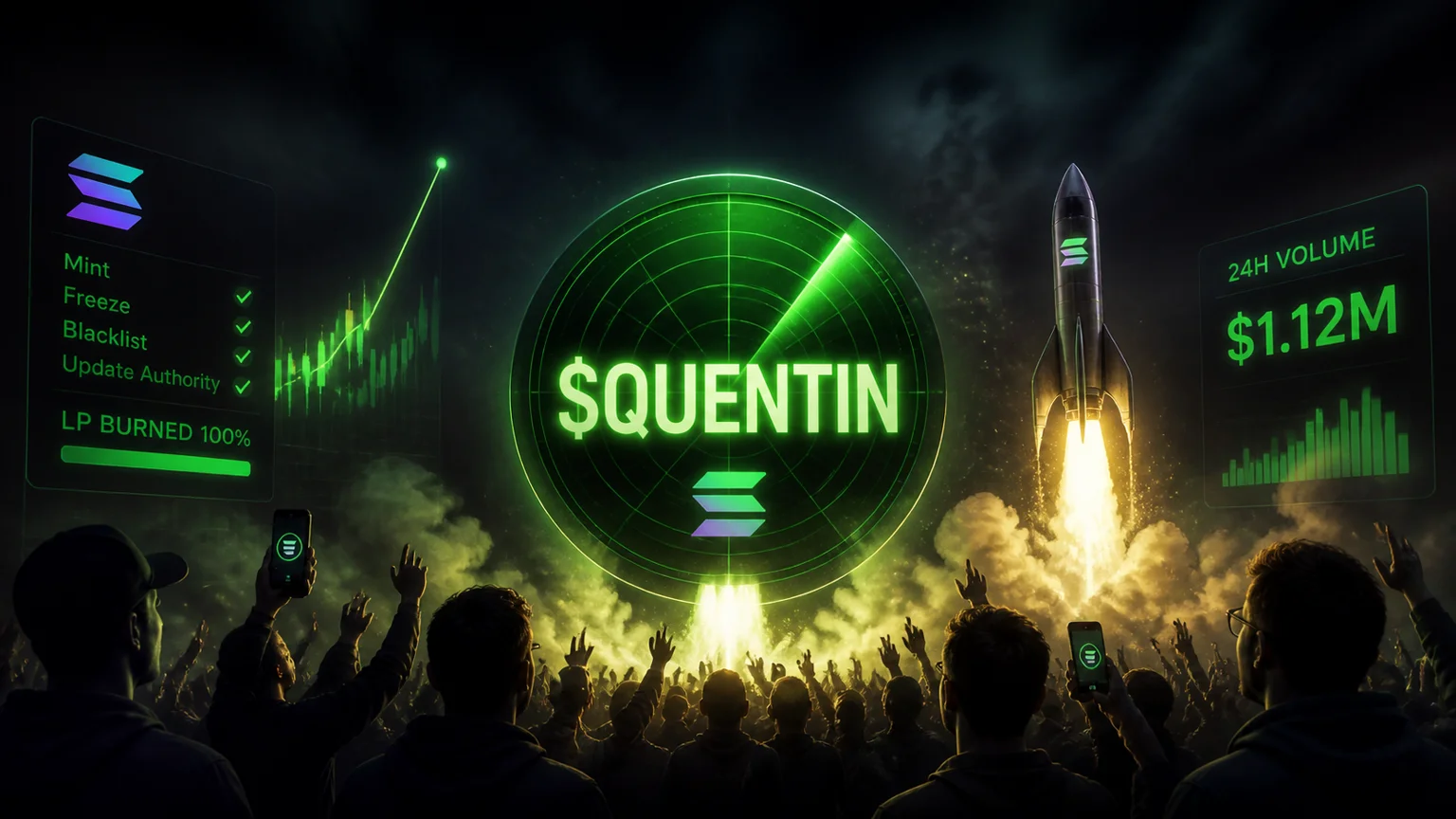
$QUENTIN shows disabled freeze authority, disabled mint authority, a Rugcheck score of 1, and listed top-three holder concentration near 17.2%; the main concern is whether liquidity can deepen after a fast 24-hour reprice.
$QUENTIN is doing the uncomfortable meme-coin thing: making a ridiculous character look like serious market structure before the market has had time to agree on what the joke even is. Disaster Man launched through pump.fun, sat around 11.6 hours old at the saved snapshot, and had already pushed roughly $1.12M in 24-hour volume against a market cap near $180.1K. That is the signal. Not the name by itself, not the absurdity of the visual, and not a single green candle. The tape is treating a fresh disaster meme like it deserves repeated rotation, and that is worth separating from the usual disposable launch noise.
The editorial angle here is organic volume anomaly with a culture-meme bid underneath it. $QUENTIN is not a mature asset, and nothing about a half-day-old Solana meme should be read as durable until sellers have had their turn. But the early data is stronger than a normal microcap flash. The token is up about 87.0% in one hour, 190.4% in six hours, and 1,076.3% over 24 hours, while 23,142 transactions have already moved through the market. For a token this young, that is not just a chart twitch. It is a crowd repeatedly deciding the Disaster Man joke still has room.
- → $QUENTIN is around a $180.1K market cap with about $1.12M in 24-hour volume, a large turnover print for a token this small.
- → $QUENTIN has 548 holders and a 53.98% buy ratio, which suggests the move is not just one-sided panic buying.
- → The current Solana profile shows disabled freeze authority, disabled mint authority, Rugcheck score at 1, and top-three listed holder concentration near 17.2%.
Why This Disaster Meme Is Getting Bid
Disaster Man has the kind of instant-read meme wrapper that works on Solana when traders are tired of complicated lore. The character does not need a whitepaper or a long origin story. It gives the market a simple emotional frame: chaos, bad decisions, and the kind of absurd confidence that fits a pump.fun chart moving four digits in a day. That matters because meme tokens are attention markets first. A token with an obvious image can travel faster than a token that needs five posts to explain itself.
$QUENTIN's advantage is that the market data is already giving the joke some weight. A $180.1K market cap is still small enough for violent moves, but $1.12M in daily volume means the token has been traded through multiple rotations rather than sitting on a decorative launch candle. The one-hour transaction split, 495 buys versus 422 sells, is not euphoric enough to be clean mania, yet it is positive enough to show that buyers are still contesting supply after a huge move. That is a healthier read than a token where the first buyers simply pass a thin bag to the next group.
The key is whether the meme keeps being useful after the first laugh. Disaster memes can perform because they give traders a way to narrate risk without pretending the trade is elegant. When a chart is already up more than 1,000%, a character called Disaster Man almost becomes the warning label and the bull case at the same time. That does not remove risk. It does make the ticker easier to repeat, and repetition is the first primitive of meme liquidity.
The Volume Is Bigger Than The Market Cap
The most important $QUENTIN number is the volume-to-market-cap mismatch. About $1.12M in 24-hour volume against a $180.1K market cap means the token has churned several times its own market value in a single day. In isolation, that can be bullish or dangerous. Bullish, because it shows traders are actually engaging with the ticker. Dangerous, because rapid turnover can become exit liquidity if ownership does not broaden and liquidity does not deepen alongside the move.
Liquidity is the restraint. $QUENTIN had about $15.8K in liquidity at the snapshot, which is meaningful for a brand-new pump.fun name but still narrow compared with the amount of volume now passing through it. A thin pool can make every candle look more dramatic than the actual capital behind it. That is why the clean read cannot be just percentage performance. The stronger case is that $QUENTIN has enough holders, enough turnover, and enough buy-side pressure to keep discovery alive while the market figures out whether the meme has staying power.
What the On-Chain Data Shows
$QUENTIN's Solana profile is cleaner than the average early meme that moves this hard. The available Rugcheck score is 1. Freeze authority is disabled, and mint authority is disabled. Those two authority checks matter because live freeze authority can restrict transfers, while live mint authority can create unexpected supply risk. In the current snapshot, the obvious contract-control problems are not showing up, which is why the token earns a cleaner watchlist read than most half-day launches.
Holder concentration is also not in the usual panic zone. The largest listed holder controls 9.38%, the next controls 4.06%, and the third controls 3.78%, putting the top-three listed concentration near 17.2%. None of those top three are marked as insiders in the supplied profile. That does not make the holder map harmless. A 9.38% wallet still matters when liquidity is only $15.8K, and a microcap can sell off hard even without one obvious insider cluster. But this is a very different read from a launch where one wallet visibly owns 30%, 40%, or more of supply.
The deployer data is quiet rather than dramatic. The profile shows no creator-token history and no listed risk flags, so the dev wallet is not the central story. That is useful because it keeps the article focused on the real question: can $QUENTIN convert market activity into sturdier distribution? A clean authority profile removes one class of immediate concern, but it does not solve the liquidity problem or guarantee that early holders will behave well when the chart starts testing them.
The Organic Read Is Better Than The Hype Read
$QUENTIN's organic score is listed at 71.1 with a medium label. That is not a perfect reading, and it should not be treated as proof that every trade is natural. It does suggest the token is not relying only on raw wash-like turnover to look alive. Combined with 548 holders and more than 23,000 transactions, the current market has enough breadth to justify watching it as a real early rotation rather than a single-wallet stunt.
That is the cleaner bull case. If $QUENTIN keeps adding holders while liquidity rises, Disaster Man starts to look less like a one-session joke and more like a culture bid that found its first base. If the holder count stalls, liquidity stays near $15K, and volume remains high only because the same market participants are rapidly flipping, the read turns into post-pump exhaustion. The token has already done the easy part: getting noticed. The hard part is making that attention less fragile.
Where The Setup Can Break
The bear case does not require assuming bad intent. $QUENTIN is up more than 1,000% over 24 hours, the pair is less than 12 hours old, and the liquidity base is still shallow. That alone can create a brutal unwind if early buyers decide the meme has reached its first fair price. A clean authority map helps, but it does not provide exit depth. The market can still punish late entries if volume fades faster than liquidity improves.
The other risk is narrative fatigue. Disaster Man is funny because it is immediate, but immediacy can burn out quickly. The token needs visible community repetition, deeper liquidity, and a holder map that keeps broadening. Without those, the same joke that made the chart memorable can become the reason traders move on. Solana meme markets reward speed, but they only keep paying when the meme keeps producing new buyers after the first rush.
$QUENTIN's cleanest argument is the combination of $1.12M volume, 548 holders, disabled mint authority, disabled freeze authority, and only 17.2% top-three listed holder concentration. The caution is the same number that makes the chart move: just $15.8K in liquidity.
The Current Read
$QUENTIN gets a clean rating on the current snapshot because the obvious on-chain disqualifiers are not present and the market activity is large enough to matter. The rating is not a safety claim. It means the token's authority profile, listed holder map, and early turnover look better than the average chaotic micro-launch. The trade is still young, thin, and capable of moving violently in both directions.
For the next tape check, the most useful signals are simple: liquidity above the current $15.8K level, holder count pushing beyond 548, and price holding while volume normalizes. If those improve together, $QUENTIN can graduate from an organic volume anomaly into a stronger culture-meme bid. If liquidity stays shallow and the first large sellers start leaning on the pool, Disaster Man becomes exactly what the name promises: a good meme wrapped around a painful exit.
$QUENTIN is a clean watchlist name with a thin-liquidity warning attached. Disaster Man has real early turnover, a cleaner authority profile, and a moderate listed holder map, but the next leg depends on deeper liquidity and broader distribution.
What is $QUENTIN?
$QUENTIN is the Solana meme token Disaster Man, launched through pump.fun at contract 9uNefL6BciwknzLCkJ8BbXyf6CEuhrYeF7biyngHpump.
Why is $QUENTIN on watch?
$QUENTIN is on watch because it printed about $1.12M in 24-hour volume while sitting near a $180.1K market cap, with more than 23,000 transactions in the snapshot.
What is the biggest $QUENTIN risk?
The biggest risk is liquidity depth. $QUENTIN had about $15.8K in liquidity, which can make reversals violent after a large early move.
Does $QUENTIN have mint or freeze authority enabled?
The current Solana profile shows both mint authority and freeze authority disabled.