
$VENEZUELA Pulled Two Watched Wallets Into the Same Solana Sprint, but the Exit Door Is Still Thin
At the 2026-06-27 07:15 UTC reference point, $VENEZUELA was trading near a $133.3K market cap with roughly $851.9K in 24-hour volume and about $27.7K in liquidity after two watched GMGN wallets kept adding through the first hour. The permissions look clean, but a thin pool and a top holder above 21% keep this in the fast-money zone.
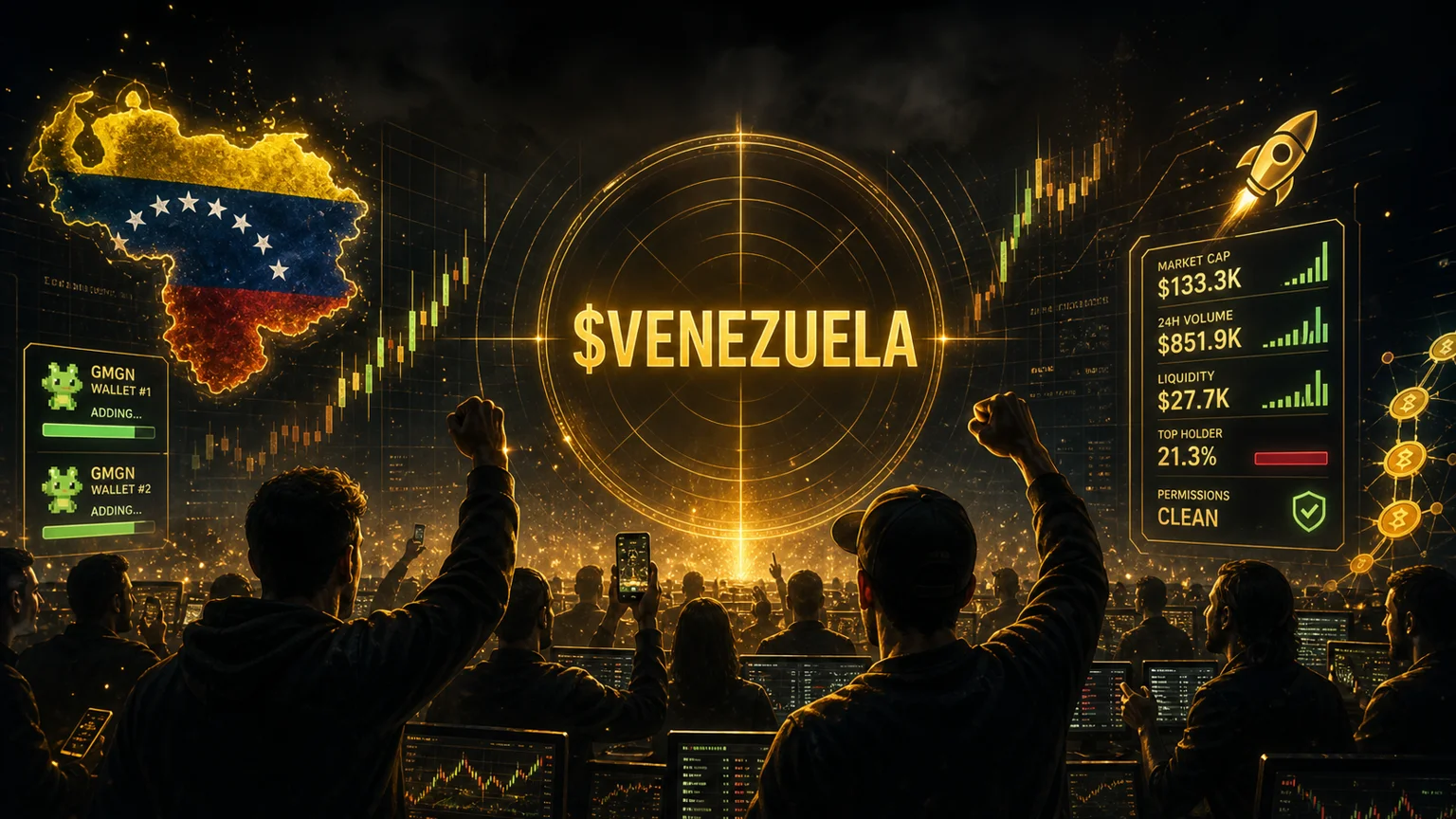
$VENEZUELA currently shows no freeze authority, no mint authority, a Rugcheck score of 1, and a creator wallet balance of zero. The problem is not contract control but structure: the top visible wallet holds 21.54% of supply, the top three wallets hold 35.74% combined, and the active pool is still thin enough for exits to hit harder than the headline suggests.
$VENEZUELA has the exact kind of opening tape that can make a Solana chart feel smarter than it really is. The headline looks easy to sell: two watched wallets showed up early, the token churned through roughly $851.9K in 24-hour volume, and the market cap was still only about $133.3K at the 2026-06-27 07:15 UTC reference point. That combination tells traders they might still be catching a board before it fully escapes. It also tells them the move has already become crowded enough to punish lazy entries. Whenever a microcap prints that much turnover against only about $27.7K in liquidity, the story is never just who bought. The story is whether the next crowd will still be there when the first crowd starts taking chips off the table.
The reason this one deserves a closer read is that the buying sequence was not random noise. One watched wallet linked to Zrool kept building between 03:20 UTC and 03:27 UTC, scaling from tiny starter clips into larger adds as the token moved away from its first prints. Then another watched wallet tied to Tobx arrived around 03:40 UTC and stacked a cluster of buys of its own. In meme markets that is the difference between a curiosity candle and a board with a narrative. One wallet can be dismissed as a flyer. Two watched wallets stepping into the same fresh board within twenty minutes of each other creates a cleaner sentence: somebody saw this early, and then somebody else worth watching agreed fast enough to matter.
- → Two watched GMGN wallets built positions in $VENEZUELA within the first trading hour, giving the token a real pile-in signal instead of a single-wallet screenshot trade.
- → $VENEZUELA rotated roughly $851.9K in 24-hour volume against only about $27.7K in liquidity while holding near a $133.3K market cap at 2026-06-27 07:15 UTC, which is enough action to attract degens and enough fragility to make exits matter more than entries.
- → The contract read stays clean with freeze authority off, mint authority off, a Rugcheck score of 1, and a creator balance of zero, but the top wallet still controls 21.54% of supply and the top three visible wallets hold 35.74% combined.
Why Two Watched Wallets Matter More Than One
Watched-wallet articles usually go bad when the entire thesis depends on one recognizable name. A single wallet can be early, smart, careless, or simply willing to buy something because the position size is trivial. A second wallet changes the psychology. It lowers the odds that the first print was just recreational aping and raises the odds that the board had enough shape to attract another trader with a reputation to protect. That does not make $VENEZUELA a safe trade or even a good trade. It makes the early tape legible. Traders can now explain the move without inventing mythology: watched money noticed the board, pressed it, and gave the rest of the market a reason to look.
The timing matters too. Zrool's sequence started while the token was still a much smaller board, with buys landing around the $0.000078 to $0.000080 region before later adds arrived closer to the $0.000208 to $0.000210 zone. Tobx arrived later, but not late enough to feel like a victory lap. Those buys landed while the board was still in the process of proving itself. In practical terms, that means the first watched-wallet buyer did not just print a top tick, and the second watched-wallet buyer did not wait for an obviously mature chart. The overlap creates a stronger editorial angle than the usual “wallet bought, chart moved” filler because the sequence suggests an emerging consensus among fast hands rather than a single trader fishing for attention.
What the On-Chain Data Shows
The best thing $VENEZUELA has going for it is that the contract-level read is not the part traders need to fear. Rugcheck scores the token at 1. Freeze authority is disabled. Mint authority is disabled. The creator wallet balance reads zero. Liquidity on the main Pump Fun AMM pool is fully locked. Those are the boxes traders want cleared before they even bother asking whether the move has legs. Too many fresh runners die because the first real look uncovers obvious admin levers or a creator who still owns enough size to vaporize the board. That is not the lead problem here.
The real issue is how much activity this board is trying to support with how little actual depth. About $851.9K in turnover on a $133.3K market cap sounds strong, and it is. But it is also a warning that the chart may be doing far more emotional work than structural work. The active liquidity pool is only around $27.7K. That means the market does not need especially large flows to produce dramatic candles. It also means the same traders celebrating the vertical move can wind up trapped in a very small doorway if momentum stalls for even a few minutes. Thin pools create beautiful screenshots because price can lift quickly. They also create ugly exits because price can fall with the same efficiency.
Holder concentration keeps that warning alive. The top visible wallet owns 21.54% of supply, while the top three visible wallets hold 35.74% combined. Those numbers are not catastrophic by fresh-launch standards, but they are large enough to matter because the liquidity base is still tiny. Concentration is always contextual. A crowded cap table can be manageable if the pool is deep and the buyer base keeps broadening. On a board this thin, concentration becomes more dangerous because every meaningful wallet has more power over the candle. In other words, the on-chain read is cleaner than a scam board, but it is not broad enough to be mistaken for a comfortable market.
The Board Still Needs a Real Handoff
That is the next test for $VENEZUELA. The first wave has already done its job. It made the token visible. It gave traders a narrative about watched money getting there early. It delivered a tape strong enough to keep the chart in circulation. What it has not done yet is prove that the token can hand off from the first crowd to a broader one without the board collapsing under its own excitement. That handoff is what separates a meaningful day-one runner from the endless pile of Solana names that print a good first paragraph and a terrible second act.
For that handoff to happen, the pool has to deepen and the next buyers have to arrive for reasons bigger than imitation. A board like this usually survives when the market decides there is enough meme energy, cultural stickiness, or visible order flow to keep demand alive after the first smart-money tell gets fully priced. It usually fails when copy-traders chase the sentence without checking the structure. That difference sounds basic, but it is the whole game in microcaps. When degens believe a watched-wallet tag is the same thing as durable sponsorship, they stop measuring the distance between liquidity and market cap. That is how thin boards turn from “still early” into “why is the chart gone” in one ugly reset.
There is also a subtle problem with the relief-fund framing. It is sticky enough to get attention, especially in a cycle where political-adjacent memes can travel quickly, but it is not automatically deep enough to guarantee a second rotation. Narrative strength on Solana is less about whether a name is topical and more about whether traders can keep recycling it into fresh reasons to buy. Right now the story is still heavily dependent on the opening tape. That is fine for a launch-radar trade. It is not enough yet to call this a stronger culture bid. The market still needs to prove it wants the token, not just the screenshot of who touched it first.
🟡 $VENEZUELA earns a speculative read because the watched-wallet pile-in is real, the contract permissions are clean, and the token already forced a serious amount of turnover through a tiny market cap. The problem is that the same thin structure making the chart exciting also makes it fragile. With only about $27.7K in liquidity, a 21.54% top wallet, and 35.74% held by the top three visible addresses, the board still needs a broader handoff before traders can treat this as more than a fast Solana sprint with a narrow exit door.
What is $VENEZUELA on Solana?
$VENEZUELA is the Venezuela Relief Fund meme token on Solana. At the 2026-06-27 07:15 UTC reference point, it was trading near a $133.3K market cap with roughly $851.9K in 24-hour volume.
Why did $VENEZUELA get attention so quickly?
Two watched GMGN wallets built positions in the first trading hour, which gave the token a cleaner early-flow story than most fresh launches. That kind of overlap matters because it suggests the move was noticed by more than one fast-money participant.
What does the on-chain read say about $VENEZUELA?
The contract permissions look clean. Freeze authority is off, mint authority is off, Rugcheck scores the token at 1, and the creator balance reads zero. The real caution comes from market structure: liquidity is still thin and the top visible wallet controls 21.54% of supply.
What has to improve for $VENEZUELA to hold its range?
The next confirmation would be deeper liquidity and a broader holder handoff. If fresh buyers expand the pool without making concentration worse, the watched-wallet story has a better chance of becoming a real second-leg trade instead of a one-cycle headline.