$SIEGE Has the Castle-War Hook Traders Want, but the Exit Door Is Still Tiny
$SIEGE pushed more than $276K of 24-hour volume in its first few hours on Solana with a playable medieval-raider wrapper and a clean permission set. The tension is not the contract shell. It is whether roughly $20K of liquidity can absorb a board where the biggest wallet still controls more than a fifth of supply.
Rugcheck scores $SIEGE at 1 and both permission switches are off, but the board still trades on shallow depth. The biggest wallet controls 20.7% and the top three wallets together hold 39.3%, which can turn a fast launch into a crowded exit if the next bid slows.
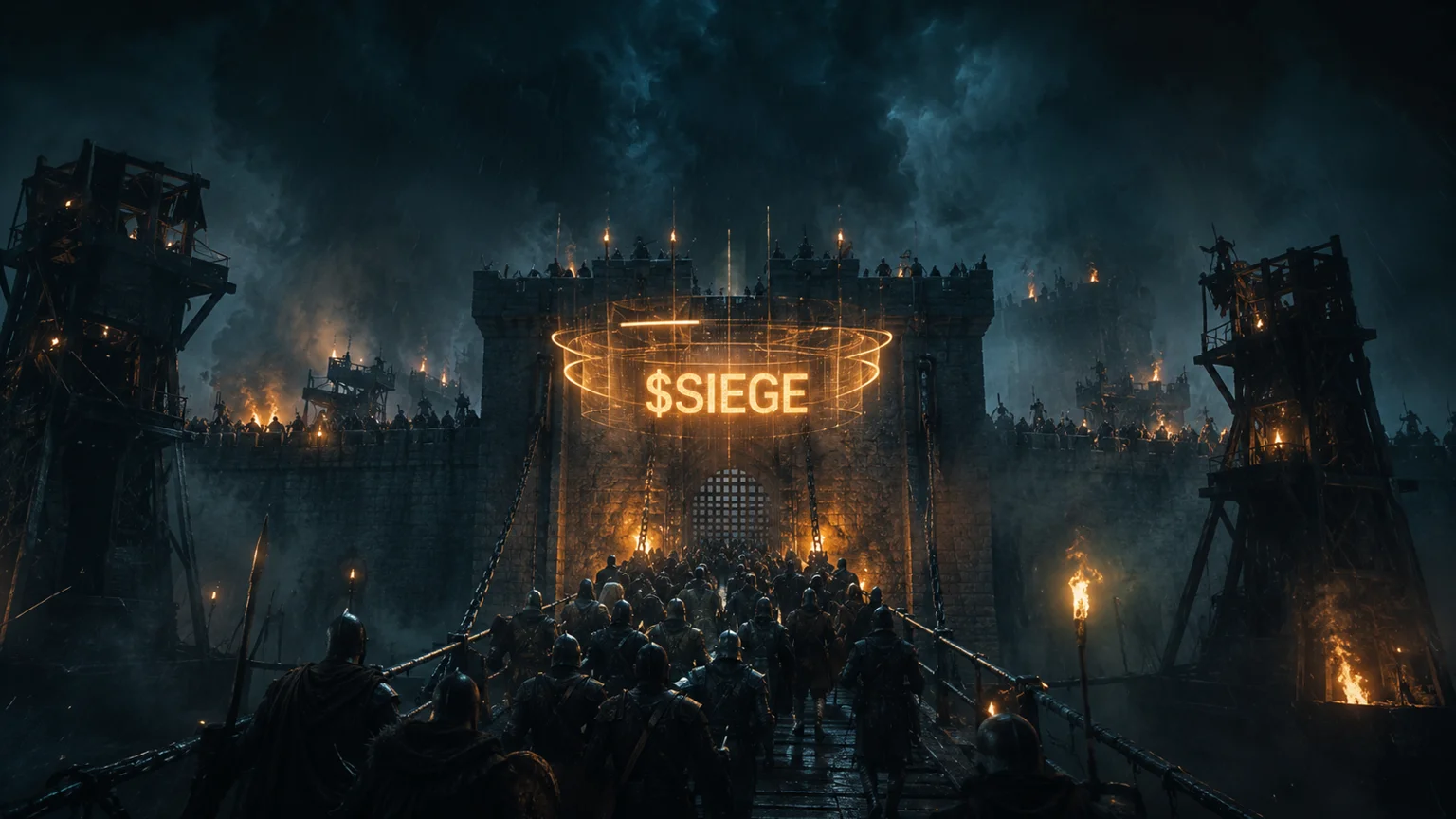
$SIEGE landed on radar because it found the exact kind of wrapper that gives a fresh Solana launch a chance to matter for more than one candle. The project sells itself as a Clash-style medieval raider where players crack chests for troops, fortify a keep, and raid rival warlords for more $SIEGE. That is a better first sentence than most new meme boards ever get. It gives traders a picture to repeat, a reason to post, and a game-shaped excuse for why a tiny ticker might hold attention after the first rush of launch curiosity fades.
The board also moved quickly enough to earn a harder look. By the 7:04 AM UTC selection snapshot on June 14, $SIEGE had printed roughly $276.8K in 24-hour volume on an $85.7K fully diluted value with a buy ratio near 58.4%. For a pair only about 2.8 hours old, that is real turnover. It says the market did not treat this as a one-wallet vanity launch. People were coming back for second and third looks, and they were still willing to cross the spread for the story. The problem is that good early turnover and a good early structure are not the same thing. On $SIEGE, the structure is where the risk starts.
- → $SIEGE came out fast, reaching roughly an $85.7K fully diluted value with about $276.8K in 24-hour volume in less than three hours.
- → The playable castle-war framing is doing real work for the bid because it gives the ticker a usable story instead of a mascot with no second sentence.
- → The contract shell looks clean, but the setup is still speculative because liquidity sits near $20.9K while the largest wallet holds 20.7% and the top three wallets control 39.3% combined.
What Makes This One Different
Most first-day Solana launches are asking traders to suspend disbelief and buy the possibility that some future joke, influencer mention, or Discord campaign will eventually arrive. $SIEGE is not exactly deep art, but it at least shows up with a coherent frame. The website pitches a medieval raid loop. The token name matches the game hook. Even the social handle stays on message. In this market, that consistency matters because it reduces the amount of imagination the crowd has to spend. A degen can see the ticker, glance at the landing page, and understand the pitch instantly.
That kind of clarity matters more when the board is still tiny. At under six figures of fully diluted value during the selection read, $SIEGE does not need a huge absolute flow to move hard. What it does need is a reason for that flow to keep renewing. The playable wrapper gives it a shot at that. The risk is that a legible story can attract people into the trade faster than the market can build enough depth to let them leave comfortably later. That is why this looks less like a clean runner and more like a classic liquidity trap candidate wearing a stronger costume than average.
The Numbers So Far
The raw tape tells two different stories depending on where you stand. The bullish version is simple: a fresh board turned over more than three times its market cap in its opening hours and still kept buy flow ahead of sells. That usually means the market sees an unfinished repricing, not a dead-on-arrival listing. A 58.4% buy ratio across 6,022 swaps is healthy enough to show actual participation. The volume also did not come from a single random print. There was enough activity to suggest traders were genuinely rotating through the pair and trying to establish a fairer price.
The bearish version sits right beside it. DexScreener still showed only about $20.9K of liquidity and a 23.8% one-hour pullback at the time of selection. That is the uncomfortable combination for a launch that just went loud on social feeds. The wrapper is sticky enough to recruit fast attention, but the depth is nowhere near large enough to make that attention safe. A market like this can feel excellent on the way up because every buy looks dramatic. It can feel just as dramatic in reverse the moment early holders decide that two or three hundred thousand dollars of turnover is enough for day one.
What the On-Chain Data Shows
The clean part of the read is the permission set. Rugcheck scores $SIEGE at 1. Freeze authority is off. Mint authority is off. That removes two of the easiest disaster switches a new Solana launch can carry. There are no obvious authority flags in the current profile, and the creator wallet is not tagged as an insider concentration problem in the Rugcheck snapshot. If somebody wanted a reason not to touch the board at all, the contract shell is not giving them the obvious one.
The more important issue is distribution. The largest wallet controls 20.72% of supply. The second-largest holds another 13.45%. The third wallet adds 5.08%, putting the top three at 39.26% combined. That is a lot of influence for a board with only 674 holders and less than $21K of liquidity. None of those numbers automatically prove bad intent. They do prove that a small group of wallets matters a great deal to what happens next. On a board this thin, a single large holder trimming into strength can change the tone before the rest of the market even finishes debating the story.
There is also a subtle detail in the creator profile that cuts both ways. Rugcheck shows no creator-token history worth flagging and no listed risk stack, which is cleaner than many same-day launches. But a clean history does not automatically create a mature market. Sometimes the riskiest first-day setup is not a malicious contract. It is a normal contract with concentrated ownership and shallow depth that gets overpromoted before the market has enough room to absorb supply. That is the exact trap $SIEGE still has to prove it can escape.
Why the Pullback Matters More Than the Pump
The 199% 24-hour move is the part everybody sees first, but the 23.8% one-hour retrace is more important for judging whether this board has legs. Early pumps are common. What matters is whether the first cooling phase still finds enough fresh demand to keep the structure from turning into a one-wave event. On $SIEGE, the answer is still unsettled. If the castle-war narrative continues to pull in real new buyers, the dip simply becomes part of the discovery process. If the same wallets that rode the opening burst are the only ones still really involved, then the retrace is not a pause. It is the first sign that the board outran its own depth.
This is what makes the liquidity trap angle more useful than a plain bullish or bearish read. Traders do not need $SIEGE to be fraudulent for it to be dangerous. They only need it to be popular slightly faster than it becomes liquid. That gap between story strength and balance-sheet strength is where first-day pain usually happens. A board with a catchy wrapper and thin books can look healthier than it is because the narrative makes people underestimate how crowded the door really is.
What Would Make the Setup Better
The improvement path is straightforward. $SIEGE needs more liquidity, a looser holder map, and a calmer tape that can keep trading without every marginal buy or sell producing a dramatic percentage move. If the board can hold attention while those things improve, the castle-war theme has enough personality to keep it on watchlists. If not, the same story that helped it break out becomes the reason people keep chasing a setup that never really matured.
🟡 $SIEGE deserves the launch-radar look because the medieval-raider wrapper is coherent, the early turnover was real, and the on-chain permission set is cleaner than average. It still reads as speculative because the board is trying to sustain a loud first-hours narrative on only about $20.9K of liquidity with 39.3% of supply parked in the top three wallets. That is enough concentration to make every rebound look exciting and every exit look violent. If the next sessions build depth and spread ownership, $SIEGE can graduate into a stronger chart. Until then, this is a story-driven board with a very small escape hatch.
FAQ
What is $SIEGE on Solana?
$SIEGE is the token for Siege the Castle, a Solana meme launch framed around a medieval raider game where players crack chests, fortify keeps, and attack rival warlords.
Why did $SIEGE make launch radar?
Because it reached roughly $276.8K in 24-hour volume on only about an $85.7K fully diluted value within its first three hours, which is enough turnover to force attention on a tiny board.
Does $SIEGE look safe on-chain?
The permission set looks clean relative to many same-day launches. Rugcheck scores the token at 1, freeze authority is off, and mint authority is off. The bigger concern is market structure, not contract permissions.
What is the biggest risk for $SIEGE right now?
Liquidity depth. The board had only about $20.9K of liquidity at the selection snapshot while the top three wallets controlled 39.3% of supply, which can make exits messy if momentum slows.
What would change the read on $SIEGE?
A better holder spread, materially deeper liquidity, and proof that the castle-war theme can keep recruiting new buyers after the first opening burst rather than just recycling the same early wallets.