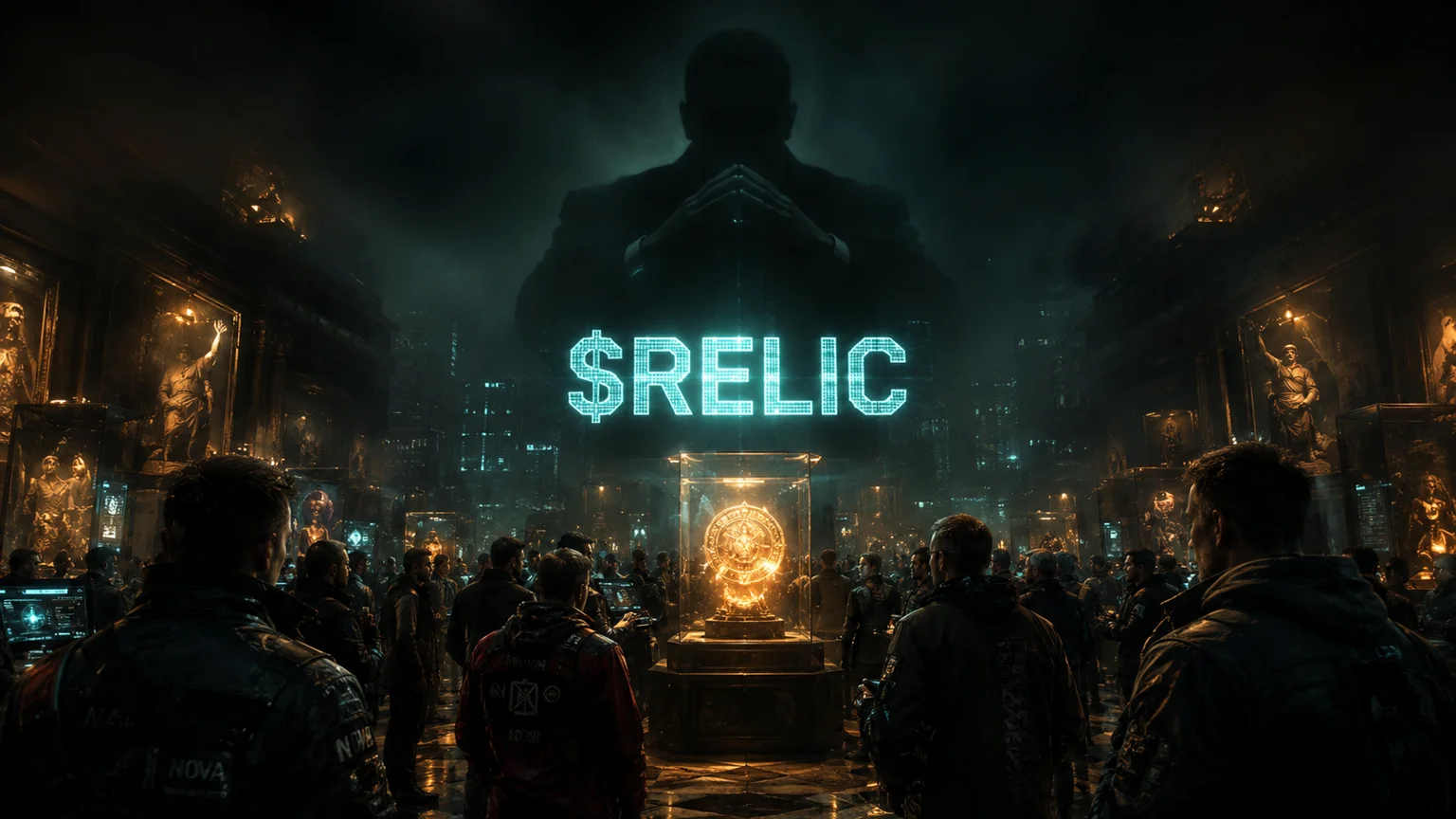
$RELIC Is Catching a Solana Reprice, but One Wallet Still Owns Too Much of the Story
$RELIC ripped higher on met-dbc momentum and a watched-wallet buy, yet the setup still runs through a top holder controlling 20.17% of supply.
The contract permissions look calm, but one wallet held 20.17% of supply and the top three wallets controlled about 30.3% at the saved snapshot.
$RELIC is the sort of Solana board that can become expensive to understand one hour too late. The tape has the ingredients traders usually chase without thinking twice: a met-dbc launch, a 644% daily move, roughly $373.3K in 24-hour turnover, and a watched-wallet buy that makes the move feel discovered rather than accidental. That stack is enough to turn a small meme into a live session story. It is not enough to make the board clean. At the saved 2026-06-10 22:15 UTC snapshot, the real tension in $RELIC was simple. The contract permissions looked calm, but one wallet still owned 20.17% of supply. That single fact changes the entire quality of the chase.
This is why the best angle on $RELIC is holder concentration, not just momentum. There are plenty of launches that deserve suspicion because the contract itself carries ugly switches or the deployer still sits on a balance big enough to dump through the first bounce. That is not the immediate problem here. Freeze authority was disabled. Mint authority was disabled. Rugcheck scored the contract at 7, which is elevated only in the sense that no meme coin should ever be treated casually, not in the sense that the permissions profile is flashing catastrophe. The discomfort comes from supply placement. A chart can look lively, fair, and even organic for a while, then suddenly stop belonging to the market once one oversized holder decides the move has gone far enough.
- → $RELIC was sitting on roughly $373.3K in 24-hour volume and about $27.3K in liquidity at the saved 2026-06-10 22:15 UTC snapshot, with a 644% daily move that made the board impossible to ignore.
- → The permissions profile is not the main issue: freeze authority was disabled, mint authority was disabled, and Rugcheck scored the contract at 7.
- → The trade gets tougher because one visible wallet held 20.17% of supply and the top three wallets controlled about 30.3%, which means the tape can look healthy right until concentration turns into a decision point.
Why $RELIC Feels More Like a Narrative Trade Than a Generic Spike
The met-dbc label matters because traders are still primed to treat that launchpad as a place where fresh boards can produce sudden follow-on attention. In practice, that means a token like $RELIC does not need to invent a full mythology before buyers show up. It only needs enough momentum and enough visual identity to fit into a conversation already happening elsewhere on the timeline. The name helps in that respect. $RELIC sounds collectible, a little mystical, and vague enough to let traders project a bigger story onto a tiny chart. That is exactly how many fast meme moves get their second leg. The ticker stops being just a contract and starts behaving like a narrative object people can pass around.
The watched-wallet entry reinforces that read. One of the easiest mistakes in this lane is assuming every fast move is organic just because the chart feels active. Wallet quality does not prove sustainability, but it does sharpen the read on why the token moved this quickly in the first place. A watched wallet stepping in during the opening stretch implies somebody with experience in the lane saw enough to make the board worth inventory. That matters more on a ticker like $RELIC than it would on a fully random launch, because the broader trade here is not just about raw numbers. It is about whether the market is willing to tell itself a story about a collectible-style meme long enough for the chart to keep repricing.
What the On-Chain Data Shows
The first thing the on-chain profile says is that the ugly switches most traders fear were not sitting in plain sight. Freeze authority was disabled, which removes the obvious transfer-control hazard that can turn a running chart into a hostage situation. Mint authority was disabled, which matters because nobody wants to discover a surprise supply expansion after momentum already arrives. Rugcheck scoring the contract at 7 is not the kind of number that forces a red verdict on its own. In a vacuum, those details would make $RELIC look calmer than a lot of same-session meme launches that never earn the benefit of a second look.
The second thing the profile says is that concentration is doing most of the arguing. The top visible wallet held 20.17% of supply. The next two wallets held 7.32% and 2.78%, taking the top-three concentration to about 30.3%. That distribution is not instantly fatal, but it absolutely changes the quality of price discovery. When one wallet owns a fifth of the token, the market is never fully setting the terms on its own. It is negotiating with an invisible overhang. Even if that wallet never sells into the move, every buyer has to price in the possibility that a single holder can alter the chart more aggressively than the crowd can absorb. For a token with only 400 holders at the snapshot, that concentration deserves to sit at the center of the read.
Why Concentration Changes the Entire Read
Concentration is not just an abstract risk metric. It directly shapes how a move behaves after the first attention burst. On a better-distributed board, traders can watch volume, liquidity, and meme spread to judge whether the market is broadening. On a concentrated board, that same data can flatter the chart for longer than it deserves because too much of the float still sits under too few hands. That is the problem with reading $RELIC as a clean runner. The tape may be real. The interest may be real. But the market is still borrowing confidence from a structure that leaves one wallet with a disproportionate amount of power over what happens next.
This is also where the modest creator history cuts both ways. The saved profile showed zero prior creator tokens, which means there is no obvious serial-launch assembly line hiding behind the board. In another article, that would be a strong positive. Here it mostly acts as a reminder that clean deployer optics do not erase holder-map risk. A token can avoid the usual deployer red flags and still become dangerous because supply settled into one pocket too early. The absence of freeze authority, the absence of mint authority, and the lack of a factory-style creator history keep $RELIC away from the ugliest end of the spectrum. They do not solve the harder problem of who gets to control the exit if the room starts leaning the wrong way.
Can the Met-DBC Bid Stay Loud Enough to Matter?
That question depends on whether the narrative stays louder than the concentration warning. A board with roughly $373.3K in daily turnover and a 644% move can still produce another impulsive leg if the meme keeps circulating and late traders feel they are not already staring at the top. The watched-wallet presence helps because it gives the market a reason to believe early participants saw something more than a random blip. The met-dbc wrapper helps because traders are still trained to watch that pipeline for boards that can catch a second round of volume. In the short run, story flow can absolutely overpower structural discomfort.
The problem is that liquidity remains thin relative to how fast the chart already moved. About $27.3K in liquidity is enough to host a sprint, but not enough to promise elegant exits if momentum pauses. On a concentrated board, thin liquidity becomes even more dangerous because it reduces the margin for error around every larger sell. The next move higher would likely need broader holder growth, stronger repeat turnover, and proof that the top-heavy supply map is not freezing newcomers out of the trade. Without that, $RELIC risks becoming one of those charts that still looks exciting in screenshots while the actual trade quality quietly worsens under the surface.
🟡 Speculative — $RELIC has enough going for it to stay on the board: a met-dbc narrative wrapper, roughly $373.3K in 24-hour volume, a watched-wallet entry, disabled freeze authority, disabled mint authority, and a Rugcheck score of 7. The reason it stops short of a clean read is concentration. One wallet holding 20.17% of supply and the top three controlling about 30.3% means the market still does not fully own the chart. If the narrative keeps spreading, the token can keep repricing. If that concentration starts expressing itself, the unwind can come faster than the screenshots suggest.
What is $RELIC on Solana?
$RELIC is the Relic Drops meme token on Solana with contract address PAFwaS3ER3GL1hMHtg8RxnJ6JLLi4vHPyMxkmBReLic. At the saved 2026-06-10 22:15 UTC snapshot it had roughly $373.3K in 24-hour volume, about $27.3K in liquidity, and 400 holders.
Why is $RELIC rated speculative instead of clean?
$RELIC avoids several obvious contract problems because freeze authority was disabled, mint authority was disabled, and Rugcheck scored it at 7. The speculative label comes from supply concentration, with one wallet holding 20.17% and the top three wallets controlling about 30.3%.
What does the watched-wallet buy mean for $RELIC?
It suggests at least one repeat meme trader noticed the board early enough to take inventory during the opening stretch. That improves the case that the move was discovered by active participants, but it does not erase the fact that concentration can still dominate the chart later.
What has to happen next for $RELIC to keep working?
$RELIC needs broader holder growth, repeat turnover that stays firm above the current liquidity base, and a narrative bid strong enough to keep new participants interested despite the top-heavy supply map. If volume cools before the holder base widens, the structure gets much harder to defend.