$KIRI Is Running on a Tiny Board. That Makes the Holder Map the Whole Trade.
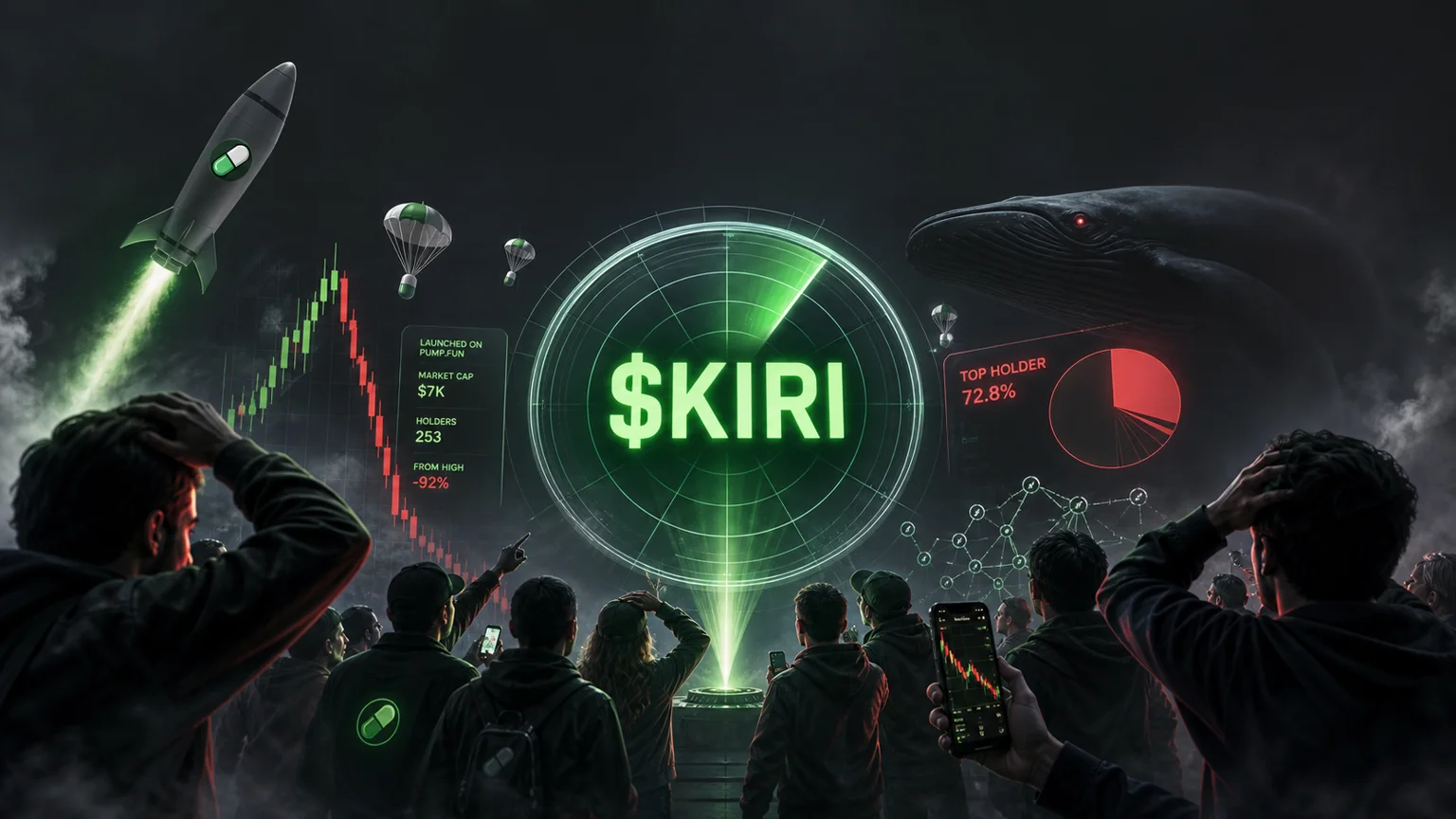
$KIRI flashed out of pump.fun with a $7K market cap, 253 holders, and a brutal drop from its early high. The clean contract read helps, but one outsized holder makes this a concentration test, not a victory lap.
Contract-level read is cleaner than the average microcap launch, but the holder map is heavily dependent on one large wallet.
$KIRI is the kind of microcap Solana meme that can look ridiculous until it suddenly becomes the only chart a room is staring at. Kyrannio came through pump.fun with almost no cushion underneath it: roughly a $7.5K market cap, 253 holders, and about $2K in 24-hour volume on the latest read. That is not a mature market. It is a small table where one or two wallets can change the mood, the chart, and the exit math in a single transaction.
The reason $KIRI is worth a launch-radar note is not that the chart is clean. It already put in a sharp early high near a $54.8K market cap and then bled back about 86%. That is usually where weak launches disappear into the scroll. The reason this one stays on watch is that the contract-level profile is cleaner than the typical throwaway microcap, while the holder map is still tight enough to make every bounce fragile. In plain English: the token does not have obvious authority traps showing, but it also does not have enough distribution to treat the rebound as proven.
- → $KIRI is trading near a $7.5K market cap after an early run toward roughly $54.8K, putting it about 86% below that first high.
- → The on-chain profile shows no active freeze authority and no active mint authority, which removes two of the nastier contract-level risks from the first read.
- → The problem is concentration: the largest tracked holder controls 42.95%, while the top three add up to about 50.2%.
The Angle: One Wallet Can Decide the Mood
A tiny board changes how a degen should read the tape. On a larger meme token, a 40% drawdown can be noise if liquidity is thick, holders are wide, and volume has multiple independent sources. On $KIRI, the board is still so small that the first lesson is simpler: do not confuse a clean contract read with a clean market structure. The coin can be technically safer than a freeze-enabled trap and still be structurally dangerous because supply is not spread out.
That is why the top-holder number matters more than the headline market cap. A $7.5K token can double on thin buying and still leave late entries staring at the same exit door. If the largest wallet is patient, the chart has room to build a second base. If that wallet sells into every green candle, the whole setup becomes a liquidity donation machine. The first real $KIRI trade is not price prediction. It is watching whether the biggest holder lets the market breathe.
What the On-Chain Data Shows
The Rugcheck-style profile gives $KIRI a mixed but useful read. Freeze authority is not active, so the deployer does not appear to have the simple ability to freeze transfers from holders. Mint authority is not active either, so the basic unlimited-supply danger is not showing in the current profile. The normalized rug score sits at 1, and the scan does not surface named risks in the provided data. For a microcap pump.fun graduate, that is a better starting point than the usual wall of contract warnings.
The holder map is where the optimism stops. The largest tracked holder sits at 42.95% of supply. The second and third tracked holders are much smaller at 3.72% and 3.57%, but together the top three still reach about 50.2%. None of those top three are flagged as insider wallets in the data provided, yet concentration does not need an insider label to matter. At this size, a whale-sized holder does not have to be malicious to become the chart. Even routine selling can crush a low-liquidity bounce.
The dev profile is also quieter than expected. The creator wallet is listed as 8gjio6bTm21pdTnpnXWc5agxipF9zmYvQLL1Za1QHoLq, with no creator-token history showing in the supplied profile. That means this is not currently reading like a serial deployer pattern from the available data. There is no reason to build a whole bear case around the deployer wallet alone. The stronger editorial point is narrower: contract controls look fine, deployer history is not the story, and holder concentration is doing all the risk work.
Why the Early High Matters
The $54.8K early high gives $KIRI a reference point, but it should not be read as proof of demand. Early microcap highs are often created by a small burst of buyers chasing a new ticker, not by a durable base of holders. The move down to roughly $7.5K says the first impulse was not defended. That matters because the next bid has to do more than print a candle. It has to prove there are enough new wallets willing to absorb supply without letting the largest holder dictate every turn.
This is where many tiny Solana launches trick readers. A token can be down 86% from its first high and still look like it has asymmetric upside because the market cap is tiny. That upside is real in mathematical terms, but the path is not free. Thin books produce violent upside and violent failure from the same condition: not enough depth. $KIRI needs volume that is not just one early rotation, holder growth that does not stall around the first few hundred wallets, and a top-holder balance that does not become the whole chart.
The Bull Case
The cleanest bullish read is that $KIRI already survived its first flush without carrying the worst contract-level warnings. No freeze authority and no mint authority do not make a meme token safe, but they remove two fast reasons to ignore it. The market cap is still tiny enough that a modest second wave can move the token hard. The social references attached to the launch also give the ticker a meme wrapper instead of leaving it as a nameless chart. For a launch-radar token, that combination is enough to keep it alive on the board.
There is also a psychological setup that sometimes works after early collapses. When the first high is far above spot, every bounce lets traders point at a visible reclaim path: first back to five figures, then toward the prior high, then into price discovery if the crowd shows up. $KIRI does not need a complex narrative for that trade to form. It needs the market to decide that the first dump was an overreaction and that the holder map can loosen without killing the chart.
The Bear Case
The bear case is brutally simple: $KIRI is too concentrated and too small to absorb careless exits. A 42.95% top holder is not a footnote at a $7.5K market cap. It is the central risk. The top-three concentration near 50.2% means the early market is still dependent on a tiny number of balances behaving gently. If one of those wallets sells aggressively, the chart may not get a graceful pullback. It may just lose the bid.
The second risk is that the early volume is not yet large enough to prove broad demand. Roughly $2K in 24-hour volume can mark a token as alive, but it does not prove a real crowd has formed. It is possible for $KIRI to look active on a small screen while still being unable to support meaningful entries or exits. That is the uncomfortable part of these ultra-low-cap launch trades: the upside gets advertised by the market cap, while the downside hides in the lack of depth.
The clean contract read is not the headline. The headline is whether $KIRI can dilute the influence of its largest holder before the next green candle becomes exit liquidity.
What Would Upgrade the Read
$KIRI upgrades if the next leg comes with holder expansion, steadier volume, and a visible reduction in top-holder dominance. The most convincing version would be a grind back above the first post-flush levels without one wallet absorbing the whole chart. A stronger read would also include liquidity improving enough that buyers are not forced to treat every entry as a sprint. At this size, the best signal is not a single vertical candle. It is boring stability after the vertical candle.
It downgrades quickly if the token keeps printing lower highs while the holder count stalls. It also downgrades if the top wallet remains huge and the market starts reacting badly to small sells. Meme traders love tiny caps because the math can get silly fast, but the same math works in reverse. $KIRI has the clean-enough contract profile to deserve a watch, not the distribution profile to deserve trust.
$KIRI is a speculative launch-radar watch, not a clean green-light signal. The Solana contract profile looks better than average with freeze authority off, mint authority off, and a low rug score in the supplied data. The market structure is the problem: 253 holders, shallow volume, an 86% retreat from the early high, and one holder near 43% of supply. The next read is whether buyers can broaden the board before concentration turns the rebound into someone else's exit.
What is $KIRI?
$KIRI is Kyrannio, a fresh Solana meme token that came through pump.fun and is currently trading as an ultra-low-cap launch-radar signal.
Why is $KIRI only rated speculative?
$KIRI has a cleaner contract profile than many microcap launches, but the largest tracked holder controls 42.95% and the top three holders sit near 50.2%, which makes the market structure fragile.
What is the main thing to watch next?
The key test is whether $KIRI can add holders and volume while reducing dependence on its largest wallet. Without that, the chart can move fast but remain difficult to trust.