
$PROV Has the Cleaner Solana Contract Shell, but the Holder Map Still Decides the Trade
$PROV traded near a $151.1K market cap with about $514.5K in 24-hour volume roughly 5.4 hours after launch, and watched-wallet buying showed up before the board fully spread. The clean part is the contract read. The harder part is that the top three visible wallets still control roughly 40.6% of supply, including a 10% developer bucket.
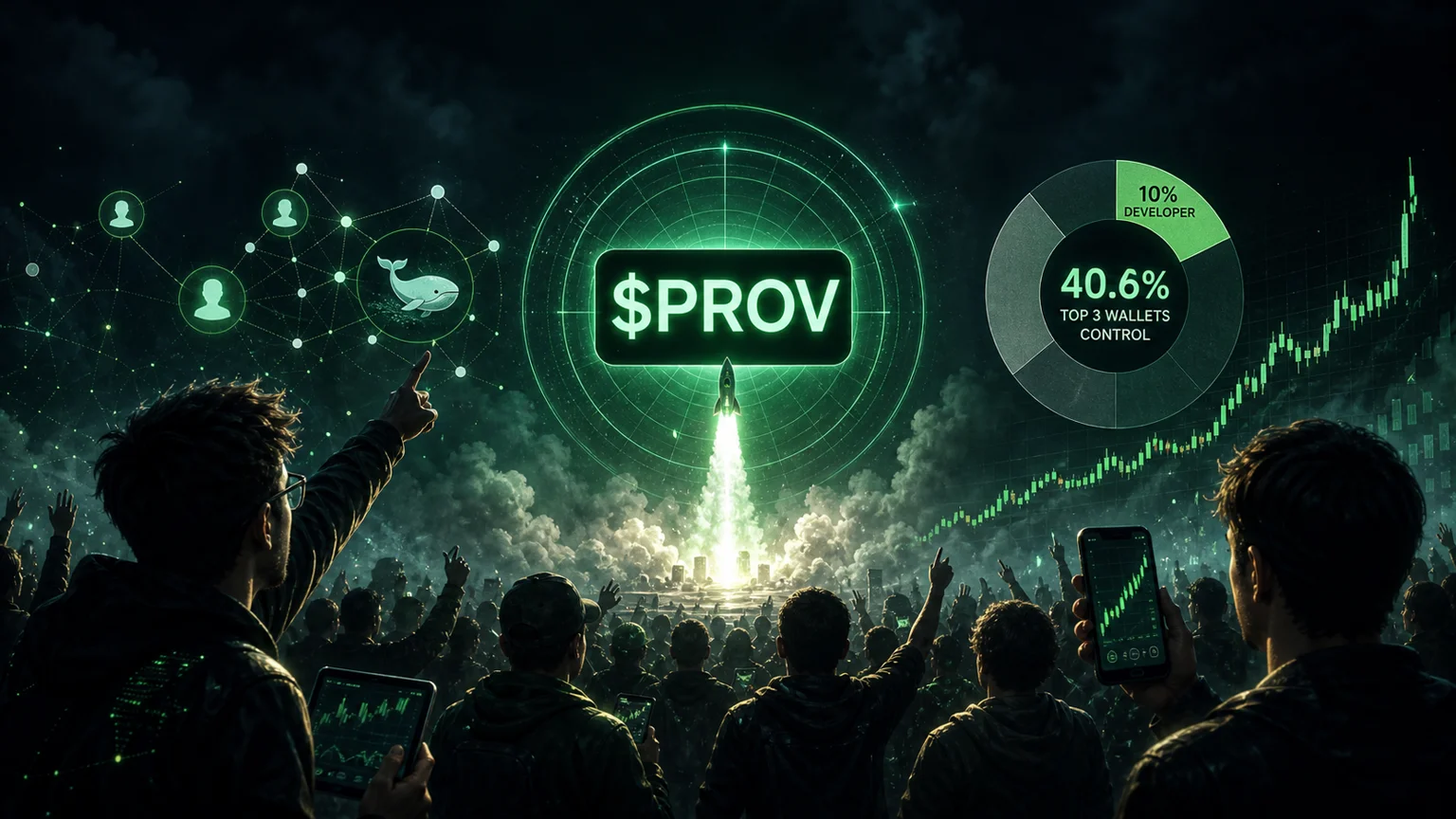
$PROV's contract shell is cleaner than most same-day Solana launches because freeze authority is off, mint authority is off, and Rugcheck scored it at 1. The real constraint is ownership. The top three visible wallets control about 40.6% of supply, and the developer wallet alone still holds 10%, which means the tape remains structurally crowded even without obvious contract poison.
$PROV has the sort of saved profile that tempts traders into using the word clean too quickly. Roughly 5.4 hours after launch, the token was trading near a $151.1K market cap after about $514.5K in 24-hour volume, with a 427% move still hanging on the board. The contract permissions read well, the Rugcheck score is low, and watched-wallet buying showed up before the trade fully spread. Those are all real positives. They just are not the whole story.
The real story is that $PROV is trying to prove two different things at once. First, it has to show that the early velocity was more than a reflexive same-day sprint. Second, it has to show that a board with a clean contract shell can still develop healthier market structure from here. Too many meme traders stop at the first sentence and ignore the second. In $PROV's case, the second sentence is where the decision actually lives.
That is because the token's best attribute and biggest weakness sit side by side. Freeze authority is off. Mint authority is off. Rugcheck scored the token at 1. Those are the kind of inputs traders hope to see when they are scanning a fresh Solana board. At the same time, the top visible wallet controls 20.69% of supply, the developer wallet still holds 10%, and the third-largest visible wallet adds another 9.95%. That pushes the visible top-three concentration to roughly 40.6%, which is a lot of gravity for a $151.1K board.
- → $PROV reached the saved read near a $151.1K market cap with about $514.5K in 24-hour volume while the pair was still only around 5.4 hours old, so the board already did enough turnover to get taken seriously.
- → Cupseyy-linked watched wallets bought across two addresses between 2026-06-24 02:34 UTC and 2026-06-24 02:52 UTC, which tells traders the board was discovered early by fast hands even if the size itself was still modest.
- → Freeze authority is off, mint authority is off, and Rugcheck scored the token at 1, but the top-three visible holder cluster still sits around 40.6%, including a 10% developer wallet that keeps the cap table crowded.
How $PROV Got Its First Velocity
The first useful clue is the wallet timing. One Cupseyy-linked watched wallet started building exposure at 2026-06-24 02:34 UTC and came back again around 2026-06-24 02:52 UTC. A second watched wallet tied to the same identity mirrored the sequence across the same two timestamps. Combined, those four entries were not huge in dollar terms, but they were early and coordinated enough to matter. In meme trading, that is often how attention starts: not with one giant bet, but with multiple fast wallets deciding a board is worth touching before everyone else can frame it.
The rest of the tape suggests the market did not ignore those early touches. Volume crossed the half-million-dollar mark and the token held a major percentage move even after the easiest discovery phase had already passed. That gives $PROV a stronger case than a board whose entire life is one bursty candle and a dead feed. There was enough turnover here to prove that more than a tiny pocket of traders noticed the name.
Even so, the buy ratio is a good reminder not to romanticize the move. At roughly 48.2%, the saved read shows the board was not cleanly one-way. That is not necessarily bearish. It is simply honest. Buyers were interested, but sellers were active too. For a meme launch that is usually healthier than a fake straight line because it means the market is already negotiating value in public. The trade becomes more difficult only when that negotiation is happening on top of a cap table that is still too concentrated.
What the On-Chain Data Shows
Start with the positive read because it is real. Freeze authority is off, so the developer cannot lock transfers if the board gets ugly. Mint authority is off, so there is no obvious supply-expansion overhang threatening the chart. Rugcheck scoring the token at 1 is also meaningful because it tells traders the basic shell looks cleaner than the average same-day Solana meme. If $PROV were hiding ugly permissions abuse, the article would read very differently.
The market still cannot stop there. Clean permissions are table stakes, not a verdict. The part degens actually trade is the relationship between liquidity, concentration, and attention. Here, liquidity is only about $28.3K. That is a thin cushion under a token doing roughly $514.5K in 24-hour turnover. Thin liquidity does not automatically kill momentum, but it amplifies whatever the holder map decides to do next.
And the holder map is exactly why $PROV stays yellow instead of graduating to green. The top visible wallet controls 20.69% of supply. The developer wallet is another 10%. The third-largest visible bucket is 9.95%. Add those together and the visible top-three cluster reaches roughly 40.6%. None of that means a dump is imminent. It does mean the board remains vulnerable to a few addresses shaping the mood faster than new buyers can dilute them.
The developer wallet percentage matters in a different way too. A 10% dev bucket can be framed as alignment if the project keeps building interest and the wallet stays patient. It can also become overhead the moment the tape slows. That is why developer ownership should never be read as automatically bullish or automatically bearish. On a board this young, it is simply one more part of the supply map traders have to respect.
Why the Clean Shell Is Not the Whole Trade
A lot of fresh Solana boards die from obvious contract poison. That is the easy category. Traders learn to spot active mint authority, freeze risk, or a horrible Rugcheck score and walk away. $PROV is more difficult precisely because it avoids those cartoonish failures. The token asks for a more mature read: if the shell is acceptable, can the market structure still be weak enough to punish late buyers? The answer is yes, and that is what makes this board worth covering.
The best version of the bullish case is that $PROV already survived the first scrutiny round. It attracted tracked wallets, it generated real turnover, and it did so without the usual contract-level ugliness. If the board now spreads ownership more broadly and keeps bringing in fresh flow, the same clean permissions read that looks merely encouraging today can become much more powerful tomorrow. A decent shell becomes far more valuable once the cap table stops feeling cramped.
The bearish case is that traders confuse clean permissions with safe price action. They are not the same thing. A token can have freeze authority off, mint authority off, and a Rugcheck score of 1, then still trap buyers because too much supply remains close to too few hands. If that happens, every bounce becomes an opportunity for early holders to lighten up into excitement instead of a sign that the board is maturing.
$PROV's clean contract shell can lull traders into skipping the part that matters most right now.
Freeze authority is off, mint authority is off, and Rugcheck scored the token at 1, but liquidity is only about $28.3K and the visible top-three holder cluster still controls roughly 40.6% of supply.
If the board slows before fresh buyers dilute those early buckets, the same clean read that attracted attention can turn into a crowded exit with very little room underneath it.
Where the Next Decision Comes From
The next upgrade path for $PROV is not mysterious. Liquidity has to improve. The visible holder cluster has to matter less with every new wave of buyers. And the board needs to keep printing enough legitimate turnover that traders can tell the move is broadening instead of simply recycling among the same early participants. If those things happen together, the clean shell starts carrying more weight because the market around it is no longer fighting itself.
Until then, the token belongs in the speculative bucket even though some of its inputs look cleaner than average. That is not a contradiction. It is the correct read for a board where the contract profile is good but the ownership structure still asks for caution. $PROV earned the radar spot because the first hours were active, early wallets showed up, and the shell passed the basic smell test. It stays yellow because the trade still depends on whether the crowd can outgrow the cap table.
$PROV is speculative because the contract shell is cleaner than the market structure around it. Freeze authority is off, mint authority is off, Rugcheck scored the token at 1, and watched-wallet buying gave the board a credible early signal. The cap table is why it stops there. With about 40.6% of visible supply sitting in the top three wallets and only around $28.3K in liquidity, the token still needs a broader holder handoff before the cleaner shell translates into a cleaner trade.
What is $PROV on Solana?
$PROV is the ticker for Prova on Solana, trading under contract address 9bNNfsNpi4kRP9JdQHjeVRHpjazoshvEJzLykLLEpump. At the saved read it was trading near a $151.1K market cap.
Why is $PROV on launch radar?
Because the token generated roughly $514.5K in 24-hour volume, held a 427% move on the saved read, and drew watched-wallet entries between 2026-06-24 02:34 UTC and 2026-06-24 02:52 UTC while the pair was still young.
What looks clean on-chain for $PROV?
The saved contract profile shows freeze authority off, mint authority off, and a Rugcheck score of 1. Those are stronger-than-average inputs for a same-day Solana meme board.
What is the main risk on $PROV right now?
The main risk is concentration. The visible top-three wallets control roughly 40.6% of supply, including a 10% developer wallet, while liquidity is still only about $28.3K. That makes the board structurally crowded even with a cleaner contract shell.