
$BC Gets the KOL Rebound, but the Holder Map Is Still the Trade
BCGame Coin is green on fresh Solana volume after kokid951 put it back in view, yet the real read is whether buyers can absorb a supply stack where the top three wallets hold about 44%.
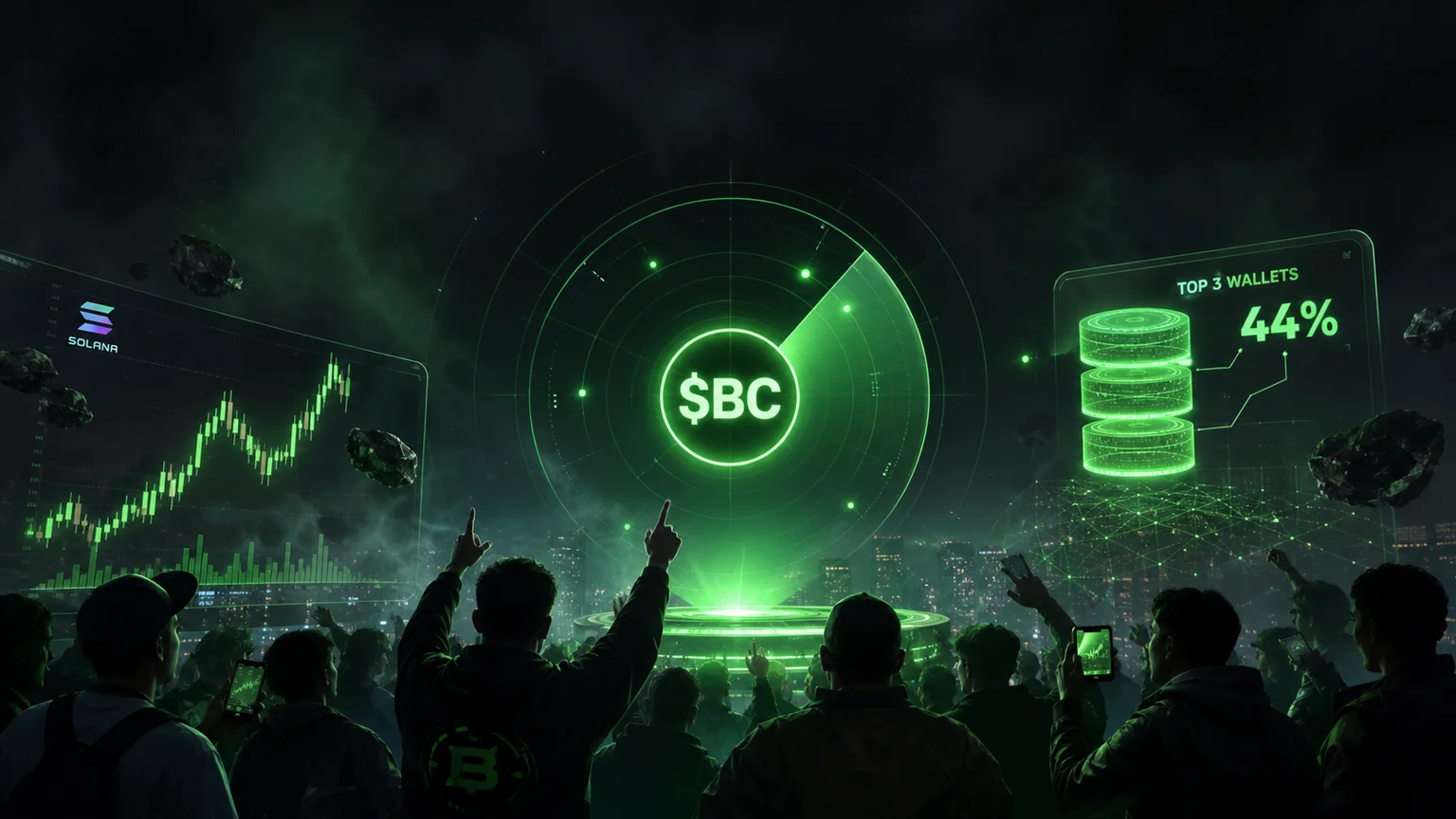
Top three wallets control about 44.2% of supply, and top-ten ownership is elevated.
$BC is back on the MemeDesk radar because the market is trying to price a rebound around a token that already has brand recognition, deep nominal market cap, and a KOL spark from kokid951. That is a very different setup from a tiny pump.fun coin trying to graduate out of nothing. $BC already trades like a large Solana meme-adjacent asset, with a roughly $170.8 million market cap and about $2.16 million in visible liquidity on its main Raydium pool. The question is not whether anyone can find the chart. The question is whether this latest bid is real demand or just a short attention burst into a supply map that still asks buyers to trust a very top-heavy holder base.
The bullish read is simple: price was up about 10.6% over 24 hours at the 10:15 PM UTC snapshot, while the six-hour move was still green and the one-hour tape had active two-way trading instead of a dead pool. That matters because $BC is not moving from a dust valuation. A move at this size needs actual liquidity and a reason for traders to care. The reason this time is social confirmation layered over a chart that had enough depth for larger wallets to enter without immediately turning the pool into a slippage machine.
- → $BC was trading near $0.01707 with about $170.8M in market cap and $2.16M in liquidity on the main Raydium pair.
- → The latest read showed +10.6% over 24 hours, but only about $135.7K in 24-hour volume, so the rebound is not yet a full-market stampede.
- → Rugcheck shows freeze authority disabled and mint authority disabled, while the top three wallets still control about 44.2% of supply.
The Rebound Is Real, but It Is Not Loud Yet
For a token this large, $135.7K in 24-hour volume is not an explosive rotation. It is more like a pulse check. The market is saying $BC has not been abandoned, but it has not yet shown the kind of volume expansion that forces sidelined traders to reprice the whole board. That is why this sits in speculative territory. A clean rebound on a $170M asset should normally come with expanding swaps, stronger buy imbalance, and enough fresh participation to make the move feel less dependent on one social push.
Still, the tape is not empty. The main Raydium pair printed 124 buys and 169 sells across 24 hours, with 44 buys and 46 sells across six hours. That mix is not a one-sided ape parade. It looks like a market being repriced by active participants while existing holders continue to use the bid for liquidity. The important point is that $BC can absorb that churn better than a microcap. A $2.16M liquidity base gives the chart a real exit door, which is rare in the faster corners of Solana meme trading.
Why the KOL Spark Matters Here
The kokid951 mention matters because $BC already has enough infrastructure for attention to become measurable. Some KOL calls land on tokens that have no pool depth, no identity, and no reason for a second wave to care. This one lands on BCGame Coin, a token tied to a recognizable crypto casino brand and supported by official-looking social and web links on DexScreener. That does not make the trade safe. It does mean the call is not floating over a blank token page.
The better framing is that $BC is a brand-token rebound test. If social attention keeps arriving, buyers have something to point at besides a candle. If it fades, the market will probably treat the move as a bounce inside an already-known asset rather than a new meme cycle. That difference matters for expectations. A microcap can double because ten wallets decide to fight over a thin pool. A $170M token needs a broader reason, and KOL attention is only the opening shove.
What the On-Chain Data Shows
The contract read is mixed in a very specific way. Freeze authority is disabled, so the token does not show the obvious transfer-freeze trap that instantly changes the risk profile. Mint authority is also disabled, which removes the unlimited-supply overhang that would make any rebound nearly impossible to trust. Those are the cleaner parts of the $BC profile, and they matter more than vague comfort language. A token can still trade badly with clean authority settings, but at least the basic contract permissions are not the central danger.
The holder map is the central danger. Rugcheck shows a normalized score of 53, with top-ten ownership flagged as high and the top three wallets controlling about 44.2% of supply. The largest wallet alone is near 20.0%, followed by wallets around 14.0% and 10.2%. None of the listed top holders are marked as insiders in the available profile, but concentration does not need an insider label to matter. When so much supply sits near the top of the cap table, every rebound has to answer one question: are those wallets letting the bid mature, or are they using attention as exit liquidity?
The Bull Case Is Brand Memory
The strongest argument for $BC is not that it is undiscovered. It is that it is remembered. Meme traders often rotate back into names that already have a ticker, a visual identity, and enough exchange-board history to feel tradable when the market gets bored of raw launches. BCGame Coin fits that lane. If the broader Solana meme feed is hunting for recognizable names with liquid pools, $BC has more to work with than a random chart that appeared five minutes ago.
That also means the upside path is cleaner to describe. The first step is volume expansion above the current six-figure daily print. The second is a holder-behavior check: large wallets need to avoid leaning on the order book every time the chart gets attention. The third is social repetition from more than one account. A single call can wake up a token, but it rarely sustains a larger market-cap reprice by itself. $BC needs the brand memory to turn into repeated demand, not just one round of recognition.
Where This Setup Breaks
The bear case is not hidden. $BC can look strong on a percentage chart while still failing the quality-of-demand test. The 24-hour move was green, but the dollar volume was modest relative to the market cap. That can produce a fragile signal: visible price movement without enough churn to prove that new buyers are absorbing supply at scale. If top wallets sell into each uptick, the chart can flatten fast even if the social story stays alive for another cycle.
The Rugcheck warnings make that risk harder to ignore. Top-ten ownership above 70% and top-user ownership above 80% are not small footnotes. They mean the token is structurally dependent on large holders behaving well. For a speculative meme rebound, that is the whole trade. Traders watching $BC from here should care less about one green candle and more about whether liquidity rises, daily volume expands, and the largest wallets stop being the only line in the story.
The cleanest $BC upgrade would be simple: stronger 24-hour volume, deeper liquidity, and no heavy distribution from the biggest holder cluster while social attention broadens.
$BC has a real rebound signal because the chart is green, the pool is deep enough to matter, and kokid951 gave the market a reason to look again. It does not get a clean rating because the holder map is too concentrated to ignore. With mint and freeze authority disabled, the obvious contract traps are not the headline. The headline is supply control. Until volume expands enough to prove large-holder absorption, $BC is a speculative brand-token bid rather than a clean momentum read.
Why is MemeDesk watching $BC now?
$BC returned to the radar after a KOL-confirmed attention burst, a green 24-hour move, and active trading on its main Solana pair.
What is the biggest risk in the $BC setup?
Holder concentration. The top three wallets control about 44.2% of supply, and Rugcheck flags high top-ten ownership.
Does $BC have freeze or mint authority enabled?
No. The available Rugcheck profile shows freeze authority disabled and mint authority disabled.
What would improve the $BC signal?
More daily volume, deeper liquidity, broader social confirmation, and a holder map that does not show heavy selling into the bid.