$POKEGOTCHI Has the Right Solana Nostalgia Hook, but Two Wallets Are Carrying Too Much of the Board
$POKEGOTCHI was sitting near a $52.7K fully diluted value with about $191.6K in 24-hour volume and roughly $23.2K in liquidity by 7:00 AM UTC on June 6. The Pokemon-adjacent meme is sticky enough to keep traders around, but the holder map is concentrated enough to make every bounce feel more conditional than it looks.
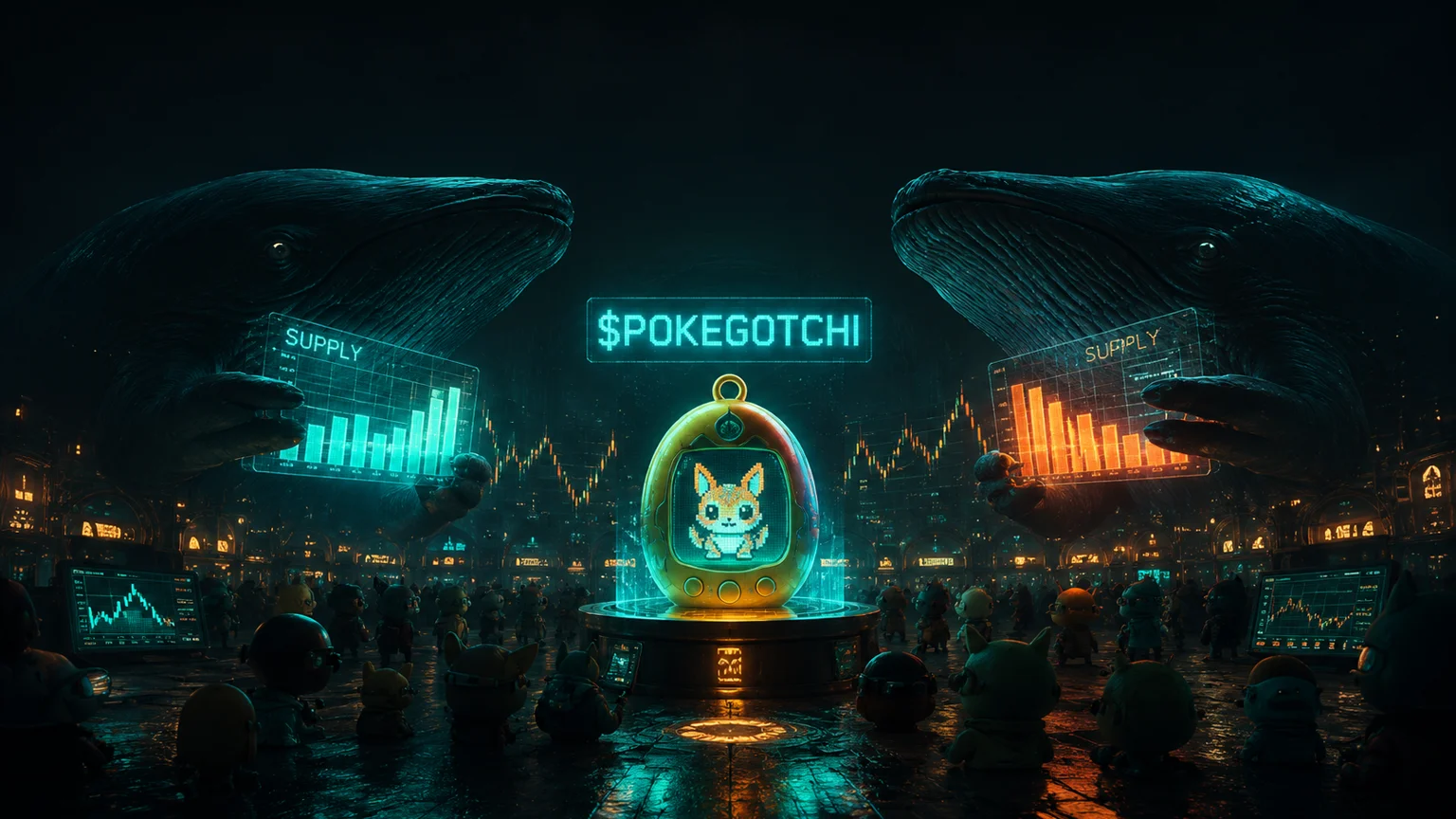
$POKEGOTCHI scores just 1 on Rugcheck with freeze authority disabled and mint authority disabled, so the contract itself looks mechanically clean. The pressure point is ownership: the top two visible wallets alone hold 41.59% of supply, with the top three at about 45.4% combined.
$POKEGOTCHI has exactly the kind of wrapper Solana traders are supposed to love. It is familiar without being stale, cute without trying too hard, and nostalgia-coded in a way that feels instantly legible even if you only glance at the ticker once. That helps explain why the token managed about $191.6K in 24-hour turnover by 7:00 AM UTC on June 6 while sitting near a $52.7K fully diluted value. But the honest editorial read is not that the meme failed to pull a crowd. It is that the crowd showed up to a board where two wallets still matter too much.
That is what makes $POKEGOTCHI worth covering. The contract file is not scary. Liquidity is actually respectable for a token at this size. The one-hour tape even bounced 11.29% after a softer day, which is enough to keep the board from looking dead on arrival. Yet the holder map changes how all of those positives should be interpreted. When the top two visible wallets control more than 41% of supply, every encouraging stat comes with an asterisk. The market can still trade. It just cannot trade freely enough to deserve the same confidence as a cleaner distribution.
- → $POKEGOTCHI was trading near a $52.7K fully diluted value with about $191.6K in 24-hour turnover and roughly $23.2K in liquidity by 7:00 AM UTC on June 6, which is decent business for a pair under four hours old.
- → The board is still alive rather than abandoned. The saved snapshot showed a 60.8% buy ratio, 4,496 total transactions, and an 11.29% one-hour recovery even though the 24-hour line was still down 10.33%.
- → The problem is ownership, not contract permissions. Rugcheck scores the token at 1, freeze authority is disabled, and mint authority is disabled, but the top two visible wallets hold 20.93% and 20.66% respectively.
The Nostalgia Trade Is Working Well Enough to Matter
There is a reason Pokemon-adjacent riffs keep resurfacing in meme markets. They do not need much setup. Traders already understand the emotional palette: collectible culture, childhood recognition, and the built-in tension between cute branding and degenerate speculation. $POKEGOTCHI borrows that recognition cleanly enough to turn a small launch into an understandable bet. You do not need to read a manifesto to know what the board is selling. That alone can generate a meaningful first rotation on Solana, especially when most competing launches are just random nouns hoping for mercy.
The traffic confirms the concept landed at least a little. Roughly $191.6K in turnover on a market cap near $52.7K is not fake attention. It shows the token earned multiple decision points from real traders, not just a single spike from a private room. The 11.29% one-hour recovery matters too because it says buyers were still willing to defend the board after the easiest excitement had already cooled. In other words, $POKEGOTCHI is not only a launch joke. It has become a small live market. The question is whether that market is being built on broad interest or on concentrated ownership wearing a friendly skin.
The Numbers Look Fine Until You Ask Who Owns the Trade
If you only looked at liquidity versus market cap, you could almost talk yourself into a cleaner read. About $23.2K in liquidity against a $52.7K fully diluted value is not luxurious, but it is much sturdier than the microscopic pools that create cartoon percentages on empty order books. That is one reason $POKEGOTCHI remains interesting instead of instantly dismissible. There is enough depth here to support a real intraday trade, and the volume number is large enough to show that traders noticed.
The trouble is that healthy-looking surface stats do not cancel concentrated ownership. A 60.8% buy ratio and nearly 4,500 transactions can still describe a board where too much near-term fate is controlled by too few hands. That is the line traders need to keep straight. The market may be functioning, but it is functioning in a structure where one or two large decisions can rewrite the chart faster than ordinary flow can resist. On a coin with a playful nostalgia wrapper, that kind of concentration is especially dangerous because the branding makes the setup feel safer than it is.
What the On-Chain Data Shows
Mechanically, $POKEGOTCHI looks cleaner than many launches in its neighborhood. Rugcheck scores the token at 1, which is about as calm as a fresh Solana profile gets. Freeze authority is disabled, so there is no obvious transfer-permission trap hanging over the board. Mint authority is disabled too, which removes the quick infinite-supply panic that often forces a downgrade before the chart even has a chance to matter. If this article were only about contract settings, the tone would be much more relaxed.
But contract cleanliness is not the same thing as market fairness. The top visible wallet holds 20.93% of supply and the second visible wallet holds 20.66%. Together they control 41.59%, and the top three visible wallets combine for about 45.4%. That is the kind of holder concentration that can overpower any cute narrative on the screen. Even if none of those wallets are flagged as insiders in the saved profile, their size alone gives them an outsized vote on whether the board can keep trending or whether a bounce becomes someone else's exit liquidity.
This is the key distinction in the $POKEGOTCHI setup. The holder map is the risk. Not freeze authority. Not mint authority. Not a scary Rugcheck number. A trader who only scans for obvious contract red flags could look at this file and conclude the board is safer than it is. A trader who actually reads ownership concentration will understand why the rating stays speculative. The meme can still win. It is just winning on terms that remain heavily influenced by a couple of wallets.
As long as two visible wallets hold more than 40% of supply, $POKEGOTCHI needs stronger market behavior than a normal microcap to justify a cleaner label.
What Would Actually Improve the Read
The path to an upgrade is not mysterious. $POKEGOTCHI would look materially better if the holder base widened, those top wallet percentages drifted lower, and the board kept defending price without needing a perfect mood around the meme. A coin with this kind of brand recognition does not need flawless structure to move higher, but it does need proof that the market is becoming less dependent on concentrated supply. That can happen over time if new participants keep arriving and larger holders distribute responsibly rather than dumping into the first real recovery.
Until that happens, the setup deserves caution even though the meme is clearly tradable. The one-hour rebound proves there is still appetite. The decent liquidity proves the market is not completely hollow. The low Rugcheck score proves the contract itself is not waving obvious danger. Those are all positives. They just sit underneath a concentration profile that can change the tone of the board in one bad decision. That is why $POKEGOTCHI belongs on radar, but not in the clean bucket.
🟡 $POKEGOTCHI earns a speculative holder-concentration read because the meme is sticky enough to generate real traffic and the contract file is mechanically strong, yet too much of the supply still sits in too few visible hands. Rugcheck at 1, disabled freeze authority, disabled mint authority, roughly $23.2K in liquidity, and nearly $191.6K in turnover make this a live board, not a throwaway ghost launch. What blocks a cleaner label is simple: when the top two visible wallets own 41.59% of supply, the chart can never be treated as fully democratic no matter how charming the nostalgia wrapper looks.
FAQ
What is $POKEGOTCHI on Solana?
$POKEGOTCHI is a Solana meme token trading under contract address 6KHeDqkeGc5JKAM9u5UKXZ1uqTeV4o45PAjAruHNpump, built around a Pokemon-adjacent nostalgia meme.
Why is $POKEGOTCHI getting attention?
Because by 7:00 AM UTC on June 6 the token had already pushed about $191.6K in 24-hour volume while holding roughly $23.2K in liquidity, showing that the nostalgia wrapper was strong enough to pull real speculative traffic.
Does $POKEGOTCHI have obvious contract-level danger?
The saved profile looks mechanically clean. Rugcheck scores the token at 1, freeze authority is disabled, and mint authority is disabled.
What is the biggest risk with $POKEGOTCHI?
The largest risk is holder concentration. The top two visible wallets hold 20.93% and 20.66% of supply, which means a couple of wallets can have outsized influence over the near-term chart.
What would improve the $POKEGOTCHI setup from here?
A stronger setup would mean broader wallet distribution, lower concentration across the top holders, and proof that price can stay resilient while the market becomes less dependent on those two oversized wallets.