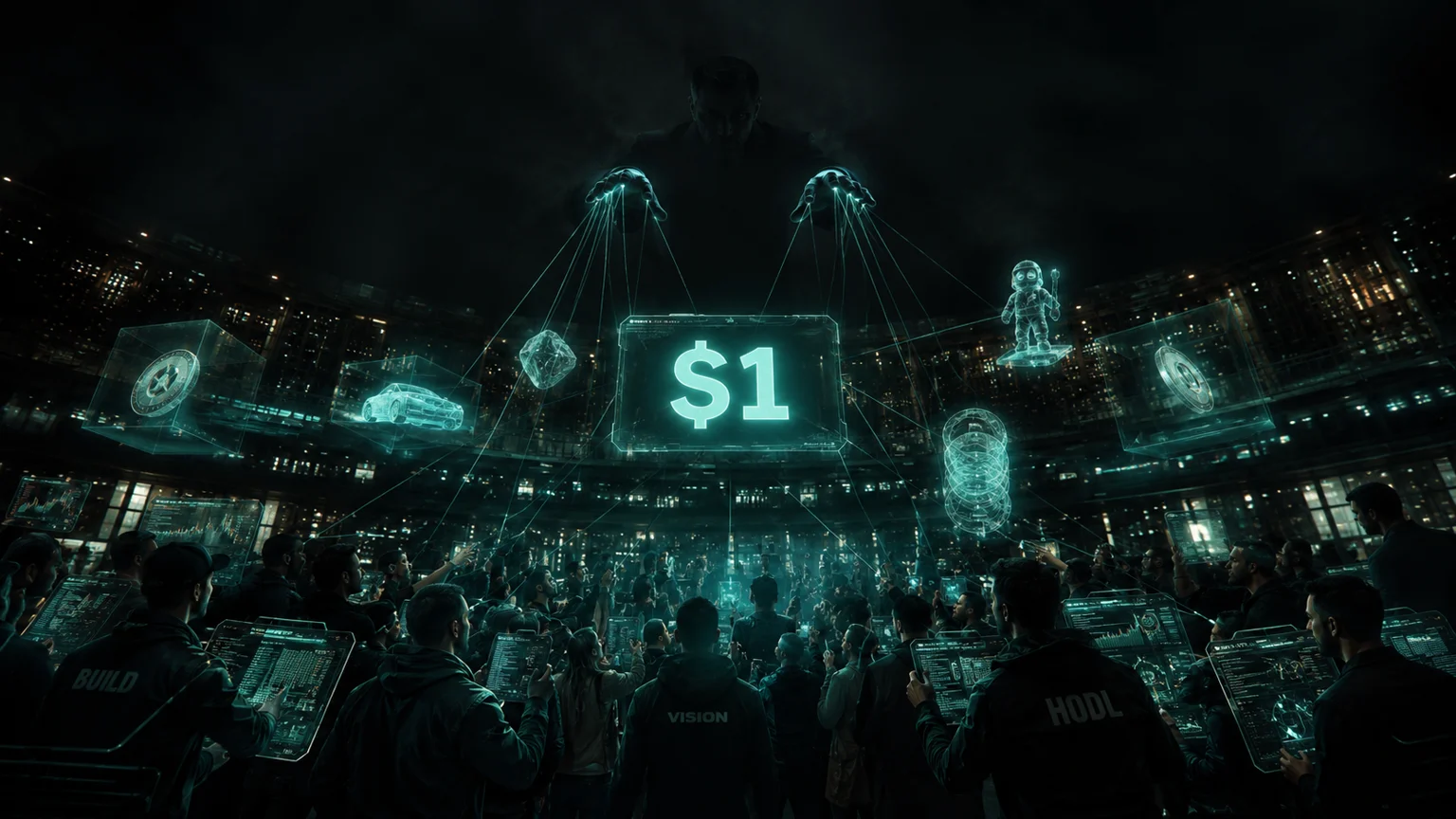
$1 Is Trading Like a Startup Parody That Accidentally Found Real Flow, but the Holder Map Still Controls the Punchline
one.sc pushed roughly $1.33M in 24-hour turnover and nearly 59,000 swaps on Solana while branding itself like an AI 3D startup, yet one wallet still owns 32.2% of supply and keeps the move firmly in speculative territory.
Rugcheck scores $1 at 16 with freeze authority disabled and mint authority disabled, and the creator file does not show a serial-launch warning. The structural issue is concentration rather than contract abuse: one wallet controls 32.2% of supply, the top three wallets hold 38.6%, and liquidity around $63.5K can still get thin quickly if that size decides to leave.
There are plenty of meme coins that move because the name is dumb enough to spread. $1 is doing something a little sharper. The token is tied to one.sc, a site that presents itself like a glossy AI startup promising production-ready 3D assets in one second. That wrapper matters because it gives the board a punchline bigger than the ticker. In the saved snapshot, $1 was trading around a $795.4K market cap with roughly $1.33M in 24-hour turnover, a 2,815% daily jump, and another 70.4% over the latest hour while the pair was already more than 16 hours old. That is no longer a first-candle novelty pop. It is a meme board that found a narrative people can repeat.
The stronger read is not that $1 went vertical. Solana prints vertical charts every day. The stronger read is that this one attached the move to a very specific aesthetic: startup parody, AI gloss, sleek landing-page energy, and a ticker so minimal it looks designed for screenshots. That makes the board easier to market and easier to remember, which helps explain why the transaction count exploded to nearly 59,000 swaps. The problem is that all of this narrative efficiency sits on top of a cap table where one wallet still owns 32.2% of supply. So the story is real, but the power structure above the story is still the thing traders have to price.
- → $1 generated roughly $1.33M in turnover on a $795.4K market cap with 58,883 swaps and a 64.3% buy ratio, which is large enough to treat the move as an actual market event rather than decorative feed noise.
- → The one.sc wrapper gives the board a cleaner identity than the average number meme because it feels like a parody of AI startup culture instead of a random launch with a thin joke and no surface area.
- → Rugcheck scores the contract at 16 with freeze authority disabled and mint authority disabled, but the top wallet still holds 32.2% of supply, which means the holder map can overpower the branding if momentum stalls.
Why the Startup Wrapper Matters
one.sc is not being traded like a generic low-effort ticker. The site makes the whole thing feel closer to a product parody. It talks in the visual language of AI tooling, polished landing pages, and instant output, which is exactly the sort of surface-level sophistication that travels well in meme coin chats. Degens do not need the promise to be literal. They just need the board to feel more finished than the thousand other names trying to fight for the same hour of attention. $1 clears that bar. It looks intentional, and intentionality is a genuine advantage on Solana when half the competition still feels like it was uploaded in a rush.
That design language also helps explain why the ticker can stay sticky even though it is absurdly minimal. A bare number can be forgettable on its own. A bare number attached to a crisp website, a clean brand, and the idea of one-second AI output becomes easier to package. Traders are not just buying $1 as a number meme. They are buying a little cultural mash-up between startup vapor, creator-tool hype, and microcap reflexivity. That is a stronger engine than a plain numeric ticker, and it is why the board deserves more respect than a random same-day bounce.
The Board Is Busy Enough to Be Real
The numbers make the case that this is more than a logo-driven squeeze. Roughly $1.33M of turnover on a sub-$800K market cap means the board recycled well beyond its own size in a single day. That is real churn. The 64.3% buy ratio tells you buyers were willing to stay aggressive while the token kept climbing, and the 58,883 transaction count matters even more because it implies a broad enough participation footprint to keep the chart alive across multiple waves instead of one fast burst. When a meme board prints this much activity, it stops being easy to dismiss as a one-wallet trick.
The liquidity line is where the read becomes less comfortable. Around $63.5K is not nothing, especially compared with the truly microscopic boards that can barely absorb four-figure sells. But it is also not deep enough to make a concentrated cap table irrelevant. On a chart moving this fast, traders tend to focus on volume and ignore exit quality. That is backwards. Volume tells you people care. Liquidity tells you what happens when they stop caring. $1 has enough of the first to matter and not enough of the second to relax.
What the On-Chain Data Shows
Contract-level risk is not the headline problem here. Rugcheck scores $1 at 16, which is not perfect but still reads relatively clean for a young Solana meme board. Freeze authority is disabled, so there is no live admin switch that can suddenly lock transfers. Mint authority is disabled, which removes the classic supply-expansion threat that can poison a hot launch after late buyers arrive. The creator profile also looks quiet in one important sense: the saved data does not show a serial-launch warning or a list of prior creator tokens that would make the deployer file the center of the story.
The holder map is the real pressure point. The top wallet owns 32.2% of supply by itself, while the next two wallets hold 3.81% and 2.63%, leaving the top three near 38.6%. None of those top positions were marked as insiders in the saved profile, and that distinction is worth keeping. Still, markets do not care about labels once size starts moving. A wallet controlling nearly a third of supply has a very different influence over price than the rest of the board, especially when the liquidity base is measured in tens of thousands rather than hundreds of thousands. That is why the on-chain read lands in the middle: mint and freeze look fine, but holder concentration keeps the trade from ever feeling truly open-handed.
The Cap Table Owns the Plot Twist
This is where the editorial angle sharpens. $1 looks like a board the market wants to love because the wrapper is clever and the numbers are loud. But the holder map means somebody else still owns the final edit. When one address controls 32.2% of supply, the public narrative is always conditional. The meme can spread, the chart can climb, and the startup parody can keep recruiting attention, but the board still depends on concentrated size staying cooperative. That is a fragile arrangement even when the contract permissions are clean.
That does not make $1 broken. It makes it reflexive. The best case from here is that turnover stays heavy enough for concentration to matter less over time because more supply rotates into the market and pool depth grows with attention. If that happens, the startup-parody narrative could keep repricing higher because the aesthetic is sticky and the board already proved it can attract real traffic. The worse case is simpler: the story stays funny right up until one large wallet decides the punchline has paid enough. In that version, liquidity matters a lot more than branding, and the exit gets narrower than the chart looked five minutes earlier.
What Would Upgrade the Read
For $1 to move out of the speculative bucket, the board needs structural improvement, not just more excitement. The cleanest upgrade would be deeper liquidity alongside continued high turnover, because that would mean the market is broadening instead of merely spinning faster. A healthier distribution would help as well. If the concentration profile starts to diffuse through actual trading rather than sudden dumps, the startup-wrapper narrative becomes easier to trust as an engine rather than a mask. Until then, the board remains a good example of how a polished meme can deserve attention without earning full confidence.
🟡 Speculative — $1 deserves radar space because the board is genuinely active, the one.sc aesthetic gives it a sharper identity than a plain number meme, and the contract read keeps freeze authority disabled, mint authority disabled, and Rugcheck risk at a manageable level. It stays speculative because one wallet still owns 32.2% of supply and the top three wallets hold 38.6%, which means the move is still living under a concentrated cap table even while public momentum looks strong.
FAQ
What is $1 on Solana?
$1 is the meme token tied to one.sc on Solana, trading under contract address BHSKdQQ8mrjtSkMwpgzGedEbTMWuHwXq7x5VSkispump. In the saved snapshot it was priced around $0.0007954 with a market cap near $795.4K.
Why did $1 land on launch radar?
Because the board combined a distinctive startup-parody wrapper with large market activity. The saved signal showed roughly $1.33M in 24-hour volume, a 2,815% daily move, a 70.4% one-hour gain, and 58,883 total swaps.
Is the $1 contract showing major permission risk?
The saved on-chain profile is relatively clean on permissions. Freeze authority is disabled, mint authority is disabled, and Rugcheck scored the contract at 16.
What is the main risk on $1 right now?
Holder concentration. The top wallet controls 32.2% of supply and the top three wallets hold 38.6%, which is a lot of influence for a board with roughly $63.5K of liquidity.