$MEMEFI Turns a One-Hour Pump.fun Graduate Into a Volume Test
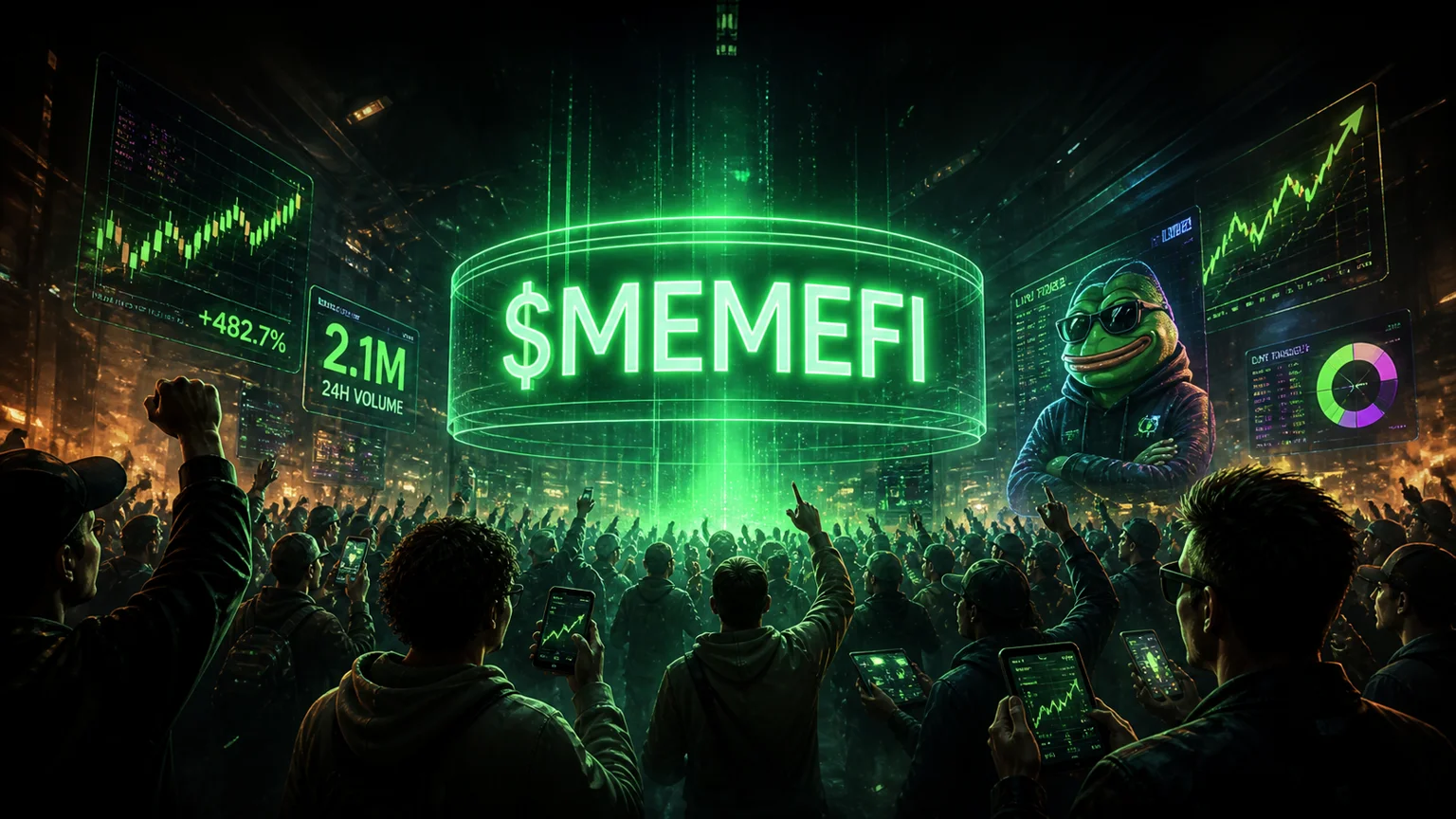
$MEMEFI printed more than $2.1M in 24h volume within roughly 90 minutes of market life, making the Solana launch less about the name and more about whether real demand can survive the first rush.
No major concentration risks in the top-three holder sample, with mint authority and freeze authority disabled at the latest check.
$MEMEFI is the kind of Solana launch that forces a second look because the market is not only bidding the chart. It is stress-testing attention. The token came through pump.fun, hit the market with roughly 90 minutes of age on the latest snapshot, and still pushed more than $2.1M in 24h volume against a market cap near $272K. That is an unusual amount of turnover for a token this small. The important question is whether that churn is distribution, discovery, or both.
The name helps, but not in the usual mascot way. $MEMEFI sounds like a shortcut for the whole game: meme liquidity, fast communities, low-friction launches, and traders moving before the story has had time to become coherent. That does not make it a durable asset. It does make the first tape more useful than a quiet launch with a cleaner-looking chart. When a sub-$300K market cap token does more than seven times its market cap in reported daily volume, the trade is already being fought in public.
- → $MEMEFI was trading near a $272K market cap with about $32.5K in liquidity at the latest snapshot.
- → The 24h volume print was roughly $2.17M, with more than 41,000 transactions recorded across the period.
- → The on-chain profile is cleaner than most first-hour meme launches: mint authority is disabled, freeze authority is disabled, Rugcheck score is 1, and the top three listed holders control about 14.7%.
The Angle Is Volume Before Story
Most tiny meme launches ask traders to buy a premise. $MEMEFI is different because the premise is almost irrelevant in the first read. The volume arrived before a mature narrative did. That can be powerful, because early meme markets often reward tokens that become a meeting point for attention rather than tokens with the cleverest lore. It can also be dangerous, because enormous volume against thin liquidity means every candle is a negotiation between new buyers, early wallets, and anyone who got positioned before the first public chase.
The latest one-hour move was about 68%, while the six-hour and 24-hour windows showed gains above 2,000%. Those percentages are less useful as a promise than as a warning about speed. A move that violent can reset in minutes if buyers stop refreshing the order book. But the size of the transaction count matters. More than 10,800 buys and 9,400 sells appeared in the latest one-hour sample, which means the chart was not sitting on a few lazy prints. There was a real fight for inventory.
What the On-Chain Data Shows
The Solana checks are the reason $MEMEFI gets a cleaner initial read rather than a default caution tag. Freeze authority is disabled, mint authority is disabled, and the deployer wallet is not showing a token balance in the provided profile. Rugcheck returned a score of 1, which is unusually low-risk for this part of the market. The top holder in the sample controls about 8.96%, while the next two hold about 3.04% and 2.69%. Together, the top three sit near 14.7%, with no insider flags shown in that group.
That does not remove the meme-coin risk. It simply changes which risk matters most. The contract profile is not the obvious problem right now. The market structure is. About $32.5K in liquidity is not deep when the token is printing more than $2M in turnover. A modest sell cluster can move price hard, and a buy wave can overstate strength just as quickly. In plain terms, $MEMEFI looks less like a classic contract trap and more like an early liquidity test where the crowd has to prove it is not only flipping the same float back and forth.
Why Degens Are Watching
The watch case is not complicated: if $MEMEFI can hold a market cap in the low six figures while volume remains seven figures, it becomes a live candidate for another repricing attempt. That is the clean version of the setup. A token does not need a massive treasury, a celebrity post, or a complicated roadmap to matter during the first day. It needs enough traders to believe the next buyer is still out there. The current buy ratio near 53.4% is not euphoric, but it does show demand remained slightly ahead of supply during the snapshot.
The better signal would be compression without collapse. If $MEMEFI cools off, keeps holders above the current 1,700 area, and does not bleed liquidity, that would suggest the launch found a base instead of only a peak. If the chart keeps rising while liquidity stays nearly unchanged, the risk rises because price can outrun the exit door. For now, the cleanest read is that the token has enough organic-looking activity to watch, but not enough depth to treat the move as settled.
$MEMEFI can have a clean authority profile and still punish late entries. Thin liquidity plus seven-figure churn means slippage, fast reversals, and early-wallet exits remain the real threats. The first danger is not a mint switch; it is the crowd losing interest before liquidity catches up.
The cleanest bullish version would be boring for a while: lower candle range, steady wallet growth, and liquidity inching higher instead of price alone doing the work. That would show the first wave did not simply exhaust itself. The weaker version would be louder volume with fewer holders and no liquidity improvement, because that is usually a sign that the same supply is being recycled through a shrinking crowd. $MEMEFI has earned attention, but the quality of the next base matters more than another vertical candle.
The Next UTC Checkpoint
The next useful checkpoint is the next few UTC hours of holder and liquidity behavior. If holders keep climbing while the market cap avoids a full retrace, $MEMEFI starts to look like a real culture-meme bid rather than a one-window explosion. If liquidity drains or the buy ratio flips hard while volume stays high, the same data becomes a warning that the token is being used as exit flow. That is why the volume anomaly matters: it gives traders a signal, but it also gives early sellers the exact crowd they need.
$MEMEFI earns a clean launch-radar read because the contract-facing checks are better than average, the top-holder sample is not extreme, and the market produced real transaction density almost immediately. The trade is still highly speculative because liquidity is thin relative to volume. This is a watchlist signal, not a safety claim.
What is $MEMEFI?
$MEMEFI is a Solana meme token launched through pump.fun and tracked after a rapid early volume surge.
Why is $MEMEFI on MemeDesk radar?
The token combined a roughly $272K market cap with about $2.17M in 24h volume, 1,700 holders, and disabled mint and freeze authority.
What is the biggest risk?
Liquidity is the main risk. Around $32.5K in liquidity is thin compared with the reported trading volume, so price can move violently in either direction.