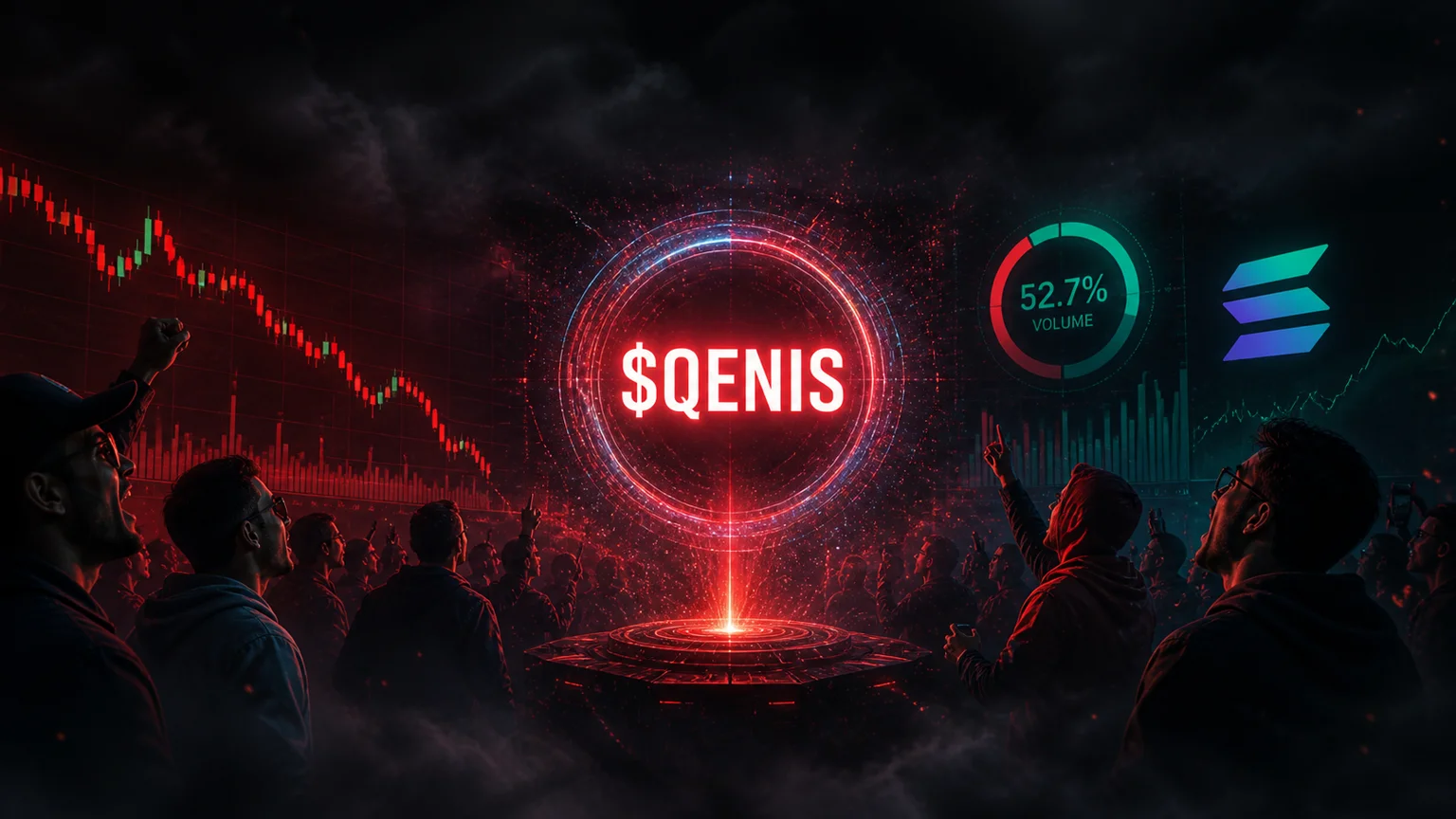
$QENIS Is Holding a $2.4M Meme Bid After the First Flush
$QENIS is seven days old, down on the day, and still turning over more than half its market cap in volume. That makes the Solana launch less of a clean breakout and more of an organic volume anomaly worth watching closely.
Mint and freeze authority are disabled, no listed Rugcheck risks are present, and the top three holder wallets control about 15.8% of supply.
$QENIS is not giving the market a simple green-candle story. The Solana meme is roughly seven days removed from its pump.fun launch, sitting near a $2.42M market cap, and still moving enough size to make the tape worth reading instead of ignoring. The uncomfortable part is that the 24-hour chart is red: about -20.1% at the latest snapshot. The useful part is that buyers have not fully left. The one-hour move is still positive, the six-hour move is still positive, and 24-hour volume is around $1.57M against roughly $348K in liquidity. That combination is messy, but it is not dead.
That is the editorial angle on $QENIS: organic volume anomaly after the first flush. Plenty of Solana launches look exciting when the initial chart is vertical. Fewer still matter after the first heavy sell window, when early entries have had a chance to take profit and late buyers start deciding whether the meme has a second act. $QENIS is now in that middle zone. It is not early enough to pretend nobody has touched it, but it has not bled into silence either. The question is whether the market is seeing a resilient meme bid or a slower distribution pattern dressed up by active turnover.
- → $QENIS is trading around a $2.42M market cap with about $1.57M in 24-hour volume, a high turnover read for a one-week Solana meme.
- → The token is down about 20.1% over 24 hours, but the one-hour and six-hour snapshots are still green, suggesting the first flush has not ended participation.
- → Mint authority and freeze authority are disabled, Rugcheck shows a low score, and the top three listed holders control about 15.8% of supply.
The Trade Is Past Easy Mode
A fresh meme can look clean before it has been tested. $QENIS has already been tested at least once. A -20.1% 24-hour move means there has been real selling, not just a harmless pause after launch. For a weaker token, that is usually where volume collapses, spreads widen, and the chart starts trading like a private joke between trapped holders. $QENIS has not shown that full breakdown in the available snapshot. Daily volume is still more than half the market cap, buys and sells over the latest hour are close enough to call it an active two-sided market, and liquidity is deep enough that the chart has a real order book to fight over.
The risk is that heavy volume cuts both ways. It can mean demand is broadening, but it can also mean the same tokens are changing hands while earlier buyers quietly use every bounce as an exit. That is why the current $QENIS read should stay speculative. The market is not being asked to believe in a roadmap or a polished brand. It is being asked to decide whether a meme with a strange name, a pump.fun origin, and a still-active chart can keep attracting attention after the first obvious momentum trade has already happened.
Why This Still Made the Radar
The strongest part of the $QENIS setup is the mismatch between drawdown and activity. At roughly $2.42M market cap, $1.57M in 24-hour volume is not background noise. It means the token is being repriced repeatedly rather than drifting. The liquidity pool, around $347.97K, gives traders enough room to enter and exit without treating every transaction like a coin flip, while still leaving the token small enough for volatility to dominate the chart. That is exactly where many Solana meme trades either mature into broader watchlist names or get exposed as one-session churn.
$QENIS also has a cleaner-than-average mechanical read for this stage. There are about 3,959 holders in the latest data, the buy ratio is close to balanced at roughly 52.3%, and the token carries a high organic label from the available market data. None of those facts make the token safe. They do, however, separate it from the lowest-quality launches where the entire story is a thin pool, a handful of wallets, and one suspicious candle. $QENIS has enough participation to deserve a second look and enough downside pressure to keep the rating out of the clean bucket.
What the On-Chain Data Shows
The on-chain profile is the reason $QENIS does not read like an automatic avoid, even with the daily candle under pressure. Rugcheck data shows mint authority disabled and freeze authority disabled, which removes two of the ugliest immediate control risks for a Solana launch. The normalized rug score shown in the profile is 1, and the selected risk list is empty. That does not mean the trade is protected from a dump, a liquidity pull elsewhere in the market, or a sudden attention collapse. It means the available contract controls are not screaming the obvious warnings that usually define the worst launch-radar names.
Holder concentration is also more measured than the worst pump.fun tapes. The largest listed holder sits around 10.32%, while the next two listed wallets are around 3.33% and 2.15%. Together, the top three concentration is about 15.8%. That is still meaningful. One large wallet can pressure a chart this small, especially when liquidity is under $350K and retail starts chasing the same candle. But it is not the kind of 50% holder wall that turns every green candle into a hostage situation. For $QENIS, the more relevant holder question is whether those larger wallets are patient enough to let the market rebuild after the first flush.
The dev profile is quiet in the data. The listed dev wallet is HA5v73BPSQZ5KT5vGJghRmsa8pdkw5hPLnsUhD6yrf2, creator token count is shown as zero, and no creator-token trail is listed. That is worth mentioning precisely because there is no need to overstate it. A quiet creator history can be cleaner than a serial deployer pattern, but it is not a guarantee of future behavior. In this case, the deployer data supports the speculative watchlist read rather than becoming the main story. The story is still market activity, holder shape, and whether a post-flush meme bid can keep rotating.
The Bear Case Is the Same Reason It Is Tradable
The bear case for $QENIS starts with the 24-hour decline. A token can have plenty of volume and still be distributing. In fact, that is often how distribution looks from the outside: every dip gets bought, every bounce gets sold, and the market mistakes motion for demand until the next leg down makes the answer obvious. The current data has enough activity to keep the token alive, but it does not prove fresh capital is overpowering supply. If the next few UTC sessions show volume staying high while price grinds lower, the anomaly stops looking organic and starts looking like exit liquidity with better branding.
Liquidity is another double-edged number. Around $347.97K is strong compared with many tiny Solana memes, but it is still small relative to the kind of daily turnover $QENIS is printing. A few impatient wallets can move the chart quickly. The top holder above 10% is not an automatic alarm by itself, but it is large enough to matter if sentiment thins out. The disabled mint authority and freeze authority reduce contract-control risk, yet they do not solve market-structure risk. For meme traders, that distinction matters. Clean permissions do not stop a crowded trade from unwinding.
$QENIS has the kind of data that deserves attention, not blind confidence: high turnover, real liquidity, a cleaner authority profile, and a red daily chart that still needs to prove it can absorb supply.
What Would Upgrade the Read
For $QENIS to move from speculative watch to cleaner signal, the market needs to show that the rebound is not just a pause inside a broader selloff. The cleanest version would be simple: price stabilizes above the post-flush range, daily volume remains strong without needing panic churn, liquidity holds near or above current depth, and holder count continues expanding. If that happens, the token starts to look less like a launch that survived its first dump and more like a meme that found a durable audience after the initial hype cycle.
The weaker version is just as easy to define. If the token keeps printing high volume while market cap slides, the active tape becomes a warning instead of a strength. If liquidity drops, the exit door gets narrower. If larger holders start pressing the bid, the relatively clean concentration read becomes less comforting. $QENIS is in a window where the next data points matter more than the origin story. The meme has already earned attention. Now it has to show that attention is not only useful for early sellers.
$QENIS earns a speculative launch-radar read. The token has real liquidity, unusually active 24-hour volume, a high organic score, disabled mint and freeze authority, and a holder map that is not flashing the worst concentration signals. The problem is the daily drawdown. A $2.4M meme down 20% in 24 hours can be either a healthy reset or the first clear sign that supply is winning. Until $QENIS proves it can hold attention without bleeding market cap, this is an anomaly to watch rather than a clean momentum stamp.
What is $QENIS?
$QENIS is a Solana meme token launched through pump.fun, with the contract address EkcTa8n14fXcHdfvZqCg72cTCutJnnKb19vcHwKTpump.
Why is $QENIS on MemeDesk radar?
$QENIS is trading near a $2.42M market cap with about $1.57M in 24-hour volume, roughly $348K in liquidity, and continued short-term buying after a sharp 24-hour pullback.
What does the on-chain profile show?
The available Rugcheck profile shows disabled mint authority, disabled freeze authority, a low rug score, no listed risk flags, and about 15.8% concentration across the top three listed holders.
What is the biggest risk for $QENIS right now?
The biggest risk is that high activity masks distribution. If volume stays elevated while price keeps sliding, $QENIS starts looking less like resilient demand and more like a crowded exit.