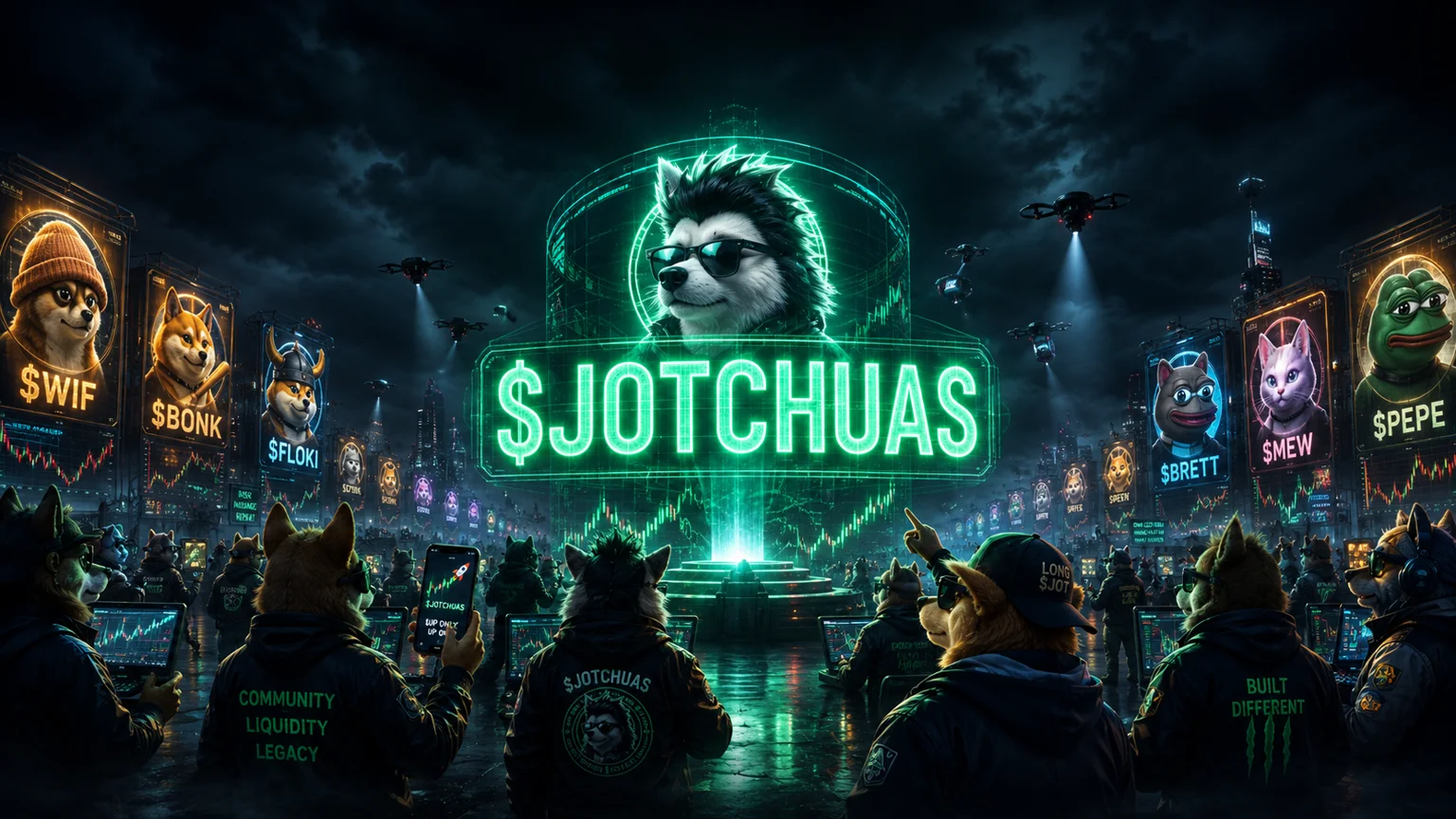
$JOTCHUAS Is Catching a Real Solana Bid, but the Bigger Question Is Whether the Jotchua Meme Family Still Has Room for One More Winner
At the 2026-06-09 22:04 UTC selection snapshot, $JOTCHUAS was trading near a $93.1K market cap on roughly $962.5K in 24-hour volume with a 66.5% buy ratio, yet the latest one-hour move was down 33.4%. The holder map looks much looser than many first-night Solana launches. The harder problem is narrative saturation: when the meme family keeps spawning new tickers, every buyer has to decide whether they are early to the next branch or late to the franchise.
$JOTCHUAS has a calmer contract shell than many same-session Solana launches, with freeze authority disabled, mint authority disabled, and a Rugcheck score of 16. The bigger risk is not admin control. It is whether traders keep rewarding another Jotchua-family ticker once the first easy meme recognition trade has already happened elsewhere.
$JOTCHUAS is not trading as if it needs a long explanation. By the 2026-06-09 22:04 UTC selection snapshot, the Solana token was sitting near a $93.1K market cap on roughly $962.5K in 24-hour volume with 71,228 total transactions and a 66.5% buy ratio. Those are not the numbers of a board no one noticed. They are the numbers of a ticker that got passed around aggressively because traders immediately understood the joke and believed somebody else would understand it too. In meme markets, that kind of instant legibility is half the battle.
The problem is that instant legibility is also what creates crowding. $JOTCHUAS does not exist in a vacuum. It lands in a stretch of the Solana meme tape where Jotchua-family variants have already shown they can command attention. That gives this board a gift and a handicap at the same time. The gift is recognition. The handicap is comparison. Every buyer has already seen at least some version of the trade, which means this chart gets judged less on novelty and more on whether it can become the preferred branch of an already-circulating meme family. That is why the cleanest editorial angle here is cashtag collision, not simple launch excitement.
- → $JOTCHUAS traded about $962.5K in 24-hour volume by 2026-06-09 22:04 UTC against a market cap near $93.1K, which is enormous turnover for a pair only around 8.33 hours old.
- → The flow still leaned bullish in aggregate, with 47,343 buys against 23,885 sells, but the latest one-hour move was down 33.4%, showing the market already testing whether the meme family can support another board after the first rush.
- → On-chain structure is relatively calm: freeze authority is disabled, mint authority is disabled, Rugcheck scored the token 16, and the top three visible wallets account for only about 16.1% of supply.
Why the Family Trade Still Pulls Money
Derivative meme families keep working because they lower the cognitive load for speculators. Nobody has to learn a whole new mythology before deciding whether to buy. A familiar naming pattern can do the marketing work immediately. $JOTCHUAS benefits from that shortcut. The market does not need to ask what kind of board this is. It can place the ticker instantly inside a known pocket of internet absurdity and then decide whether this specific branch looks tradeable. When the cap is still under $100K, that speed of recognition matters more than almost anything a team could say in a thread.
But recognition is not the same thing as ownership. The hardest part of a derivative meme launch is becoming the version traders keep, not just the version they sample for an hour. A crowded meme lane can still mint a winner if one token becomes the cleanest expression of the joke, the easiest ticker to repeat, or the board with the best chart at exactly the right time. That is the open question around $JOTCHUAS. The market has already proven that the family theme works. It has not yet proven that this is the branch it wants to carry forward once fast money starts thinning out.
Where the Tape Starts Arguing With Itself
The numbers tell a more interesting story than the headline move alone. A 66.5% buy ratio and nearly a million dollars of daily turnover say the board found broad appetite fast. A 33.4% drop in the latest hour says appetite was not enough to keep the token in a straight line once some early buyers had meaningful profit. That combination usually marks the transition from discovery to argument. During discovery, everybody is mostly reacting to the same signal: the board is moving. During argument, traders start splitting into camps over whether the meme still has room, whether better variants already exist, and whether the cap deserves another expansion after the easiest move has been printed.
Liquidity changes the character of that argument. At about $22.4K, the pool is better than some same-session pump.fun experiments but still nowhere near deep enough to make this a forgiving market. $JOTCHUAS has enough liquidity to support real speculation. It does not have enough to protect anyone from a rush for the door. That means the tape can remain appealing to nimble traders while still being punishing for anyone confusing transaction count with durability.
The Part That Actually Looks Cleaner
This is where $JOTCHUAS earns some respect. For a board fighting inside a crowded narrative lane, the structure is better than average. The top visible wallet controls 12.52% of supply, while the next two largest visible balances sit at just 1.82% and 1.77%. A top-three concentration of roughly 16.1% is dramatically easier to live with than the landlord-style distributions that suffocate many first-day microcaps. It does not make the token safe. It does make the market feel more like a real crowd and less like a hostage situation.
That cleaner holder layout matters because it shifts the debate away from obvious manipulation and toward actual narrative quality. When a board has both a weak holder map and a derivative concept, the answer is easy: ignore it. $JOTCHUAS is more annoying than that in a good way. It has enough structural integrity to stay in the conversation. So traders have to answer the harder question instead: is this just another franchise offshoot catching a temporary echo bid, or is it the one that can outlast the first round of comparison shopping?
$JOTCHUAS upgrades from a fast derivative trade into a stronger watchlist name only if later UTC snapshots show the hourly damage stabilizing while liquidity builds and the holder map stays loose. If the board keeps slipping every time profit-taking appears, the family-recognition edge will not be enough on its own.
What the On-Chain Data Shows
The on-chain file is straightforward in the ways that matter first. Freeze authority is disabled, so there is no obvious transfer-freeze lever hanging over the board. Mint authority is disabled too, which removes the easy supply-expansion nightmare that can break confidence instantly. Rugcheck scored $JOTCHUAS at 16, not a perfect read but still calm enough for a same-session Solana launch. The developer profile did not show a serial deployer résumé or a long list of extra creator tokens that would force a darker interpretation. Put simply, the contract shell is not the reason to be nervous here.
The real on-chain conclusion is that the token has enough structural breathing room to let market psychology decide the next move. Holder concentration is relatively low, freeze and mint permissions are not obvious threats, and the market cap is still small enough that fresh demand could move it hard if traders decide this is the Jotchua branch worth defending. But that same low market cap also means the narrative has to keep earning attention. A clean shell and a loose holder map can give $JOTCHUAS a chance. They cannot manufacture uniqueness once the market starts asking whether one meme family needs yet another ticker.
Why the Read Stays Speculative
The bull case is obvious enough: the board is cheap, busy, and cleaner than many first-night launches, and meme families often surprise people by supporting more than one winner at a time. If $JOTCHUAS keeps processing heavy turnover while the hourly chart calms down, traders can easily decide the earlier pullback was just a reset inside a still-healthy discovery phase. The chart does not need universal conviction. It only needs enough participants deciding that the next branch of a familiar joke is still underpriced.
The bear case is more subtle than a rug warning. It is saturation. Once a meme family starts proving it can produce multiple tradeable tickers, buyers become less loyal and more opportunistic. That can be fine during the first surge, when everyone is racing for exposure. It becomes a problem later, when the market starts ranking which version deserves to survive. $JOTCHUAS has enough going for it to stay alive in that contest. It has not yet proven it can win it.
🟡 Speculative — $JOTCHUAS has real things going for it: about $962.5K in 24-hour volume, a 66.5% buy ratio, roughly $22.4K in liquidity, disabled freeze authority, disabled mint authority, and a top-three holder map near just 16.1%. The reason it stays speculative is not obvious contract ugliness. It is the combination of a 33.4% hourly pullback and a meme lane that is already crowded with related Jotchua variants. The board looks tradeable. It still has to prove it is memorable.
What is $JOTCHUAS on Solana?
$JOTCHUAS is the Solana meme token Jotchuas Maximus under contract address 7buoMnvsxcDyPrdMLAkqtnXjc3ZjN7XYeyXuUU5opump. At the 2026-06-09 22:04 UTC selection snapshot it was trading near a $93.1K market cap.
Why did $JOTCHUAS make launch radar?
Because it paired roughly $962.5K in 24-hour volume with a sub-$100K market cap, a 66.5% buy ratio, and more than 71,000 total transactions while the pair was only around 8.33 hours old.
Does $JOTCHUAS look clean on-chain?
Relatively clean by first-session meme standards. Rugcheck scored $JOTCHUAS at 16, freeze authority is disabled, mint authority is disabled, and the top three visible wallets account for only about 16.1% of supply in the saved profile.
What is the main risk on $JOTCHUAS right now?
Narrative crowding more than contract design. The latest hour in the saved snapshot was down 33.4%, and the market has already seen multiple Jotchua-family variants, so traders may rotate to whichever branch feels freshest next.
What would improve the $JOTCHUAS thesis from here?
Later UTC snapshots showing the hourly chart stabilizing, liquidity increasing, and the holder map staying loose while turnover remains strong. That would suggest the token is becoming the preferred version of the meme rather than just another short-lived derivative.