$HOODRAT Has the Tape for a Real Solana Follow-Through, but a Cashtag Collision Keeps the Read Honest
At the 2026-07-09 16:05 UTC selection read, the Solana version of $HOODRAT was trading near an $89.9K market cap with roughly $964.1K in 24-hour volume and about $24.3K in visible liquidity. The tape is strong enough to matter, but the same cashtag is also active on Robinhood chain, which makes every bullish mention harder to trust.
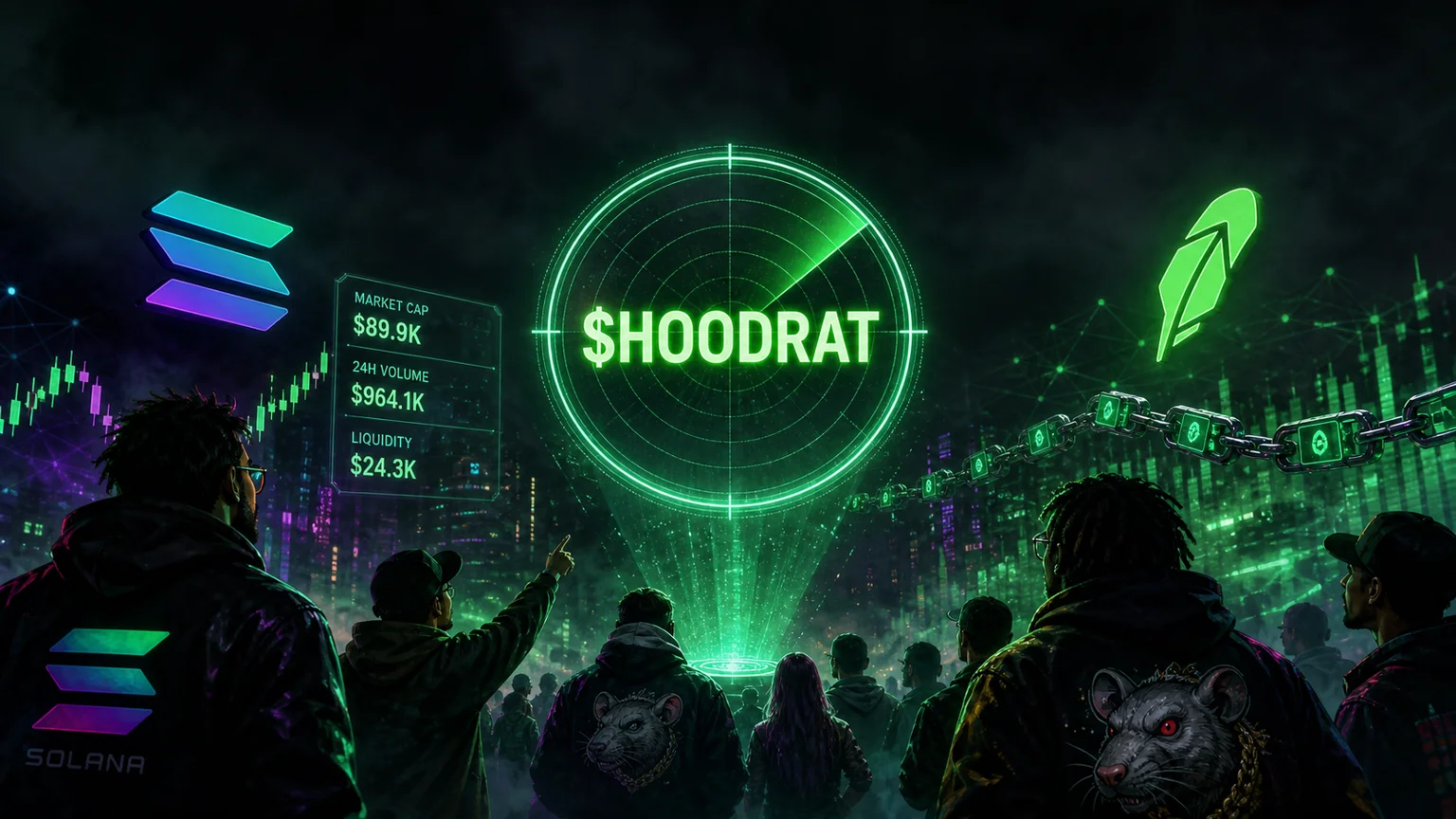
The saved on-chain profile for the Solana $HOODRAT board is cleaner than the average fresh launch: freeze authority is off, mint authority is off, Rugcheck scores it at 1, and the top three visible wallets account for about 20.9% of supply. The harder problem is not the contract shell. It is whether the board can keep social attention when the same $HOODRAT ticker is also trading on Robinhood chain.
The Solana version of $HOODRAT has a better chart than the discourse around it. By the 2026-07-09 16:05 UTC selection read, the board was sitting near an $89.9K market cap with roughly $964.1K in 24-hour volume, around $24.3K in visible liquidity, and a 287% daily move. Those are lively numbers for a board that was only about 29 hours old. Traders were not just glancing at the ticker. They were using it. The reason this still lands as a yellow read instead of a clean green one is that the same $HOODRAT cashtag is also active on Robinhood chain, so every bullish mention has to clear one more question than usual: which board is the crowd actually talking about?
That ambiguity matters more than it sounds. Most fast Solana launches live or die on whether attention can translate into clean execution before the next meme steals the room. When a ticker is split across chains, social demand gets fuzzier. Some buyers chase the symbol, some chase the chain they already prefer, and some assume everyone is talking about the same thing when they are not. $HOODRAT is interesting because the Solana tape itself has done enough to deserve attention. The problem is that attention has to travel through a noisier pipe than usual.
- → The Solana $HOODRAT board pushed roughly $964.1K in 24-hour volume on an $89.9K market cap, which is big enough flow to keep the launch on radar instead of letting it fade into first-day noise.
- → The saved on-chain profile is cleaner than the average fresh meme sprint: freeze authority is off, mint authority is off, Rugcheck scores the contract at 1, and the top three visible wallets account for about 20.9% of supply.
- → The harder read is social, not mechanical. A fresh @gem_insider post mentioned $HOODRAT while also asking about Robinhood chain launches, and the same ticker is active on Robinhood chain, which turns a potential KOL tailwind into a cashtag-collision test.
Why the Chart Still Deserves Respect
It would be lazy to dismiss this as just another confused multi-chain ticker because the Solana board has already printed real evidence of demand. Nearly a million dollars in 24-hour turnover against an $89.9K market cap means the market is revisiting the pool repeatedly, not just tagging it for one novelty candle and leaving. The transaction count matters too. Roughly 18,325 trades in the same window tells you this was not a quiet little insiders' pocket. The board got touched from multiple directions, which is what keeps it relevant after the earliest launch adrenaline should have started cooling.
The 53.2% buy ratio is not euphoric, but it is healthy enough for the context. On a token this small, an extreme buy ratio can be a warning that the market is one-sided and unstable. A more balanced tape with strong turnover often means the board is liquid enough to trade instead of only liquid enough to pump. At roughly 29 hours old, this is also past the easiest novelty phase. If the board were completely fake, the tape would usually look emptier by now.
What the On-Chain Data Shows
The contract layer is calmer than the social layer. Freeze authority is off. Mint authority is off. Rugcheck scores the Solana contract at 1 and the saved report does not attach any obvious risk entries. That immediately removes two of the dumbest ways a first-day Solana meme can embarrass late buyers. If this board fails, the likely failure mode is ordinary market structure, not a cartoonishly hostile contract shell waiting to spring shut.
Holder concentration also looks better than the average micro-cap scramble. The top visible wallet sits at 14.6%, while the next two visible holders are 3.25% and 3.07%, leaving the top-three cluster around 20.9%. That is not perfect dispersion, and on a shallow pool every large wallet still matters, but it is materially cleaner than the setups where three rows quietly control half the game before CT even notices the ticker. The saved creator history is also blank, with zero prior creator-token count surfaced in the report. There is no serial-launch backstory hijacking the read and no obvious admin authority looming over the market.
This is why the article angle cannot be rug risk. On-chain, the Solana board has already passed the easy disqualifier checks. The real issue is that a clean shell does not rescue a confused narrative. A board can be mechanically tidy and still underperform if social demand keeps scattering across two different assets that share the same ticker.
The Cashtag Collision Is the Whole Editorial Problem
The social complication is not theoretical. A tier-one CT account, @gem_insider, posted about $HOODRAT at 2026-07-09 10:04 UTC while also asking followers for more interesting Robinhood chain launches. In isolation, that looks like a bullish touch. In context, it is fuzzier. The same cashtag already has an active Robinhood chain board with meaningfully higher market cap and stronger absolute liquidity. That does not invalidate the Solana move, but it changes how traders should read every mention.
Sometimes a cashtag collision helps the smaller board because confusion itself becomes a demand source. Traders see attention piling onto the symbol and ape the version easiest for them to access. But that same mechanic is why the signal stays speculative. Demand born from confusion has a short half-life. It works until the market notices the mismatch, at which point social fuel can leak as quickly as it arrived.
This is also why the Solana board's otherwise solid tape matters so much. If $HOODRAT had weak flow and thin participation, the cashtag collision would be enough to ignore it. Instead, the board has enough turnover to make the ambiguity tradable. The chart is doing real work on its own. That creates a sharper decision for degens. Are they looking at a small-cap Solana board that can stand independently once the confusion fades, or are they watching a temporary beneficiary of multi-chain ticker noise? The next session will answer that more clearly than any hot take can.
The Solana $HOODRAT setup is not getting downgraded because the contract looks dirty. It is getting downgraded because social demand is harder to trust when the exact same ticker is competing for attention on another chain at the same time.
What Would Turn This Back Into a Cleaner Read
The easiest upgrade path is simple: the Solana board needs to keep printing independent strength after the ticker confusion becomes common knowledge. That means holding useful turnover, thickening liquidity, and staying active without needing every new mention to do the explanatory work. If the market continues treating this as the version worth trading even after traders understand there are two $HOODRAT boards in circulation, then the Solana launch earns more respect precisely because it survived a handicap most small memes would not survive.
The downgrade path is just as clear. If volume starts fading, if the pool stays shallow, or if the next burst of attention appears to belong mainly to the Robinhood chain version, then the current chart strength will look more like borrowed oxygen than durable demand. That is the right way to frame risk here. The board is not one scary wallet away from instant death. It is one failed social handoff away from proving that clean tape alone was not enough to overcome the naming mess.
🟡 Speculative — the Solana version of $HOODRAT has a stronger chart than a typical sub-$100K meme launch, with roughly $964.1K in daily turnover, a 287% 24-hour move, and an on-chain profile that looks clean at first pass with freeze authority off, mint authority off, and a Rugcheck score of 1. The yellow tag stays because the social read is compromised by a live cashtag collision: the same $HOODRAT ticker is active on Robinhood chain, and even the clearest recent KOL touch arrived in a context that blurred which board was getting the real vote of confidence.
What is the Solana version of $HOODRAT?
It is the Solana meme token Hood Rat trading under contract 9motHbNmm4Km8u7VYGhg6xJWN5Ro9XDKYmEkaMMYpump.
Why is $HOODRAT getting attention on July 9?
Because at the 2026-07-09 16:05 UTC selection read, the Solana board had already pushed roughly $964.1K in 24-hour volume on an $89.9K market cap while still showing active two-way flow and a live KOL-adjacent social tailwind.
What does the on-chain profile look like for the Solana $HOODRAT board?
The saved profile showed freeze authority off, mint authority off, a Rugcheck score of 1, and about 20.9% concentration across the top three visible wallets, which is cleaner than many fresh Solana meme launches.
Why is the rating speculative instead of clean?
Because the tape looks solid, but the market has to sort out a live cashtag collision with another $HOODRAT board on Robinhood chain. That makes every social mention harder to trust as chain-specific conviction.
Where can traders verify the Solana $HOODRAT contract?
The quickest check is on DexScreener at the Solana pair page tied to contract 9motHbNmm4Km8u7VYGhg6xJWN5Ro9XDKYmEkaMMYpump, which is the version discussed in this article.