
$GLUE Repriced Too Fast to Ignore After an Early Wallet Buy, but the Next Solana Leg Still Needs Broader Hands
$GLUE was trading around a $193.3K market cap with roughly $297.3K in 24-hour volume and about $31.2K of liquidity by 2026-06-25 07:15 UTC, hours after a watched wallet tied to @KayTheDoc bought in around 2026-06-25 01:53 UTC and 2026-06-25 01:54 UTC. The market clearly noticed, yet the top wallet still controls 20.86% of supply and the token is already up roughly 590% on the day, so the setup remains a second-look momentum trade rather than a free pass.
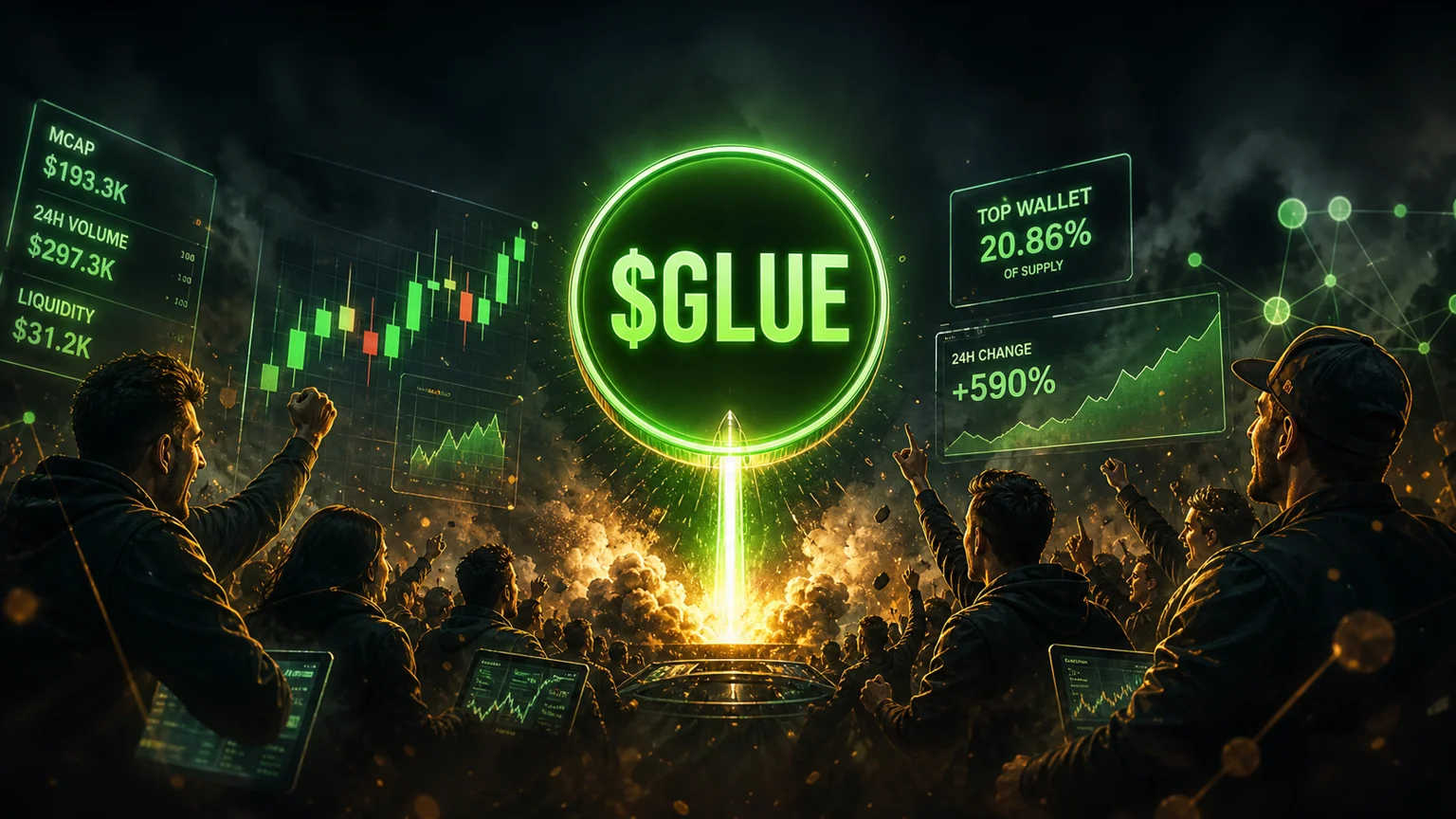
$GLUE currently shows no freeze authority, no mint authority, and a Rugcheck score of 1, while the top three visible holders control about 34.2% of supply, leaving the structure cleaner than average on permissions but still concentrated enough to matter.
$GLUE gets interesting the moment you stop thinking about the percentage and start thinking about the sequence. Yes, the token was up roughly 590% on the day in the saved snapshot, which is enough to make any Solana chart look ridiculous. But the more useful detail is how the move started. A watched wallet tied to @KayTheDoc stepped in with two buys at 2026-06-25 01:53 UTC and 2026-06-25 01:54 UTC, deploying about $1.28K in total for roughly 18.59 million tokens before the board fully repriced. That timing matters because it tells traders the move did not begin with a late social chase.
That does not automatically turn the token into a clean winner. Fresh watched-wallet entries can still end as perfect top signals if the rest of the market piles in too late. What makes $GLUE worth writing up is that the board still has enough depth and churn to justify a second look after the first breakout instead of only before it. By 2026-06-25 07:15 UTC, the token was sitting around a $193.3K market cap with roughly $297.3K in 24-hour volume and about $31.2K of liquidity. For a board that was only about 4.9 hours old in the saved data, that is enough structure to keep the conversation alive, even if the ownership map still leaves little room for complacency.
- → A watched wallet tied to @KayTheDoc bought roughly 18.59 million $GLUE for about $1.28K across two entries at 2026-06-25 01:53 UTC and 2026-06-25 01:54 UTC, giving the move an identifiable early sponsor before the full reprice arrived.
- → $GLUE later traded around a $193.3K market cap with roughly $297.3K in 24-hour volume and about $31.2K of liquidity, which is enough depth to keep a second-look setup alive instead of treating the board like a one-candle stunt.
- → Current on-chain checks show freeze authority disabled, mint authority disabled, and a Rugcheck score of 1, but the top wallet still controls 20.86% of supply and the top three wallets hold about 34.2%, so the structure remains speculative despite the cleaner permission set.
Why the Early Wallet Timing Matters
In meme trading, price alone often tells you less than timing. Anyone can quote a token after it has already gone vertical. The more revealing move is buying before the board becomes consensus entertainment. That is the real signal inside $GLUE. The watched wallet did not chase a finished candle. It bought while the token was still cheap enough that the market had not decided what kind of story this would become. When traders track these wallets, they are not looking for prophecy. They are looking for evidence that somebody with a practiced eye was willing to own risk before the crowd had a clean narrative to repeat.
That framing matters because the wallet buy alone is not a thesis. The thesis is that the board later proved tradable enough to validate the attention. If the pair had gone illiquid or volume had stalled, the early buy would read like a curiosity. Instead, the token kept moving into a busier market. The reported one-hour volume was already about $244K, which means the board was not surviving on stale bragging rights from the first buyers. It was still being actively repriced by a larger room. That gives the watched-wallet entry more weight because the market followed the lead instead of ignoring it.
The Reprice Is Big, but So Is the Depth
The temptation with a 590% move is to assume the easy money is over. Sometimes that is exactly right. But the more careful read on $GLUE is that the board has already reached a size where the next leg does not need fantasy assumptions. A market cap around $193.3K is still small enough to move hard if new attention arrives, while liquidity above $31K gives the pair more credibility than the average four-hour board. Traders are not looking at a ghost pool with a cartoon candle. They are looking at a real enough market where bids and offers can still change the story.
Volume is what keeps that argument alive. Roughly $297.3K over 24 hours on a sub-$200K market cap means the market is still rotating the token aggressively. Even more important, the reported buy ratio sat near 49.5%, which tells a subtler story than a pure moonshot chart. The move is not being carried by a one-sided frenzy alone. Sellers are present, profit-taking is happening, and buyers are still strong enough to keep the board elevated. That two-sided action is healthier than a chart that only looks strong because nobody bothered to hit sell yet.
What the On-Chain Data Shows
$GLUE gets a better first read on permissions than many boards that jump this fast. Current checks show freeze authority disabled and mint authority disabled, which removes two of the simplest contract-level traps Solana traders have to worry about. The saved Rugcheck score also sits at 1, keeping the immediate fear away from broken permissions and closer to ordinary market structure. That is a meaningful distinction. It means late buyers are not obviously fighting a token that can be frozen or inflated out from under them while they are still trying to parse the chart.
Ownership still deserves more attention than the permission set. The top visible wallet holds 20.86% of supply, while the next two largest visible holders control 7.47% and 5.88%. That puts top-three concentration at about 34.2%. The number is better than the ugliest launchpad boards, but it is not loose enough to ignore. One wallet controlling more than a fifth of supply means the market remains vulnerable to a single balance having too much say over the tone of the next session. That is why the board can look cleaner than average and still stay firmly in speculative territory.
The encouraging part is that the profile stops short of the usual serial-deployer paranoia. The saved creator snapshot shows no freeze authority, no mint authority, a low Rugcheck score, and no track record of the creator spinning up a long list of other tokens. None of that guarantees good behavior. It simply means the market can focus on concentration and momentum rather than chasing a messy admin-key story. In practical terms, $GLUE is a board where the most relevant risk is still trading behavior, not obvious contract sabotage.
Why This Still Has Room for a Second Look
The bull case on $GLUE is not that it is undiscovered. It clearly is not. The bull case is that the discovery may still be in its middle innings because the first visible wallet sponsor arrived early, the liquidity is usable, and the valuation remains small enough for another rotation to matter. Traders love calling everything overextended once the first percentage gets silly, but meme boards do not care about emotional fairness. They care about whether the next wave of participants still sees enough room to matter. At under $200K, $GLUE still offers that psychological room.
There is also a practical reason second-look trades can outperform on Solana. The first leg often belongs to people closest to the launch. The cleaner continuation move belongs to the broader market once it decides the pair is liquid enough to engage with. $GLUE is hovering in that transition zone. The wallet call gives the story an anchor. The volume gives it proof of life. The only thing missing is a broader owner base that can make the next move feel earned instead of squeezed out of a still-crowded float.
The watched-wallet timing got $GLUE onto the radar.
The usable liquidity and active volume kept it there.
Now the board needs broader ownership so the next leg belongs to the market instead of one oversized wallet.
Where the Trap Still Sits
The biggest trap is assuming a cleaner permission set solves everything. It does not. A token can have freeze authority disabled, mint authority disabled, and a low Rugcheck score and still fail as a trade because the float remains crowded and the best buyers were earlier than you. That is the exact hazard around $GLUE right now. A top wallet with 20.86% of supply does not need to dump aggressively to cap upside.
There is also the simple risk of exhaustion. A 590% day compresses a lot of future optimism into the present. If new buyers decide the wallet story is already fully reflected in price, the board can spend the next phase chopping or retracing instead of trending. That would not erase the fact that the early wallet timing was sharp. It would just mean the profitable part of the signal belonged to the first readers, not the late interpreters. For $GLUE, the next few hours matter less because they predict the future and more because they reveal whether this move has real handoff demand under it.
🟡 $GLUE earns a speculative read because the early watched-wallet timing was sharp, the board still has usable liquidity, and the contract permissions look cleaner than average on current checks. The caution is structural, not cosmetic: the token is already up roughly 590% on the day, one wallet still controls 20.86% of supply, and the next leg has to come from broader buyers rather than from the same early hands replaying the first move.
Why are traders watching $GLUE right now?
$GLUE drew attention after a watched wallet tied to @KayTheDoc bought early at 2026-06-25 01:53 UTC and 2026-06-25 01:54 UTC, then the market continued repricing the token into a sub-$200K board with active volume and usable liquidity.
What does the on-chain profile show for $GLUE?
Current saved checks show freeze authority disabled, mint authority disabled, and a Rugcheck score of 1. The bigger concern is ownership concentration, with the top wallet holding 20.86% and the top three visible holders controlling about 34.2%.
What is the main risk after a 590% daily move?
The main risk is that the early-wallet edge may already be largely priced in. If fresh buyers do not broaden the holder base and keep volume active, concentration and fatigue can turn a strong first reprice into a messy handoff.