
$CAGE Is Forcing a Clean Runner Reprice After $6.2M in Volume
$CAGE has pushed Future Colosseum to a $3.17M market cap with broad holders, disabled authorities, and a low Rugcheck score, but the liquidity pool still has to prove it can absorb late-cycle profit taking.
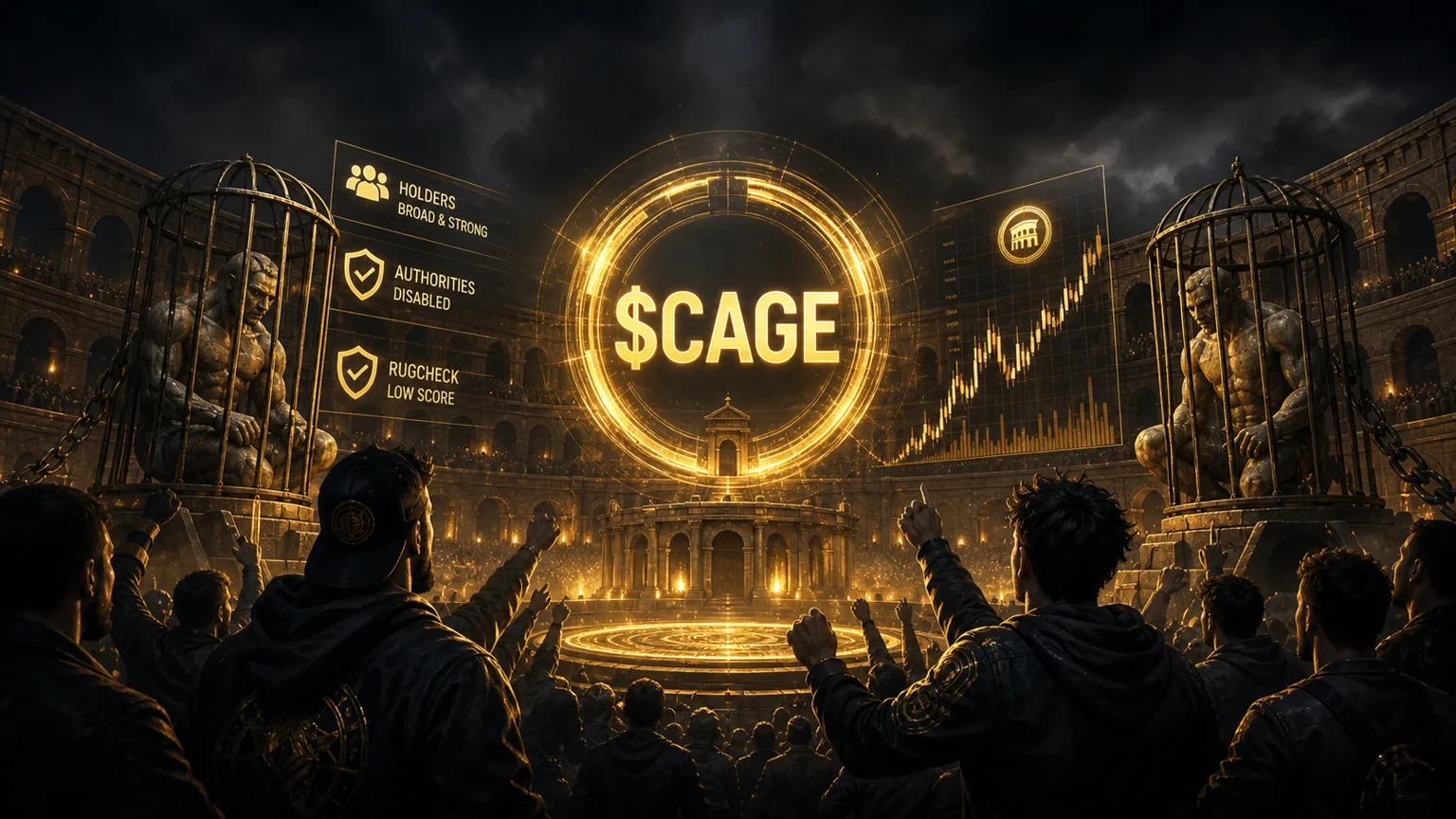
$CAGE has freeze authority disabled, mint authority disabled, a Rugcheck score of 1, and top-three holder concentration near 3.8%, so the visible risk is liquidity depth and momentum exhaustion rather than a concentrated authority map.
$CAGE is no longer trading like a random pump.fun afterthought. Future Colosseum was about 14 days old at the saved source timestamp, which makes this less of a first-hour launch scramble and more of a delayed attention test. The token had already reached a $3.17M market cap, printed roughly $6.20M in 24-hour volume, and was still moving hard with a 30.3% latest-hour gain and a 108.3% 24-hour move. That is the part that matters: the market is not just discovering $CAGE, it is repricing it after enough time for the easiest launch-day noise to clear.
The cleaner read comes from the spread of the bid. A lot of Solana meme charts can fake urgency with a tiny holder base and a handful of wallets pushing price through a shallow pool. $CAGE does not look like that simple version. The saved data shows 10,862 holders, an $83.9K liquidity pool, and more than 36,000 transactions across the last 24 hours. The buy side also had a real edge in the latest-hour sample: 1,152 buys against 924 sells, a buy ratio near 55.5%. That does not mean the trade is comfortable. It means the demand was still active after the chart had already made a large move.
- → $CAGE was trading near a $3.17M market cap with roughly $6.20M in 24-hour volume and a 108.3% daily move at the saved snapshot.
- → The holder base is unusually broad for this lane: 10,862 holders, top-three concentration near 3.8%, and no insider flag on the listed top wallets.
- → The cleanest warning is not the contract map. It is whether $83.9K in liquidity can handle the next profit-taking wave after a fast reprice.
Why Future Colosseum Repriced
The $CAGE setup is a clean runner rather than a pure launch snipe. A token that is 14 days old has already survived the most disposable window of pump.fun rotation, where the average chart can turn into a museum piece before anyone outside the first wallets notices it. Future Colosseum is now trading in a different phase. The question is no longer whether a few early buyers can force a candle. The question is whether the market has found a theme and a ticker that can keep attracting turnover while the valuation is already in the low millions.
That is why the volume number is useful but not enough by itself. $6.20M in 24-hour activity is loud, especially against a $3.17M market cap. It says the market is rotating through the token, not letting it sit stale. But volume can mean accumulation, churn, or a crowd fighting over exit liquidity. The better clue is the combination: price was up across the latest hour, six-hour, and 24-hour windows; buyers outnumbered sellers in the latest-hour sample; and the holder map is not dominated by a single obvious stack. That mix makes $CAGE worth a cleaner read than the average fast Solana chart.
What the On-Chain Data Shows
$CAGE gets its clean rating from the on-chain profile as much as from the chart. The saved Rugcheck data shows freeze authority disabled and mint authority disabled, removing two of the most direct contract-level concerns Solana meme traders check first. Rugcheck's normalized score is 1. The listed risk array is empty. The deployer wallet is recorded as 8jLmERhshAwvLKPa9NVtdbAUiHdzNYU8cSSepsvJr5Zk, and the creator token count is listed as zero, so the current file does not show a serial-launch pattern that needs to dominate the story.
The holder map is the stronger signal. The largest listed holder owns 2.49%, the second owns 0.67%, and the third owns 0.61%, placing top-three concentration around 3.8%. None of those three top wallets are marked as insiders in the saved profile. The broader enrichment data puts top-holder concentration near 4.61%, which points in the same direction: $CAGE is not obviously being held together by one giant wallet at the top of the board. For a token already doing millions in daily volume, that matters because concentration is often where the clean chart turns into a one-wallet problem.
The liquidity depth is the part that keeps the verdict measured. $83.9K is not tiny for a pump.fun graduate-style meme, but it is still thin compared with $6.20M in daily turnover and a $3.17M market cap. The market can move quickly in both directions when attention is that large relative to the pool. A clean authority map does not protect late buyers from a crowded exit. It only says the visible risk is more about market structure than obvious contract controls.
The Clean Runner Angle
$CAGE is strongest when read as a clean runner reprice. It has already left the instant-launch phase, and the current move looks more like a second wave of attention than a first candle. That matters because second waves usually have a different buyer. The first wave buys because something is new. The second wave buys because the chart survived long enough to become visible. Future Colosseum now has the kind of numbers that can get passed around without needing a complicated explanation: low-millions market cap, multi-million volume, broad holder count, and a cleaner-than-average holder concentration profile.
The name also helps. Future Colosseum gives traders a stage metaphor without forcing a rigid lore package. It can read as arena, competition, survival, and spectacle, all of which fit the way meme markets explain momentum after the fact. That does not create intrinsic value, and it should not be treated as a catalyst on its own. But in meme coins, a flexible theme can matter when a token is trying to graduate from chart-only attention into something a community can keep repeating.
$CAGE is cleaner than the usual fast Solana reprice because the visible holder map is broad and the authority checks are calm. The trade risk is whether liquidity catches up before momentum cools.
Where the Setup Can Fail
The bearish case is straightforward: $CAGE has already moved. A 108.3% 24-hour candle can invite new demand, but it also gives earlier holders a reason to hit bids. The fact that the latest-hour sample still leaned buy-side is useful, but it is only a snapshot. If that ratio flips while volume stays high, the same turnover that made the chart look healthy can start acting like distribution. Meme traders often call this strength until the pool proves it cannot absorb the selling.
Liquidity is the pressure point to watch first. The pool needs to deepen or the chart needs to cool into a more orderly range. If $CAGE keeps running vertically while liquidity remains near $83.9K, slippage and exit pressure become part of the signal. If liquidity improves, holders keep spreading, and the top wallets stay small, the clean-runner case gets stronger. The difference between those two paths is not philosophical. It is visible in the next few market updates.
What Would Confirm the Bid
The best confirmation for $CAGE would be boring in the right way. More holders, deeper liquidity, and continued two-way volume would do more for the case than another dramatic one-minute candle. The chart has already proven it can attract attention. Now it has to prove that attention is not just late buyers chasing a green number. A stronger version of this setup would show the holder count expanding beyond 10,862 while top-three concentration stays low and the liquidity pool grows alongside volume.
The weaker confirmation would be a loud chart with narrowing participation. If volume remains high but holder growth stalls, if the buy ratio falls under sell pressure, or if the liquidity pool does not improve, $CAGE starts looking more like a crowded reprice than a durable runner. That would not erase the clean on-chain read. It would simply change the trade from clean runner to post-pump exhaustion watch.
$CAGE earns a clean launch-radar read because the visible structure is stronger than most Solana meme names at this stage: 10,862 holders, top-three concentration near 3.8%, no insider flag on the listed top wallets, mint authority disabled, freeze authority disabled, and a Rugcheck score of 1. The market signal is real too, with roughly $6.20M in 24-hour volume and a $3.17M market cap. The caution is not hidden. Liquidity sits near $83.9K, so a fast profit-taking wave can still turn a clean runner into a harsh chase.
Why is $CAGE getting a clean read?
$CAGE gets a clean read because the saved profile shows disabled mint and freeze authority, a Rugcheck score of 1, top-three holder concentration near 3.8%, and a broad holder base of 10,862 wallets.
What is the biggest $CAGE risk right now?
The biggest visible risk is liquidity depth. About $83.9K in liquidity is workable, but it is still thin beside $6.20M in daily volume and a market cap above $3M.
Is $CAGE still early?
$CAGE was about 14 days old at the saved source timestamp, so this is not a brand-new launch candle. The better read is a second-wave reprice where the market is testing whether the runner can hold attention.