$DogTrain Built a Cleaner Solana Runner Board Than Most, but the Meme Still Needs a Bigger Crowd Than the First Rush
At 2026-06-21 19:05 UTC, $DogTrain was trading near a $360.4K market cap after roughly $985.8K in 24-hour volume with about $45.7K in liquidity, a 70.4% buy ratio, and only 6.9% of supply in the top three wallets. The structure is better than the average same-day board. The live test is whether the dog-train joke can keep pulling new buyers once the easiest first-wave momentum is gone.
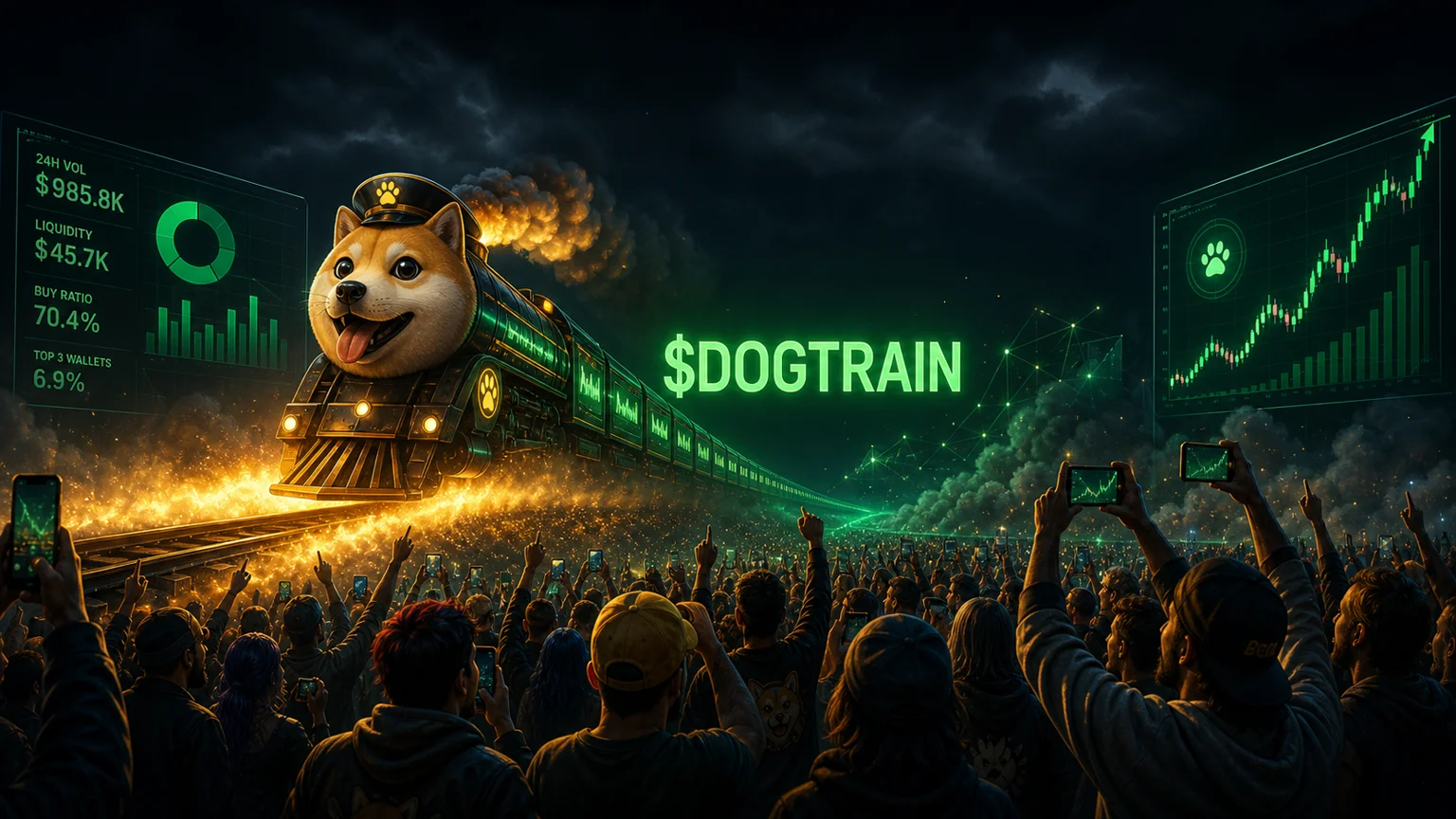
The on-chain read is cleaner than most fresh Solana launches: freeze authority off, mint authority off, Rugcheck score 1, and only about 6.9% of supply in the visible top three wallets. The structural risk is low for a same-day meme board; the bigger risk is whether demand broadens after the first joke lands.
$DogTrain sounds like the kind of meme you laugh at once and forget, which is exactly why the board is more interesting than the branding suggests. By the saved 2026-06-21 19:05 UTC snapshot, the Solana token was trading near a $360.4K market cap after roughly $985.8K in 24-hour volume with about $45.7K in liquidity. It had already posted a 358% 24-hour move while the pair was still only about 3.4 hours old. That is enough velocity to get degens involved. What makes the setup worth a closer read is that the on-chain structure looks materially cleaner than the average same-day launch. In a market full of fast jokes and dirty boards, that difference matters.
The first thing that stands out is how much real traffic the pair already absorbed. Roughly 19,377 transactions and a 70.4% buy ratio are not small numbers for a token that has not even finished its opening session. More importantly, the chart has not behaved like a one-candle accident. The saved one-hour change was still positive at about 5.93%, while the five-minute read only slipped about 0.88%. That is not proof of a second leg, but it does suggest the board is holding together after the first rush rather than immediately collapsing under its own hype. For an early meme launch, that stability is a signal in itself.
- → $DogTrain pushed roughly $985.8K in 24-hour volume against a market cap near $360.4K while the pair was only around 3.4 hours old, which is a serious participation read for a same-day Solana board.
- → The saved buy ratio was about 70.4%, with 13,649 buys against 5,728 sells, so the crowd leaned aggressively toward accumulation instead of treating the first spike like an instant exit point.
- → Freeze authority was off, mint authority was off, Rugcheck scored the token at 1, and the top three wallets controlled only about 6.9% of supply, making the structure much cleaner than most launches that appear this quickly on radar.
Why the Board Reads Cleaner Than the Meme
A lot of fresh Solana boards look strong right up until you check the holder map and realize one address can end the entire story before lunch. $DogTrain does not carry that immediate structural fear. The joke is silly, but the market beneath it looks organized. Volume is large relative to the capitalization. Liquidity is decent by first-session standards. The buy skew is forceful without being absurd. Put together, those details say traders did more than screenshot the move. They kept using the board. That is usually the first difference between a token that becomes a real runner candidate and one that briefly trends because a few wallets needed entertainment.
The board also benefits from an underrated quality in this market: it is easy to remember. Dog-headed steam train is a ridiculous image, but ridiculous is often enough when the ticker is readable and the price action arrives fast. Meme coins do not need sophisticated storytelling to catch a first wave. They need to stick in the timeline long enough for the next trader to repeat the trade. $DogTrain already cleared that first hurdle. The market now knows the token exists. The next challenge is whether the joke has enough staying power to attract a broader second audience after the earliest speculators have already had their fun.
What the On-Chain Data Shows
This is where $DogTrain earns the clean rating. The saved profile showed freeze authority off, mint authority off, and a Rugcheck score of 1. The largest visible wallet held only 6.31% of supply, and the top three wallets together sat near 6.9%. For a token this new, those numbers are unusually calm. They do not make the token safe, and they do not promise follow-through, but they do remove the cheapest reasons to dismiss the move. Traders are not looking at a board dominated by one whale, a dev with active mint control, or an obvious authority trap. They are looking at a board where the next question is demand, not hidden structure.
That distinction matters because many of the best early meme moves fail for reasons that have nothing to do with the joke. They fail because concentration is too high, liquidity is fake, or a contract setting leaves the entire auction hostage to one actor. $DogTrain does not show those problems in the saved read. The holder split is broad enough that traders can actually debate the meme itself rather than fear an immediate rug mechanic. In other words, the market has space to price discovery instead of just pricing in danger. That alone makes the token more credible than a lot of same-day runners.
The only caution inside the on-chain data is scale. About $45.7K in liquidity is solid for a pair this young, but it is not deep enough to make the board immune to sharp reversals. Clean holder structure helps the exit door stay wider than usual, yet it does not eliminate volatility. Traders should read the freeze, mint, and holder profile as permission to take the board seriously, not as a reason to ignore how fast sentiment can change in a low-six-figure market.
The Real Test Is Demand After the First Laugh
Because the structure is cleaner than average, the bull case for $DogTrain is straightforward. If the meme keeps circulating and the board continues to post volume that rivals or exceeds the market cap, the token has room to keep repricing without needing a hero wallet to drag it there. That is how healthier first-session runners behave. They start as a joke, then transition into a real venue because enough traders decide the board deserves repeat attention. The saved volume and buy ratio say $DogTrain is already on that path. The question is whether it can stay there once the easiest momentum has already printed.
$DogTrain already proved it can attract real participation quickly, and the holder map gives the board room to keep trading without one wallet dominating the mood.
The next constructive sign would be stable volume through the first cooldown rather than another single vertical burst.
If buyers keep returning while freeze authority and mint authority remain off, the token can graduate from a funny first-session move into a more durable runner conversation.
The bear case is less about hidden danger and more about narrative shelf life. A ridiculous meme can win an opening session because novelty itself is enough. It becomes harder once the market has already seen the chart. Then the board needs a broader crowd, not just the first crowd, and that second crowd is usually more selective. If turnover fades, the buy ratio cools, and the timeline moves on to a louder joke, then a structurally clean board can still bleed simply because nobody feels urgency anymore. Clean structure improves the odds. It does not create inevitability.
That is why $DogTrain reads like a real watchlist name rather than an automatic chase. The saved data removed the obvious contract panic, showed real participation, and presented a holder split that is much healthier than most boards this young. Those are meaningful wins. But the token still has to do the difficult thing all first-session memes eventually face: convince new buyers that the story is worth repeating after the first traders have already made their money. If it can do that, the clean setup gives it room to keep working. If it cannot, the market will treat the launch as a well-structured one-day joke.
$DogTrain earns a clean rating because the saved read paired nearly $985.8K in 24-hour volume and a 70.4% buy ratio with a notably healthy on-chain profile. Freeze authority was off, mint authority was off, Rugcheck scored the token at 1, and the top three wallets controlled only about 6.9% of supply. That does not remove volatility, but it does make the board cleaner than most same-day Solana memes. The live issue now is not whether the structure is broken. It is whether the joke can keep bringing in a larger crowd after the first rush.
What is $DogTrain on Solana?
$DogTrain is the ticker for Dog-Headed Steam Train, a Solana meme token that quickly built a strong opening board. In the saved 2026-06-21 19:05 UTC snapshot, it was trading near a $360.4K market cap after roughly $985.8K in 24-hour volume with about $45.7K in liquidity.
Why does $DogTrain look cleaner than many fresh launches?
The saved on-chain profile showed freeze authority off, mint authority off, a Rugcheck score of 1, and only about 6.9% of supply in the visible top three wallets. That is a much healthier structural read than the average same-day meme token, where one wallet or one authority setting often dominates the risk.
What still has to prove itself for $DogTrain?
The board still needs broader follow-through demand. The first session already delivered strong volume, a 70.4% buy ratio, and a stable chart relative to many early launches, but the meme has to keep attracting new buyers after the first crowd has already taken notice. Clean structure helps, yet it cannot replace sustained attention.