$BWICK Turned a John Wick Joke Into a Fast Solana Board, but the Holder Stack Already Looks Crowded
By 2026-06-19 19:03 UTC, $BWICK was trading around a $170.4K market cap on roughly $660.6K in 24-hour volume with about $29.9K in liquidity. That is enough turnover to force the market to pay attention, yet the more important read sits in the holder map, where the top three visible wallets already controlled about 40.8% of supply.
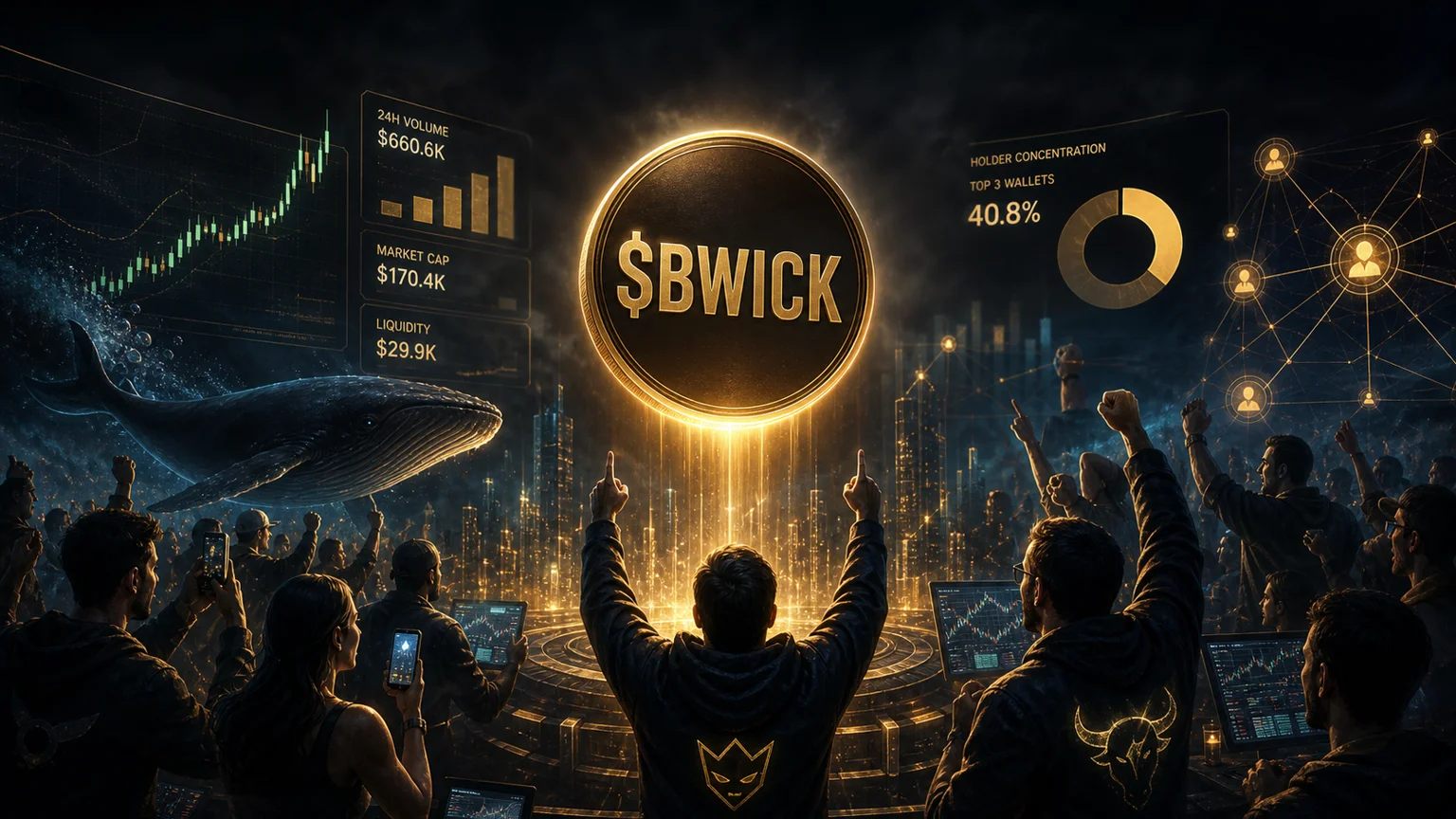
Freeze authority is off, mint authority is off, and the saved Rugcheck score is 1, but the top three visible wallets still control about 40.8% of supply. That mix leaves the contract cleaner than average while making supply concentration the practical risk traders have to respect.
Every Solana session produces at least one board that looks too silly to matter until the tape forces everybody to stop laughing. $BWICK is that board this cycle. The ticker leans on a John Wick joke, the pair is barely older than a coffee run, and yet the market still pushed roughly $660.6K in 24-hour turnover into a token that was only around a $170.4K market cap at the saved 2026-06-19 19:03 UTC snapshot. When a microcap clears that kind of traffic that quickly, it stops being a novelty listing and starts becoming a real risk-transfer venue for short-horizon traders.
That does not mean the cleanest read is pure momentum. The smarter editorial angle is holder concentration because the board is already showing a split personality. On one side, the market is active enough to matter. On the other, the visible supply stack is tighter than a healthy continuation trader would want. Plenty of first-hour Solana winners look explosive right before a crowded holder base turns them into a reflexive exit game. With $BWICK, the joke got the click, but the wallet distribution is what decides whether this becomes a real runner or just a fast rotation with a theatrical skin.
- → $BWICK traded roughly $660.6K in 24-hour volume against a market cap near $170.4K while the pair was less than thirty minutes old, which is enough real participation to keep the board on screen.
- → Liquidity sat around $29.9K at the saved read, so the market has room to move but not enough depth for anyone to mistake this for a forgiving board once larger sellers arrive.
- → The saved on-chain profile is the real fork in the road: freeze authority off, mint authority off, Rugcheck score 1, but the top three visible wallets already controlled about 40.8% of supply.
Why the Meme Hook Worked Faster Than Most First-Hour Solana Launches
The bullish case starts with speed, but not the lazy kind. Lots of new boards print a dramatic percentage move in the first few minutes because there is nothing there except a handful of buyers chasing the same candle. $BWICK looks different because the turnover is too heavy to explain away as one pocket of coordinated clicking. A board sitting around $170.4K in market cap does not casually rack up about $660.6K in turnover unless a real cluster of traders keeps revisiting the pair. That matters because repeated participation is what gives a meme coin a chance to become tradable instead of just screenshot material.
The theme also helps. The John Wick framing is dumb in the exact way this market often likes: instantly legible, culturally recycled, and easy to push through crowded feeds without a long explanation. In meme coins, recognizability is not the same thing as quality, but it is often the first bridge to order flow. Traders do not need to believe in a roadmap to understand why the ticker can travel. They only need to believe the joke is transmissible enough to attract the next marginal buyer. $BWICK already proved that part. The next question is whether the board under the meme is structured well enough to survive the first profit-taking wave.
The Turnover Is Good, but the Supply Stack Is Where the Stress Will Show
The raw board metrics are easy to respect. A roughly 3.9x volume-to-market-cap ratio means the market has already stress-tested the pair more than once. That can be constructive because it suggests the board is not living off one isolated burst. At the same time, the liquidity pool around $29.9K is still small enough that this stress test has happened inside a narrow lane. A board can look liquid while the flow is mostly one-directional. It only reveals its real width once holders begin rotating out and the market has to discover whether fresh demand is still waiting below.
That is where concentration becomes the higher-value read than percentage performance. If supply is already packed into a small set of visible hands, then continuation depends less on how funny the meme is and more on how disciplined those holders are. A board with concentrated supply can keep climbing in a straight line for longer than skeptics expect, especially when the public float feels scarce. It can also unwind with brutal speed because the same tight stack that supports the sprint can magnify the first meaningful distribution. Traders looking at $BWICK only through the lens of momentum are seeing half the picture.
What the On-Chain Data Shows
At the contract level, $BWICK is cleaner than the average first-hour Solana meme. Freeze authority is off. Mint authority is off. The saved Rugcheck score is 1. Those details matter because they remove the easiest reasons to dismiss the token outright. The board is not asking traders to ignore the classic switch risks that turn so many tiny launches into instant non-starters. If someone wants to be bearish here, the better case is not hidden permissions. It is the much simpler problem of whether the market is too concentrated and too thin to convert fast interest into durable tradeability.
The holder map is where the caution moves from abstract to practical. One visible wallet controlled about 20.78% of supply at the saved read, while the creator wallet still appeared around 10% and another top holder also sat near 10%. Add that up and the top three visible wallets held about 40.8% of supply. That is not a death sentence, but it is too much concentration to ignore in a board this young. When nearly half the visible stack sits with three wallets, the token becomes more sensitive to coordinated exits, accidental slippage, or a single wallet deciding the joke already paid enough.
The dev profile cuts both ways in a way that sophisticated traders should appreciate. Creator token history is empty, the risk list is empty, and there is no freeze or mint authority hanging over the chart. That is the cleaner half. The harder half is that the creator wallet still shows up as a meaningful holder while the total holder count has not yet broadened enough to soften the concentration math. In other words, the board is structurally cleaner than most garbage launches but still socially fragile. The difference matters. $BWICK does not read like a contract trap. It reads like a board that has to earn its distribution before it deserves a stronger label.
This Trade Will Be Decided by Supply Rotation, Not by How Loud the First Candle Was
The healthiest next step would be a calmer hand-off. Traders should want to see the token keep printing volume while ownership broadens, liquidity expands, and the board proves it can survive two-sided flow instead of just vertical curiosity. That kind of second shift is what upgrades a fast-launch curiosity into a repeatable board. If fresh wallets keep replacing early entrants and the top-visible concentration stops looking so dominant, then the market can start making a real case that $BWICK is more than a first-hour cultural flicker.
The failure path is equally obvious. If the board keeps leaning on the same narrow holder stack while liquidity stays pinned near $29.9K, then the next burst of selling can turn the chart from stylish to ugly very quickly. That does not require a scandal or a hidden contract toggle. It only requires the supply crowding that is already visible. Meme traders sometimes confuse a clean contract for a clean trade, but those are not the same thing. $BWICK has the first one. The second still has to be proved in the market itself.
$BWICK already showed it can attract real order flow fast. The open question is whether the market can widen the holder base before a crowded supply stack turns that same speed into an exit problem.
That leaves the board in the speculative bucket for now. The meme has enough transmission power to matter, the turnover is real, and the contract profile avoids the ugliest structural landmines. The holder concentration still keeps the token from earning anything cleaner. This is the kind of Solana board that can absolutely keep running for another leg, but it can do that while still being less healthy than the headline move suggests. Respect the pace, but respect the holder math even more.
$BWICK is worth watching because the board already printed meaningful turnover and the contract read is cleaner than average with freeze authority off, mint authority off, and a Rugcheck score of 1. It stays speculative because roughly 40.8% of visible supply sat with the top three wallets while liquidity remained near $29.9K, which is exactly the mix that can turn a fun fast mover into a concentration-led unwind.
What is $BWICK on Solana?
$BWICK is a fast-starting Solana meme board built around a John Wick-style joke. At the saved 2026-06-19 19:03 UTC read, it was changing hands near a $170.4K market cap while processing about $660.6K in 24-hour volume against a liquidity pool of roughly $29.9K.
Why is holder concentration the main risk on $BWICK?
The saved on-chain profile showed the top three visible wallets controlling about 40.8% of supply. In a small, early board, that level of concentration can make price action more fragile because a few holders can shape the market more than a broad base of buyers can.
Does $BWICK have obvious contract red flags?
The saved contract read was cleaner than average for a fresh Solana meme: freeze authority was off, mint authority was off, and the Rugcheck score was 1. The bigger issue is market structure, not hidden permissions.