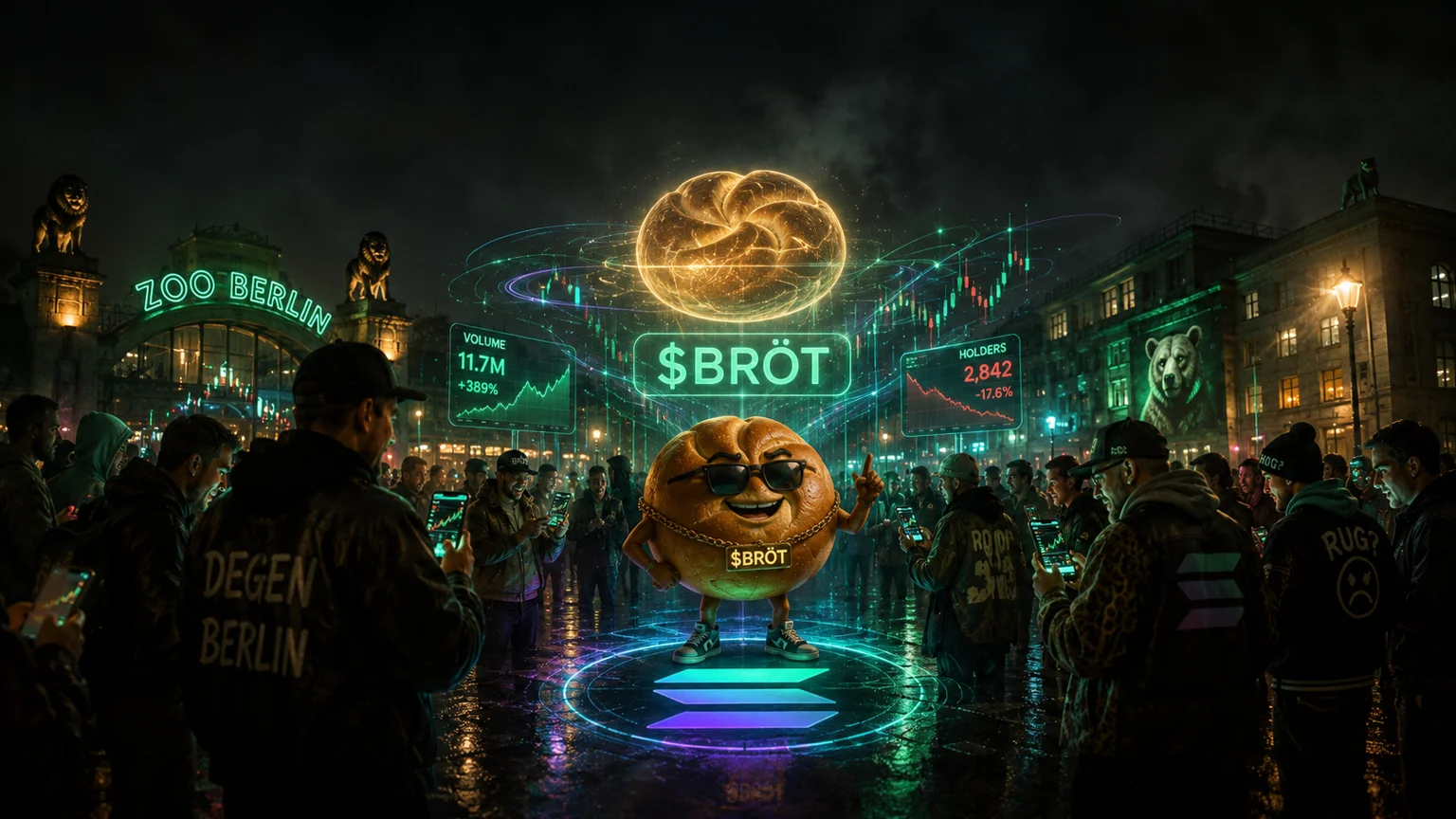
$Brötchen Is Turning Berlin-Zoo Meme Energy Into a Fast Solana Culture Bid
The Solana microcap pushed roughly $1.11M in 24-hour volume with about $34.0K in liquidity, and the real question is whether a strong culture hook can outrun a still-concentrated holder map.
Freeze authority was disabled, mint authority was disabled, and Rugcheck scored the contract at 1, but the top three wallets still controlled about 40.5% of supply at the saved snapshot.
$Brötchen is not getting attention because it solved some deep crypto problem. It is getting attention because it found the exact culture lever Solana traders love to overpay for when the tape is awake: a recognizable meme hook, a name that feels native to screenshots, and enough turnover to make the board feel bigger than its market cap. At the saved 2026-06-11 07:00 UTC snapshot, the token was sitting around a $102.4K market cap with roughly $1.11M in 24-hour volume and about $34.0K in liquidity. Those numbers are loud for a board that is still basically a microcap curiosity. The catch is that loud volume alone does not tell you whether the move is becoming a real culture trade or just a very efficient churn machine.
That is why the right angle on $Brötchen is a culture-meme bid rather than a generic momentum read. The ticker carries a built-in narrative edge because it borrows from Berlin-zoo meme branding that already exists outside the usual crypto echo chamber. In meme trading, that matters more than most people admit. A board does not always need a complicated lore package to reprice. Sometimes it only needs a reference the feed can recognize instantly and repeat without effort. $Brötchen has that. The market is now testing whether that cultural familiarity is sticky enough to keep new demand arriving after the first burst of novelty volume wears off.
- → $Brötchen printed roughly $1.11M in 24-hour turnover against about $34.0K in liquidity at the saved 2026-06-11 07:00 UTC snapshot, which is a serious amount of traffic for a token sitting near a $102.4K market cap.
- → The contract permissions read clean on first pass: freeze authority was disabled, mint authority was disabled, and Rugcheck scored the token at 1.
- → The structural argument against a green-light verdict is concentration. The top wallet held 20.69% of supply, the second wallet held 16.38%, and the top three wallets together controlled about 40.5%.
Why the Meme Hook Matters More Than the Market Cap
Microcap Solana runners rarely get the luxury of time. They either become instantly legible to the timeline or they die in a private corner of the charts before the broader room cares. $Brötchen has one obvious advantage in that race: the name is already doing half the work. It is unusual, specific, and visual. Traders do not need a white paper, a utility map, or even a carefully staged community story to understand what they are looking at. They only need to feel that the ticker has enough personality to keep moving from post to post. That is often the whole difference between a board that tops out as a niche joke and one that briefly becomes the session's preferred punchline.
That cultural legibility also explains why the volume is the first thing worth respecting here. Roughly $1.11M in daily turnover on a token at about $102.4K market cap means the board is getting recycled aggressively. Some of that flow is certainly short-term flipping, because nearly every fast Solana meme lives on reflexive inventory rotation. Even so, you do not get more than eleven thousand buys in a 24-hour window unless the token is making it through multiple layers of attention. The feed has seen it, traders have tested it, and enough people decided the meme was worth hitting again. That does not prove durability. It does prove that the board has already escaped total obscurity.
What the On-Chain Data Shows
The on-chain picture is cleaner than the average board that arrives with this kind of volume burst. Freeze authority was disabled, which removes one of the nastier admin risks that can ruin a meme trade regardless of how good the chart looks. Mint authority was disabled, which matters because surprise supply expansion is one of the fastest ways to turn a fast runner into dead inventory. Rugcheck scoring the contract at 1 is also as calm as traders can realistically hope for in this lane. None of that makes $Brötchen safe. It does mean the token is not waving the obvious permissions traps that would normally justify an immediate red verdict before the market structure discussion even begins.
The harder read comes from supply placement. The largest visible wallet held 20.69% of the token at the snapshot. The second-largest wallet held another 16.38%. Add the third wallet at 3.45% and the top-three concentration lands around 40.5%. That is meaningful concentration no matter how funny the ticker is. A holder map like that does not automatically kill a board, especially when the pair is still under a day old, but it changes what traders should fear. The main risk is not a hidden freeze switch or an open mint button. The main risk is that too much of the market's story still depends on a small number of wallets deciding not to lean into their advantage while the broader crowd is still trying to discover price.
Where the Trade Still Looks Organic
For all the concentration concerns, there are still signs this is not just a dead shell being juggled between insiders. The board logged more than twenty-one thousand total transactions in the saved window, with buys outpacing sells by roughly 57.3%. The pair had also reached nearly 20.6 hours of age, which is long enough for a weak meme to lose the room entirely if it is only surviving on first-wave curiosity. Instead, $Brötchen was still printing seven-figure turnover. That matters because the market had enough time to reject the joke if it wanted to. Instead, it kept touching the board, which suggests there is a real appetite for the branding even if that appetite remains volatile.
The absence of a serial-deployer profile helps that organic case, too. The saved creator profile showed zero prior creator tokens, which means the story does not start with an obvious factory wallet spraying out another disposable meme for the queue. Again, that is not a guarantee of clean intent. It is simply one more reason the board reads more like a culture trade than a cynical permissions trap. The token is getting its chance from recognizability and tape, not from some oversized dev balance or an admin setup designed to ambush late buyers. That distinction matters because it tells traders what kind of failure to watch for. If $Brötchen breaks, the cleaner assumption is exhaustion, rotation, or a concentrated-wallet exit, not an instant contract-level sabotage event.
What Could End the Bid Fast
The bear case is that culture only gets you the first invitation. To stay expensive, the board still needs better distribution or at least enough fresh turnover to make concentration less dangerous. About $34.0K in liquidity can support a real sprint, but it is not much padding if one of the large wallets decides to hit bids while momentum is softening. Because the top two wallets together already control more than a third of supply, the chart can feel healthy right up until it suddenly does not. That is the trap in treating a low Rugcheck score like a complete risk summary. Permissions can be clean while market structure is still fragile.
There is also the problem of meme shelf life. Cultural references move quickly, and crypto is especially ruthless about replacing one feed-friendly joke with another. $Brötchen does not need to be profound to work, but it does need to keep feeling fresh enough that new traders want exposure rather than just a laugh. If the meme loses novelty before the holder base broadens, the tape can thin out much faster than the headline volume suggests. That is why this remains a speculative read even with a Rugcheck score of 1. The clean contract setup is real. So is the possibility that the market has already consumed the best part of the joke while the supply map is still too top-heavy to support a graceful second act.
🟡 Speculative — $Brötchen has a credible culture bid because the ticker is memorable, the branding is easy for the feed to recycle, the contract profile is calm, and the saved 2026-06-11 07:00 UTC snapshot showed roughly $1.11M in 24-hour volume on a token near a $102.4K market cap. The reason it stops short of a clean verdict is concentration. Freeze authority is off, mint authority is off, and Rugcheck scored the token at 1, but the top three wallets still controlled about 40.5% of supply. That leaves plenty of room for the meme to keep running and plenty of room for the structure to punish late conviction.
What is $Brötchen on Solana?
$Brötchen is a Solana meme token trading under contract address 9ZtbETDNjnST9Y2zs82FZYy49xUMPgqXRh46YjjRpump. At the saved 2026-06-11 07:00 UTC snapshot it was sitting around a $102.4K market cap with roughly $1.11M in 24-hour volume and about $34.0K in liquidity.
Why is $Brötchen being treated as a culture-meme bid?
Because the ticker and branding are doing real attention work. The meme is easy to recognize, easy to repeat across the feed, and strong enough to help a microcap token escape obscurity long enough to print more than eleven thousand buys in a day.
What does the on-chain profile look like for $Brötchen?
The contract permissions looked calm at the saved snapshot. Freeze authority was disabled, mint authority was disabled, and Rugcheck scored the token at 1. The bigger issue is holder concentration, with the top wallet at 20.69% and the top three wallets at about 40.5%.
What has to happen next for $Brötchen to stay interesting?
$Brötchen needs the culture hook to keep pulling in fresh buyers while the holder base broadens enough to reduce the influence of the largest wallets. If the meme cools off before distribution improves, the current liquidity base can make the unwind much uglier than the headline volume implies.