$SAGAWA Turns A Japanese Culture Meme Into A Solana Momentum Bid
$SAGAWA is only about 20 hours old, but the pump.fun launch has already pulled more than $1.7M in 24h volume while its on-chain profile stays cleaner than the usual culture-meme chase.
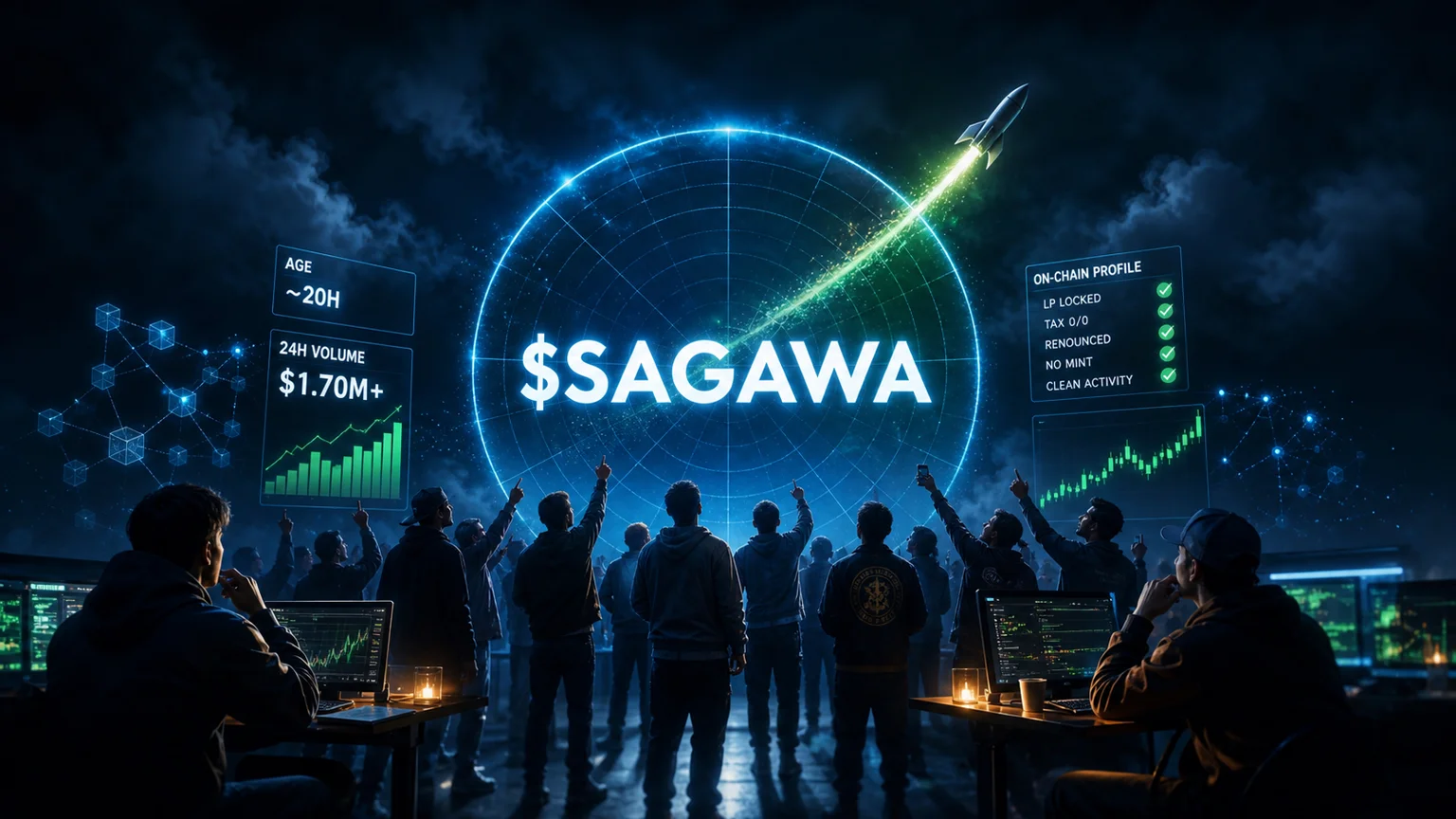
Top three known holders control about 18.7% of supply, with mint and freeze authority disabled.
$SAGAWA is the kind of strange, local-language culture meme that can look too small to matter until the volume says otherwise. The Solana token, built around 佐川トメ and launched through pump.fun, is still barely a day old. Yet the tape is already loud: roughly $1.71M in 24-hour volume, more than 42,000 trades, a 366% move over the last hour, and a market cap sitting near $119K at the latest snapshot.
That combination is why $SAGAWA deserves a sharper read than the usual microcap shrug. This is not a big-market-cap runner with deep liquidity and a week of price history. It is a thin, fast, culture-first bid where the meme is doing most of the work and the market is trying to decide whether the joke can travel outside its first crowd. When a token this young prints that much turnover against only about $14.7K of liquidity, the upside can look violent and the exit door can get crowded just as quickly.
- → $SAGAWA is about 20 hours old and already showing a 24h volume print near $1.71M.
- → The latest market cap is around $119.4K, with liquidity near $14.7K, which makes every aggressive rotation meaningful.
- → Rugcheck data is cleaner than most fresh Solana launches: mint authority disabled, freeze authority disabled, rug score of 1, and top-three holder concentration around 18.7%.
- → The main risk is not an obvious contract trap. It is whether a culture-meme burst can survive after the first momentum crowd gets paid.
The Meme Is Doing Real Work
The best meme trades usually start with a simple translation problem: outsiders see nonsense, insiders see a signal. $SAGAWA sits in that lane. The token name and Japanese-language presentation give it a very specific identity instead of another all-caps animal derivative. That does not make the asset safer, but it does explain why it can move quickly before a broader crowd understands what it is looking at.
Culture-meme bids live on recognizability, remix potential, and the feeling that a tiny corner of the internet has found its own mascot. They do not need a whitepaper. They need screenshots, captions, Telegram stickers, quote posts, and the repeated impression that people are buying the bit as much as the chart. $SAGAWA has enough of that early texture to be more than a ticker flicker, but it is still early enough that the market has not proven a durable holder base.
That is the editorial angle here: $SAGAWA is not moving because the contract invented something new. It is moving because a small meme format is being repriced by Solana traders who still reward novelty when the chart is vertical. In a market where most pump.fun launches feel interchangeable after ten minutes, a token with a distinct cultural hook can briefly command attention that pure chart spam cannot buy.
Why The Tape Got Loud
The current numbers show a token that is punching far above its size. A $119K market cap with $1.71M in daily volume means the token has already churned many times its visible valuation. That can be bullish when it reflects real rotation and repeated bids. It can also be dangerous when the same liquidity pool is being used for rapid round trips, because volume alone does not tell you whether holders are getting stronger or simply passing inventory faster.
The buy ratio near 54.9% gives $SAGAWA a modest demand lean, not a euphoric imbalance. That matters. A cleaner runner is not always the one with every candle going straight up. Sometimes the healthier version is the one where buyers are still slightly ahead while sellers are already taking profit. The question is whether new demand keeps replacing those exits or whether the chart is only digesting the first wave of early entries.
What the On-Chain Data Shows
For Solana microcaps, the contract read is often more important than the meme. $SAGAWA clears the first checks that usually matter. Freeze authority is disabled, which means the creator cannot freeze token transfers through that control. Mint authority is disabled as well, so the supply cannot be expanded through a live mint switch. Rugcheck gives the token a normalized score of 1, and the available risk list does not show active warnings in the latest profile.
The holder map is not perfect, because no meme coin holder map is perfect this early, but it is not screaming coordinated supply capture either. The largest listed holder controls 13.28% of supply. The next two known holders sit at 2.9% and 2.55%, putting the top-three concentration around 18.7%. That is still a number traders should respect. One large wallet can pressure a pool this small. But compared with the usual fresh-launch mess where one cluster can dominate half the supply, $SAGAWA looks cleaner than average.
Liquidity depth is the weaker side of the setup. About $14.7K of liquidity against $1.71M in 24h volume means the token is extremely sensitive to bursts of market orders. A few aggressive buys can make the chart look unstoppable, and a few impatient exits can erase a large piece of the move. That is not a contract flaw. It is a structure flaw that comes with almost every small Solana culture meme before deeper liquidity arrives.
The deployer profile is also quieter than the market action. The available data shows no creator token history attached to the wallet, and no notable risk list is attached to the current report. That does not make $SAGAWA safe, and it does not make the team trustworthy. It simply means the available on-chain profile is not the reason to fade the token right now. The better bear case is mechanical: fast market cap expansion, thin liquidity, and a meme that still has to prove it can keep attention after the first violent move.
The Culture-Meme Test
The strongest version of the $SAGAWA trade is that Solana traders are still willing to pay for odd, specific memes that feel native to a niche before they become readable to everyone else. That is how small culture tokens escape the first pool. They do not start as obvious brands. They start as a weird chart attached to a character, phrase, or local reference that people keep repeating until the ticker becomes the joke.
The weakest version is just as simple: a sub-$150K token can look like a phenomenon for an hour because a tiny pool magnifies every buy. The same mechanics that make a 366% hourly candle possible also make a post-pump air pocket possible. If the meme slows down before liquidity thickens, the chart can go from discovery to exhaustion without giving late buyers much time to react.
That is why $SAGAWA should be read as a culture-meme bid rather than a clean breakout. The numbers are real enough to watch. The on-chain setup is clean enough to avoid an immediate warning label. But the asset is still operating in the part of the market where attention is the product, liquidity is fragile, and the first cohort of winners can become the next cohort of sellers.
The useful signal is not simply that $SAGAWA pumped. It is that a Japanese-language meme reached high turnover while the authority checks and holder map stayed relatively calm.
What Would Make It Matter More
$SAGAWA becomes a stronger story if the market cap holds above the early burst zone while holder count keeps expanding beyond the first thousand wallets. A deeper liquidity base would matter even more. More liquidity does not remove meme-coin risk, but it changes the shape of the trade from a tiny-pool chase into something a broader Solana crowd can enter and exit without instantly distorting the chart.
The volume also needs to stay productive. If daily volume remains high while price chops instead of collapsing, that usually suggests real two-way discovery. If volume fades and liquidity stays thin, the market is saying the meme got one attention cycle and nothing more. The next few UTC hours are the difference between a quirky runner building a base and a pump.fun burst that already spent its best candle.
There is no need to overstate the read. $SAGAWA is still a very small Solana token with a very young chart. The cleaner authority profile earns it a watchlist spot, not a pass. The culture hook gives it a reason to exist, not a floor. The volume proves traders showed up, not that they will stay.
$SAGAWA gets a speculative watch rating. The market data is strong for a 20-hour pump.fun launch, the Rugcheck profile is cleaner than most microcap launches, and the culture-meme angle is specific enough to matter. The caution is liquidity: $14.7K is a narrow door for a token doing $1.71M in daily volume. Until that improves, $SAGAWA is a fast-moving attention trade with a cleaner setup, not a settled runner.
What is $SAGAWA?
$SAGAWA is a Solana meme token launched through pump.fun around the Japanese culture-meme identity 佐川トメ.
Why is $SAGAWA moving?
$SAGAWA is moving because early traders pushed strong volume into a small liquidity base, creating a fast culture-meme momentum bid.
Is the $SAGAWA contract clean?
The latest available on-chain profile shows mint authority disabled, freeze authority disabled, a Rugcheck score of 1, and top-three holder concentration around 18.7%.
What is the biggest risk for $SAGAWA?
The biggest risk is liquidity depth. About $14.7K of liquidity is thin for a token doing more than $1.7M in 24h volume, so price can move hard in both directions.