$BOOL Pulled in a Watched Wallet and a $778.6K Volume Day, but the Holder Map Still Needs to Breathe
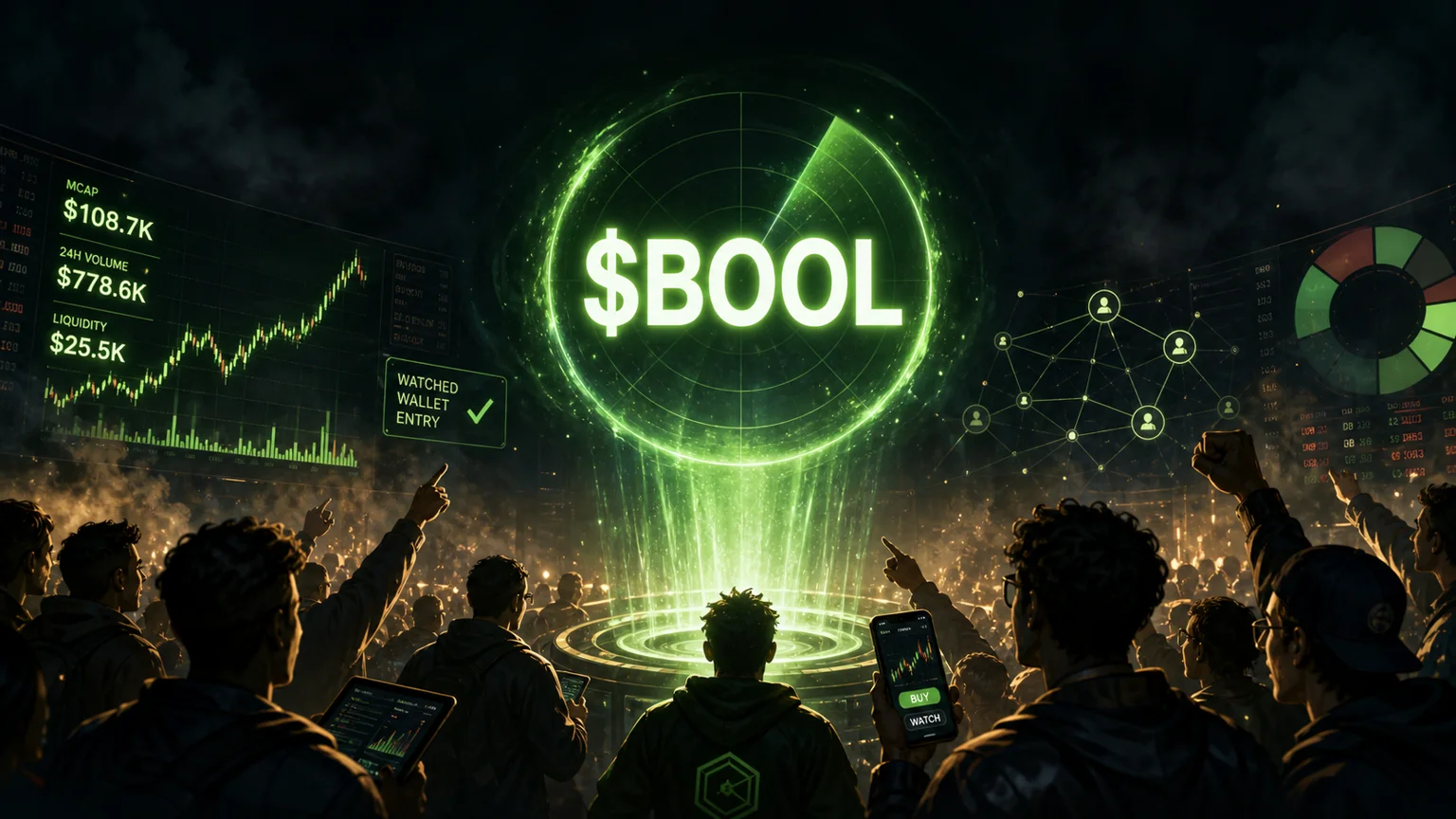
At the 2026-07-01 16:15 UTC reference point, $BOOL was trading near a $108.7K market cap with roughly $778.6K in 24-hour volume and about $25.5K in liquidity after a fast early sprint. The watched-wallet entry gives the board a real reason to stay on screens, but the next decision belongs to a holder structure that still looks tighter than the chart would like.
Freeze authority is disabled, mint authority is disabled, and the Rugcheck score reads 1, but the top wallet still controls 20.69% of supply and the top three wallets account for roughly 36.22%, which keeps the holder map tighter than the headline volume suggests.
A watched-wallet entry can rescue a fresh Solana ticker from the pile of charts that look alive only because nobody has had time to sell them yet. That is the first reason $BOOL made the board worth reading. One tracked wallet, Sunny, stepped in at 2026-07-01 13:28 UTC, spending about $331.2 to buy roughly 3.36 million tokens at an average cost near $0.0000984. The check size was not life-changing, but that is not the point. In small-cap meme markets, a visible early entry by a wallet traders already monitor can create a second round of curiosity that pure chart momentum rarely earns on its own. By the 2026-07-01 16:15 UTC reference point, that curiosity had helped $BOOL build to roughly a $108.7K market cap on about $778.6K in 24-hour volume with $25.5K in liquidity.
The harder question is whether the token deserves to keep that attention now that the first burst has already happened. The tape says the board was hot enough to print a 246% daily move, but it also says the market spent the last six hours handing back nearly 29.6% of that heat. That combination is usually where the real read begins. A chart that can run once is easy to find. A chart that can absorb an early pullback, keep enough turnover to stay tradeable, and avoid revealing some ugly structural problem underneath is much rarer. $BOOL still has a path into that second category, but the holder map is the part that keeps the read from graduating into anything cleaner.
- → $BOOL was trading around a $108.7K market cap with roughly $778.6K in 24-hour volume and about $25.5K in liquidity at the 2026-07-01 16:15 UTC checkpoint, so this was not a dead chart drifting on fumes.
- → A tracked wallet entered near $0.0000984 earlier in the session, which gives the symbol a concrete reason to stay on traders' screens beyond the first green candle.
- → The speculative catch is ownership: freeze authority is disabled and mint authority is disabled, but the top wallet still controls 20.69% of supply and the top three wallets account for roughly 36.22%.
Why $BOOL Got a Real Second Look
The bullish read starts with the amount of actual turnover the board has already processed. A token sitting around a $108.7K market cap does not accidentally produce nearly $778.6K in 24-hour volume unless traders have decided there is at least a temporary reason to care. That kind of activity can still be wasteful or circular, but it creates a real market, not just a screenshot. For $BOOL, the watched-wallet buy mattered because it arrived early enough to feel additive rather than parasitic. The wallet was not chasing a bloated chart after the entire move had already happened. It was there while the board was still trying to prove it belonged in circulation.
That timing turns the wallet action into an editorial angle instead of a random footnote. On small Solana boards, the difference between a token that gets one anonymous launch burst and a token that becomes a repeat watchlist name is often whether somebody with visible pattern recognition is willing to touch it before the market fully agrees. $BOOL now has that marker. It does not guarantee a second leg, but it does change the default posture from ignore to monitor. The buy ratio across the last 24 hours, roughly 53.9%, also helps by showing demand without making the tape look absurdly one-sided.
What the On-Chain Data Shows
The contract-level read is cleaner than the ownership read. Freeze authority is disabled. Mint authority is disabled. The Rugcheck score sits at 1. Those are meaningful positives because they remove some of the fastest ways a fresh Solana board can betray anyone trying to trade it honestly. There is no obvious permissions switch hanging over the market, and there is no inflation lever waiting to turn a decent chart into a trust fall. That matters. If $BOOL were carrying a live freeze or mint setting on top of a first-day momentum swing, the article would end there and the read would be much harsher.
The issue is that clean permissions do not automatically produce clean market structure. The top wallet owns 20.69% of supply. The next largest identified chunk is the pair address around 11.17%, and the third notable holder controls another 4.37%. Add those top three positions together and roughly 36.22% of the token is clustered immediately. That is not fatal for a board this small, but it does mean every bullish interpretation has to compete with the reality that a limited number of bags still have disproportionate influence over how graceful or ugly the next move looks. On only about $25.5K of liquidity, concentration matters more than slogans do.
The creator wallet balance reading at zero does improve the tone of the holder discussion, because it suggests the deployer is not obviously sitting there waiting to lean into the first strength. Still, the broader holder picture is not loose enough to ignore. When the market cap is only about $108.7K, concentrated ownership can turn a normal cooldown into a disorderly air pocket very quickly. That is why the 29.6% six-hour pullback is not just a chart detail. It is a live test of whether the board has enough distributed conviction to handle profit-taking without immediately collapsing into a one-wallet story.
$BOOL is speculative for ownership reasons, not because of a live contract switch. Freeze authority is off, mint authority is off, and the Rugcheck score is low. The unresolved pressure point is whether a board with a 20.69% top wallet can keep broadening out fast enough to support the volume it already attracted.
Why the Holder Map Matters More Than the Volume Flex
A lot of low-cap memes look strongest right before their biggest structural weakness becomes obvious. Volume is the most visible number on the screen, while ownership concentration stays invisible until the tape starts behaving strangely. Traders see $778.6K in 24-hour turnover against a $108.7K market cap and understandably assume the board has enough energy to keep rotating. Maybe it does. But if too much of the supply still lives in too few hands, high turnover can be less a sign of broad adoption and more a sign that the same inventory is being recycled aggressively around a thin pool. That does not make the move fake. It does make it fragile.
That fragility is exactly why $BOOL reads like post-pump exhaustion rather than a fully established clean runner. The volume already did the marketing job. The watched wallet already did the credibility job. What remains is the difficult part: the board needs new holders who are not just there to scalp the attention that somebody else created. If those buyers arrive, the current concentration profile can gradually stop mattering as much. If they do not, the same top-heavy structure that looked manageable during expansion can become the reason the retrace feels sharper than it should. In other words, the next phase is less about whether $BOOL can print another burst and more about whether it can distribute itself while people are still excited enough to help.
The Next Read Is About Absorption
There is still a constructive way to read this chart. A 29.6% six-hour pullback after a huge daily expansion is not automatically a death sentence. Plenty of meme boards need one ugly reset to find out whether the first audience was purely momentum-driven or whether there is a second layer of participants willing to buy the dip because the symbol has actually entered rotation. The tracked-wallet entry improves the odds that $BOOL gets that second audition.
But the market does not need another reason to notice $BOOL. It needs a reason to trust the next bounce. That trust comes from simple things: volume staying firm after the cooldown, liquidity not vanishing, and the holder map loosening enough that the top wallet stops feeling like the quiet co-author of every candle. If those pieces improve, $BOOL can move from a watched-wallet curiosity into a healthier small-cap continuation story. If they do not, the board will still be memorable, just for the wrong reason: it will look like one of those tokens that won the first attention war and lost the much more important battle for broader ownership.
$BOOL deserves a speculative read because the signal is real but the structure is still incomplete. The board has nearly $778.6K in 24-hour volume, a watched-wallet entry that arrived early enough to matter, and clean contract permissions with freeze authority disabled, mint authority disabled, and a Rugcheck score of 1. The reason it does not graduate beyond that is the holder map: the top wallet still controls 20.69% of supply and the top three wallets account for roughly 36.22%, which means the next move depends on whether ownership can broaden out before the first burst fully cools.
Why is $BOOL rated speculative if the contract read looks clean?
Because clean permissions are only half the story. Freeze authority is off, mint authority is off, and the Rugcheck score is low, but the top wallet still controls 20.69% of supply and the top three wallets hold roughly 36.22%.
What makes the watched-wallet entry meaningful for $BOOL?
It gives the token a concrete credibility marker beyond raw chart action. A tracked wallet stepped in early at about $0.0000984, which makes the board more likely to stay on traders' screens during the next decision window.
What would improve the $BOOL read from here?
A steadier base after the six-hour pullback, continued turnover that does not evaporate, and a broader holder map that reduces the influence of the top wallet would all make the next read stronger.