
$APES Rips 4,107% in Its First Hour, Then Runs Into the Liquidity Question
The Apes launch has the kind of violent Solana velocity traders chase, but the useful read now is whether a $34.7K pool can carry an $867K volume burst without turning into exit traffic.
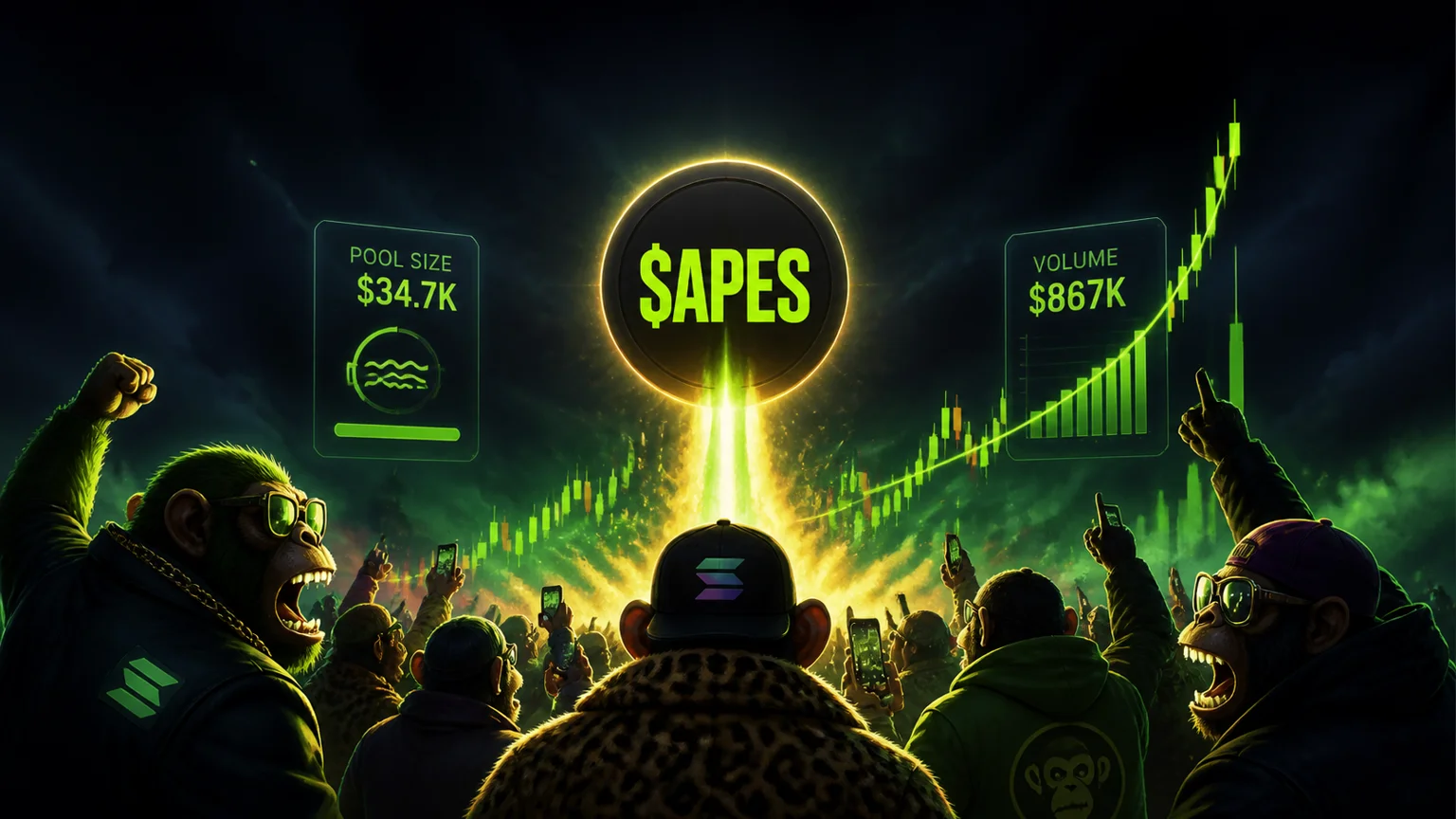
Low Rugcheck score, disabled authorities, and top-three concentration near 12.7% reduce obvious contract risk, but the liquidity base is small compared with the size and speed of the first-hour move.
$APES did not sneak onto the Solana screen. It arrived like a flare. The token is less than an hour old in the current market snapshot, yet it has already printed a 4,107% move, roughly $867K in reported 24-hour volume, and more than 18,000 transactions. That combination is exactly why launch-radar names are dangerous to ignore and dangerous to chase. The chart has already proven that buyers can move it. The unanswered question is whether those buyers are building a market or simply racing through a very small door.
The angle here is post-pump exhaustion, not because the token has failed, but because the first candle is so extreme that the second phase matters more than the first. A 4,107% first-hour move turns every buyer into a timing decision. Early wallets are sitting on massive paper gains, late buyers are paying for proof that has already happened, and the liquidity pool is still only around $34.7K. That is enough to make $APES tradable. It is not enough to make the move comfortable.
- → $APES launched into immediate velocity: about $867K in volume, 18,185 transactions, and a market cap near $297K in the first hour.
- → The contract-side profile is cleaner than the chart looks: mint authority disabled, freeze authority disabled, Rugcheck score of 1, and top-three holders near 12.7%.
- → The stress point is market structure. A 4,107% move against roughly $34.7K of liquidity can flip from breakout to exit queue fast.
The First Hour Was the Whole Story
Most new memes need time to become visible. $APES got the opposite problem: visibility arrived almost too quickly. The token’s market cap is only about $297K, but the day-volume read is already almost three times that number. In a normal market, that would look absurd. In Solana meme launches, it means the float is turning over aggressively and traders are trying to decide whether the opening pump is discovery or distribution.
The transaction profile adds weight to the move. The snapshot shows 9,824 buys against 8,361 sells over the tracked hour, which puts the buy ratio near 54%. That is a real bid, but not a clean squeeze. Sellers are already active while buyers are still pressing. For a token this young, that is the exact tension to watch. If $APES keeps absorbing sell flow while the holder base expands, the move can mature into a tradable range. If the buy side thins even slightly, the same transaction count can become evidence of churn rather than demand.
Ape Season Needs More Than a Candle
The ticker helps. Ape memes have a long history in crypto because they compress risk appetite into one word. Traders understand the signal instantly: this is not a serious utility pitch, it is a culture bid on risk, speed, and collective timing. That kind of simplicity matters when attention is moving quickly. $APES does not need a complicated pitch deck to be understood; it needs the chart to keep giving people a reason to repeat the ticker.
That is also the weakness. A broad meme category can attract fast money without creating durable loyalty. The first hour proves $APES can catch attention, but it does not prove that attention will stay once the easy percentage headline gets old. The strongest version of the trade would be a cooldown where price stops making new extremes, volume remains elevated, and liquidity increases. The weaker version is a chart that keeps demanding new buyers at higher prices while early wallets slowly feed the pool.
What the On-Chain Data Shows
The contract and holder data keep $APES from being an automatic danger read, even though the price action is already stretched. Rugcheck shows a score of 1. Freeze authority is disabled, mint authority is disabled, and the dev balance is listed at 0%. Those are important mechanical checks on Solana because open authorities can turn a live chart into a broken market. In this case, the obvious authority problems are not the reason to be cautious.
Holder concentration is also not extreme in the available data. The largest holder sits around 7.11%, the next two holders sit near 3.29% and 2.3%, and the top-three concentration is about 12.7%. The broader top-holder percentage from the market read is around 15.5%, which is relatively distributed for a launch this fresh. That is a constructive sign, but it should not be overread. A low concentration map at minute forty-five does not mean later holders are sticky, and it does not make liquidity deeper than it is.
The developer profile is quiet rather than dramatic. The enrichment shows no creator-token backlog and no listed Rugcheck risks. That matters because serial launch history or active authority controls would push this straight into rug-risk territory. Instead, the concern is market behavior. $APES has cleaner mechanics than many first-hour memes, while still carrying the classic risk of a chart that has already moved farther than its liquidity can comfortably support.
Where the Move Can Break
The pressure point is the pool. Around $34.7K of liquidity against $867K of reported volume means the market is hot but thin. That is not unusual for a fresh pump.fun token, but it creates a very specific hazard: the token can look liquid because the transaction count is huge, then trade poorly when a few larger sellers arrive together. A small pool amplifies both confidence and fear. It rewards early buyers when demand keeps stacking and punishes late buyers when the rotation gets crowded.
The second risk is psychological. A 4,107% headline changes how traders behave. Some people buy because the number is so large that they assume more attention must follow. Others sell because the number is so large that they assume the trade has already paid. That standoff can create violent candles in both directions. For $APES, the useful signal is not whether it can print another absurd percentage. It is whether price can form a range without the volume collapsing.
What Bulls Need to Prove Next
The bullish version of $APES is a controlled digestion phase. The token does not need to keep moving vertically to stay relevant. It needs enough bid support to show that the first-hour buyers were not the entire market. Holder count near 1,706 is already a decent base for a launch this young; the next useful improvement would be holder growth without the top wallets gaining too much share. More liquidity would be even more important, because deeper pools give later participants a reason to treat the chart as tradable instead of purely reflexive.
If those pieces show up, $APES can shift from pure first-hour mania into a watchable Solana meme. If they do not, the current move becomes the warning. The token is early, loud, and mechanically cleaner than the average panic launch. It is also extended, thin, and already asking new buyers to underwrite a giant first candle. That is why the rating stays speculative even with clean authority data.
🟡 Speculative watch: $APES has impressive velocity, clean mint and freeze authority checks, a low Rugcheck score, and manageable top-holder concentration. The issue is not the contract read; it is the market structure after a 4,107% first-hour move. Liquidity needs to deepen, or the next wave of selling can overwhelm the chart quickly.
What is $APES?
$APES is a new Solana meme coin launched through pump.fun, with early trading routed through Jupiter-linked markets.
Why did $APES pump so hard?
$APES attracted heavy first-hour trading, with roughly $867K in volume and more than 18,000 transactions while the token was still under a $300K market cap.
What is the main risk for $APES?
The main risk is post-pump exhaustion. The on-chain authority profile is cleaner than average, but liquidity is only around $34.7K after a very large first-hour move.