$BIBI Has the Binance Mascot Pitch and the Volume, but the Liquidity Trap Is the Real Trade
$BIBI ripped through roughly $12.03M of 24-hour volume on Solana after a Chinapumpwxc push, yet the cleaner question now is whether buyers are chasing a live meme or volunteering for a board where unlocked liquidity can change the script fast.
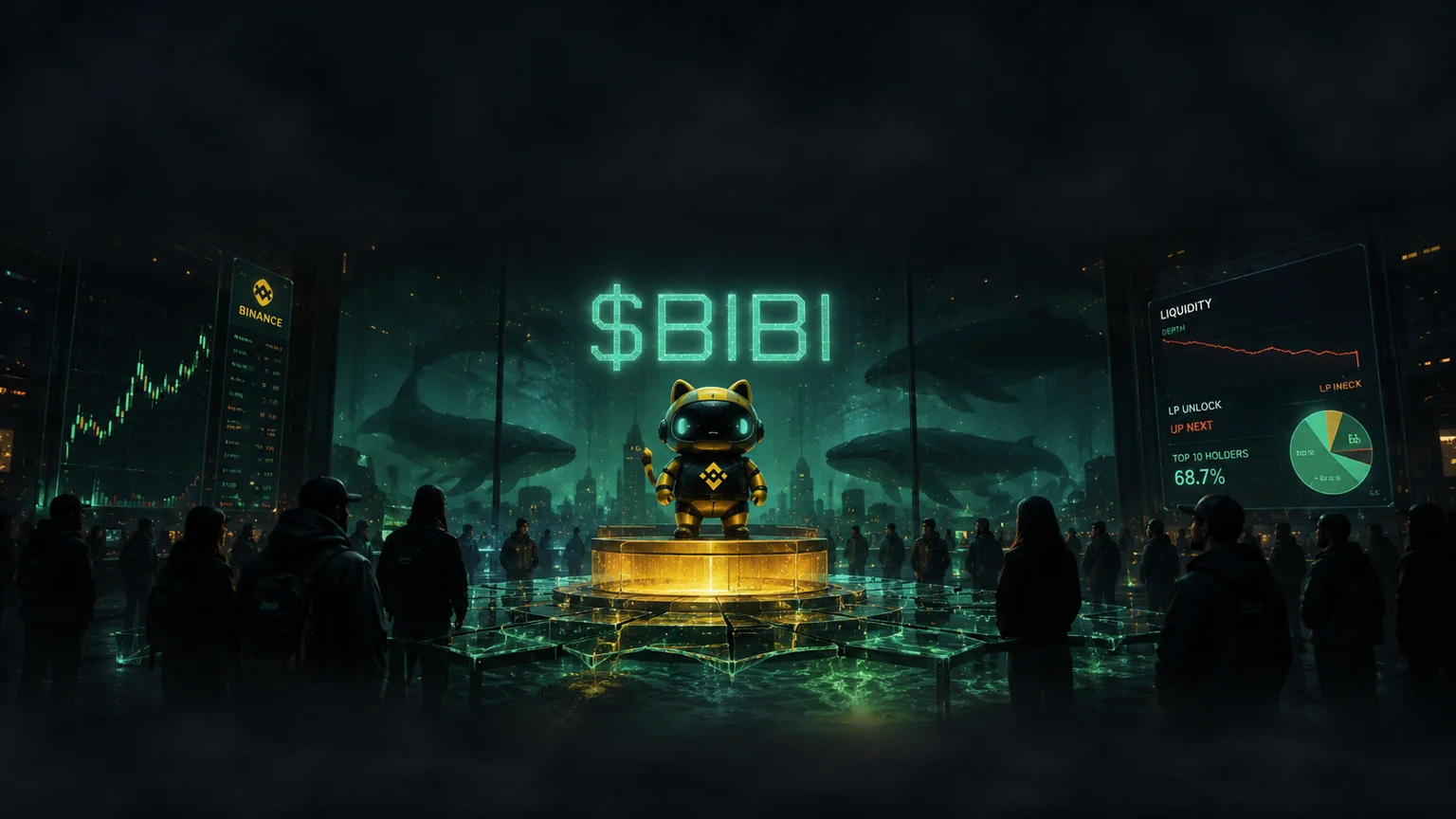
The contract permissions were already off, but Rugcheck still scored the token at 53 because a large amount of LP remained unlocked and the top three wallets controlled roughly 89.0% of supply at the saved snapshot.
$BIBI is getting the kind of attention Solana traders almost never ignore: a simple mascot pitch, a familiar exchange-adjacent meme, and enough turnover to make a tiny board look much bigger than it actually is. At the 2026-06-11 13:15 UTC reference snapshot, the token was sitting near a $50.6K market cap while printing roughly $12.03M in 24-hour volume against about $67.1K of liquidity. That headline number is why the board made it onto radar. The more important read is what sits underneath it. This is not a clean narrative reprice. It is a liquidity-trap setup where the meme can stay hot while the structure remains far more fragile than the volume makes it seem.
The catalyst is easy to understand. Chinapumpwxc pushed the line that $BIBI is the official mascot and AI assistant of Binance, which is exactly the kind of framing that can spread faster than facts in meme markets. Traders do not need a white paper when the meme already carries a built-in institutional fantasy. If enough people believe a board can piggyback on the Binance halo, they stop asking whether the token has earned its move and start asking whether they are still early enough to ride the next candle. That reflex is powerful. It is also how traders end up confusing distribution-friendly traffic with genuine durability.
- → $BIBI printed roughly $12.03M in 24-hour turnover at the 2026-06-11 13:15 UTC reference snapshot while the market cap still sat near only $50.6K, which tells you the board found velocity but not necessarily stable sponsorship.
- → The contract permissions were not the loudest red flag because freeze authority was disabled and mint authority was disabled, yet Rugcheck still scored the token at 53 due to a large amount of LP staying unlocked.
- → Supply is heavily clustered. The largest wallet held 66.95% of supply and the top three wallets controlled about 89.0%, which means the chart can look liquid right up until a few wallets decide the show is over.
Why the Binance Mascot Meme Travels So Fast
The market did not need a complicated story here. It needed a meme that could be repeated in one sentence and screenshot well. Exchange-adjacent mascots tend to do that because they borrow credibility from a brand without needing any actual relationship to the brand. That gap between familiarity and verification is where a lot of meme volume gets born. A ticker like $BIBI does not have to prove it belongs anywhere official. It only has to feel close enough to a giant brand for traders to imagine a bigger audience showing up after them.
That helps explain the turnover. More than $12M of daily volume on a microcap board is not something a token reaches by accident. It means the meme made it through several attention loops quickly: the first group that saw the pitch, the next group that saw the price action, and the final group that saw both and decided not to be the one left behind. When a board trades this much relative to its market cap, the danger is that traders begin treating turnover itself as proof of quality. In reality, it is often just proof that the token became an efficient venue for very short-term emotion.
What the On-Chain Data Shows
The first read is mixed in a way that matters. On the reassuring side, both admin-style authority flags were already off. Freeze authority was disabled and mint authority was disabled, so the most obvious contract-level trap doors were not the story at the saved snapshot. That matters because it narrows the risk away from simple permission abuse and toward market structure instead. But Rugcheck still scored the token at 53, which is not a number you shrug off on a fresh board. The reason is not hidden. A large amount of LP remained unlocked, meaning liquidity can still be pulled or altered in a way that changes the trading environment instantly.
The holder map is even louder. The pair wallet itself accounted for 66.95% of supply, while the next two wallets each held 11.04%. That leaves the top three wallets at roughly 89.0% combined. Even if one of those wallets reflects pool structure rather than an ordinary discretionary holder, the broader point does not change: this is not a widely distributed board. It is a board where a very small number of addresses still define how forgiving the market can be. In a setup like that, volume can create the illusion of democratic participation while supply remains concentrated enough for the board to turn sharp with very little warning.
Why This Looks Like a Liquidity Trap Instead of a Clean Runner
A clean runner usually earns that label because the board keeps expanding without needing a dangerous mismatch between surface activity and actual structural depth. $BIBI is not there. The tape is loud, but the loudness is doing too much of the persuasive work. When a token near a $50.6K market cap pushes more than $12M of turnover in a day, the temptation is to read that as proof that a floor exists somewhere below. The smarter read is almost the opposite. Volume this outsized can be the exact mechanism that hides how little real margin for error exists. Everybody sees movement. Fewer people ask how the board behaves if participation cools for even one cycle.
The unlocked-liquidity angle is what makes that question unavoidable. Traders often focus on admin keys because they are easy to explain. LP structure is subtler and often more dangerous in practice because it affects how the market breathes. A token can look fine while buyers keep stepping in and still become a different trade the moment liquidity conditions shift. If a large amount of LP remains unlocked, traders are not just betting on the meme and the crowd. They are betting that the market plumbing itself will remain friendly long enough for them to exit on their own terms.
What the KOL Push Actually Confirms
The Chinapumpwxc mention matters because it confirms that the board has already crossed from isolated chart action into social narrative. That is useful, but not in the simplistic way late buyers usually frame it. A KOL nod does not make the trade safer. It makes the trade more legible to the crowd. In the best case, that means another wave of demand arrives because the meme is now easier to repeat. In the worst case, it means the board receives exactly the attention needed to provide exits for wallets that got there earlier and understand the structure better than the feed does.
$BIBI has enough social and trading velocity to keep running, but a token with unlocked liquidity risk and an 89.0% top-three holder cluster can punish late conviction much faster than the headline volume suggests.
That is why the right posture here is not to dismiss the meme, but to respect the terms of the trade. $BIBI has clearly proven it can attract eyes, clicks, and repeat activity. It may even keep doing that for longer than skeptics expect if the Binance mascot line stays sticky. The issue is that none of those positives erase the structural imbalance. Traders chasing here are no longer paying for discovery. They are paying for continuation inside a board where the liquidity profile and holder map still tilt too much power toward a handful of addresses and one unresolved LP risk.
🟡 Speculative — $BIBI deserves attention because it already turned a simple Binance mascot narrative into one of the louder Solana volume prints of the session, with roughly $12.03M in 24-hour turnover and a 1168% daily move at the 2026-06-11 13:15 UTC reference snapshot. The reason it stops short of clean is structural, not cosmetic. Rugcheck scored the board at 53 because a large amount of LP was still unlocked, and the top three wallets controlled about 89.0% of supply. That combination can support explosive upside while demand is rushing in, but it also means the board can become hostile very quickly if the traffic slows or the liquidity conditions change.
What is $BIBI on Solana?
$BIBI is a Solana meme token trading under contract address 7KDHcZmRaX6AucX3vuzcjWXQETEjG8Uinjb6rymxcyhu. At the 2026-06-11 13:15 UTC reference snapshot it was sitting near a $50.6K market cap with roughly $12.03M in 24-hour volume.
Why is the main editorial angle a liquidity trap?
Because the board has already shown it can generate enormous turnover relative to its size, but the structure underneath that traffic still looks fragile. Unlocked LP risk and extreme holder concentration mean the market can stay exciting right up until it becomes much less forgiving.
Did the contract look obviously broken?
Not on the simplest permission checks. Freeze authority was disabled and mint authority was disabled at the saved snapshot. The bigger issue came from Rugcheck scoring the token at 53 because a large amount of LP remained unlocked.
What number matters most for risk here?
The top-three holder concentration near 89.0%. Even allowing for pool structure, that level of supply clustering means a very small group of addresses still has outsized influence over how smooth or violent the next move becomes.