$Babybara Just Graduated, But the Creator History Is the Trade
$Babybara has a cute capybara hook, nearly 1,000 holders, and a clean authority read. The problem is the deployer history, which turns this into a rug-risk watch instead of a simple launch chase.
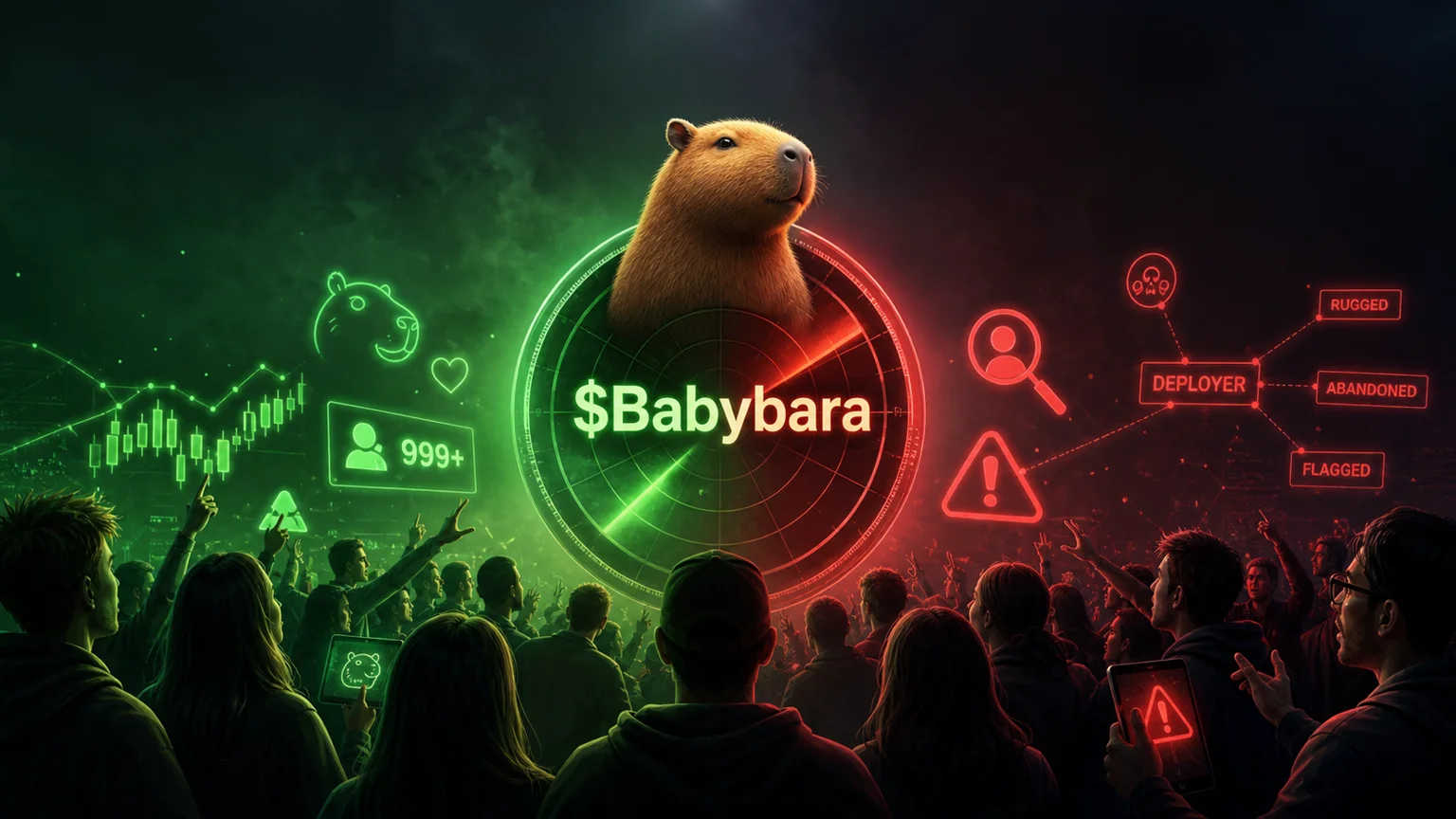
Rugcheck flags a dangerous creator-history pattern while the current holder map is not heavily concentrated.
$Babybara is the kind of Solana meme launch that looks easy to overread in the first quarter hour. It has the animal meme, the pump.fun graduation, the sub-$250K market cap window, and enough early holders to suggest the token is not just one wallet bouncing against itself. That is the bull case in one breath. The other breath is the part that matters more: the current contract looks cleaner than the deployer history behind it. That makes $Babybara less of a green-light chase and more of a live test of whether a cute culture bid can outrun a high-risk creator profile.
At selection time, $Babybara was trading around $0.00014592 with a market cap near $220K. The early all-time high sat around $231K, which means the first pullback was only about 4.8% below the peak. For a fresh pump.fun graduation, that is not a collapse. It is still inside the first-decision zone: buyers are deciding whether the capybara meme has enough stickiness to become a session trade, while faster wallets are deciding whether to rotate before the holder base gets tested.
- → $Babybara launched as The Capybara Pup and reached roughly a $220K market cap shortly after pump.fun graduation.
- → The holder map is not the main issue yet: about 984 holders, 22 snipers, and roughly 2.0% sniper-owned supply is not an automatic kill shot.
- → The creator profile is the uncomfortable part, with Rugcheck assigning an 80 score and flagging a history of rugged tokens.
The Capybara Trade
$Babybara is leaning on a simple meme surface: a baby capybara, marketed as The Capybara Pup, with a TikTok wildlife clip attached to the early social footprint. That matters because capybara memes are not abstract ticker games. They have a recognizable internet lane: calm, cute, slightly absurd, easy to remix, and friendly enough for retail timelines. In a market where a ticker can run before anyone understands the joke, that kind of visual shorthand can be enough to get the first wave of attention.
The problem is that memes with clean surfaces can still carry messy supply stories. $Babybara is not being watched because the capybara theme is revolutionary. It is being watched because the token arrived with a quick graduation, an early holder count near four digits, and a risk profile that forces a real editorial split. If the chart holds while volume expands, the market may decide the meme is the story. If liquidity thins or the deployer-related risk starts dominating the conversation, the cute wrapper becomes exit liquidity theater.
What the On-Chain Data Shows
The first read is mixed, not rotten. Rugcheck shows no active freeze authority and no active mint authority, which removes two of the most direct contract-level threats. A live freeze authority would mean transfers could be restricted. A live mint authority would mean supply could potentially be expanded. $Babybara does not show those two problems in the available report, so the contract controls are not the reason this token gets a yellow badge.
Holder concentration is also less extreme than the score might suggest. The top wallet shown in the report holds about 8.99%, and the top three visible wallets together sit near 14.0%. The broader selection data puts top-holder concentration around 17.5%, with roughly 984 holders in the early window. That is still early-launch concentration, and it can change quickly, but it is not the classic picture where one address towers over the entire market and dares buyers to ignore it.
The warning comes from the creator lane. Rugcheck assigns $Babybara a score of 80 and flags creator history of rugged tokens at danger level. The creator wallet, 69aiAKU3uJMxMLRkUEGFNt6nQ43PiVimE4ZbErJ7VSM1, is tied to 50 creator tokens in the report. That does not prove what will happen on this specific launch, but it changes the burden of proof. A serial deployer with a rug-history flag does not get the same benefit of the doubt as a clean first-time project.
The deployer still appears to hold a small current allocation, with selection data showing dev holdings around 1.06%. That can be read two ways. Bulls will argue a small retained balance limits direct dump pressure from the creator wallet. Bears will argue the creator-history warning matters more than the current balance because repeat deployer behavior is about pattern, not just one wallet snapshot. The useful read is narrower: the immediate holder map is survivable, but the origin story is not clean.
The key $Babybara question is not whether the capybara meme can get attention. It already did. The question is whether new buyers will accept an 80 Rugcheck score once the first launch rush fades.
The Numbers Behind the Rush
$Babybara reached the watchlist with around $4.8K in reported 24-hour volume and a market cap near $220K. That is not large-cap meme liquidity. It is a thin early market where a few committed buyers can make the chart look alive, and a few impatient exits can make the same chart look broken. The early high around $231K shows the token had not yet suffered a deep post-graduation unwind at the time of the snapshot, which keeps the trade alive but not proven.
The sniper data is one of the more constructive pieces. The signal recorded 22 snipers with about 2.0% of supply owned by that group. On fresh Solana launches, that is not harmless, but it is not an overwhelming sniper capture either. When sniper ownership is huge, the chart can become a delayed unload from the opening seconds. With $Babybara, the sniper footprint looks more like a factor to monitor than the central threat.
Why the Risk Is the Angle
Most tiny meme launches are either pure narrative or pure supply trap. $Babybara sits in the uncomfortable middle. The marketable part is easy to understand, the early cap is still small enough for degen imagination, and the contract read does not show mint or freeze authority hanging over every wallet. If that were the whole story, this would be a standard clean-runner watch.
But creator history changes how the tape should be graded. A danger-level history flag means buyers are not only betting on the meme. They are betting that this instance will break from the pattern, attract enough fresh demand, and avoid the behavior that gave the creator wallet its reputation. That is a much harder bet than simply asking whether a baby capybara can go viral.
This is where many early traders get trapped. They see a cute meme, a sub-$250K market cap, and a holder count that looks busy. Then they ignore the one data point that can make all of that irrelevant: whether the team or creator history gives the market a reason to trust the supply path. $Babybara has enough activity to deserve coverage, but not enough evidence to erase the creator-history warning.
What Would Improve the Read
The cleanest upgrade path for $Babybara would be boring in the best way. It needs time without a supply shock, volume that expands beyond a few early bursts, and a holder count that keeps broadening while top-wallet concentration stays contained. If the top wallets remain around the current range, the creator wallet does not become more threatening, and the chart holds above the initial graduation zone, the market can start treating the rug-history flag as context rather than destiny.
The other upgrade would be cultural. The TikTok-adjacent capybara source gives $Babybara a cleaner meme surface than a random ticker, but a link is not a community. The token needs remixes, posts, and repeat references that are about the capybara identity rather than just the candle. A meme with a real visual loop can survive longer than a ticker-only pump; a meme that only has a chart usually dies when the first holders get paid.
Where It Can Break
The bear case is not complicated. If buyers discover the Rugcheck score after entry instead of before entry, the token can reprice fast. A score of 80 plus a danger-level creator-history flag gives sellers a simple story to spread, and simple risk stories travel quickly on Solana. Even if freeze authority and mint authority are disabled, market trust can disappear before contract mechanics ever matter.
Liquidity depth is also unresolved in the available data. Market cap, holders, and volume tell part of the story, but thin liquidity can make the exit door much smaller than the headline valuation suggests. At a roughly $220K cap with only about $4.8K in reported 24-hour volume, $Babybara still needs a larger trading base before the market can pretend the price is durable.
That makes patience part of the signal. If $Babybara keeps printing higher participation while avoiding a sudden concentration spike, the trade gets more credible. If it chops sideways on fading volume, the creator-history risk will become the only thing people remember. Early meme coins rarely get judged by one datapoint; they get judged by which datapoint survives the first few hours.
$Babybara earns coverage because the launch has a real meme surface, a quick graduation, nearly 1,000 holders, and no obvious freeze or mint authority issue in the current report. It does not earn a clean rating because Rugcheck flags an 80 score and a dangerous creator-history pattern. The trade is whether the capybara bid can keep attracting demand despite that baggage. Until the market proves it can, $Babybara belongs in the speculative bucket.
What is $Babybara?
$Babybara is a Solana meme token also called The Capybara Pup. It graduated from pump.fun and was trading near a $220K market cap at the time of the latest MemeDesk snapshot.
Why is $Babybara considered risky?
The current contract read shows no freeze authority and no mint authority, but Rugcheck gives the token an 80 score and flags the creator for a history of rugged tokens.
Is holder concentration the biggest $Babybara problem?
Not yet. The top three visible wallets are around 14.0%, and broader top-holder concentration was around 17.5% in the selection data. The larger concern is creator history and whether liquidity can absorb exits.
What would make the $Babybara signal stronger?
A stronger read would need broader volume, stable or improving holder distribution, no creator-wallet pressure, and sustained meme demand after the first pump.fun graduation rush.