Two Watched Wallets Helped Put $POINTLESS on the Solana Feed, but the Creator History Keeps a Shadow Over the Sprint
$POINTLESS came into view with two watched-wallet buys, roughly $25.5K to $31.4K of visible liquidity, and more than half a million dollars of turnover in its opening stretch. The setup would look like a clean runner if the creator profile were boring. It is not: Rugcheck ties the deployer to dozens of prior rugged launches, which forces the trade into the category of momentum plus strict risk control.
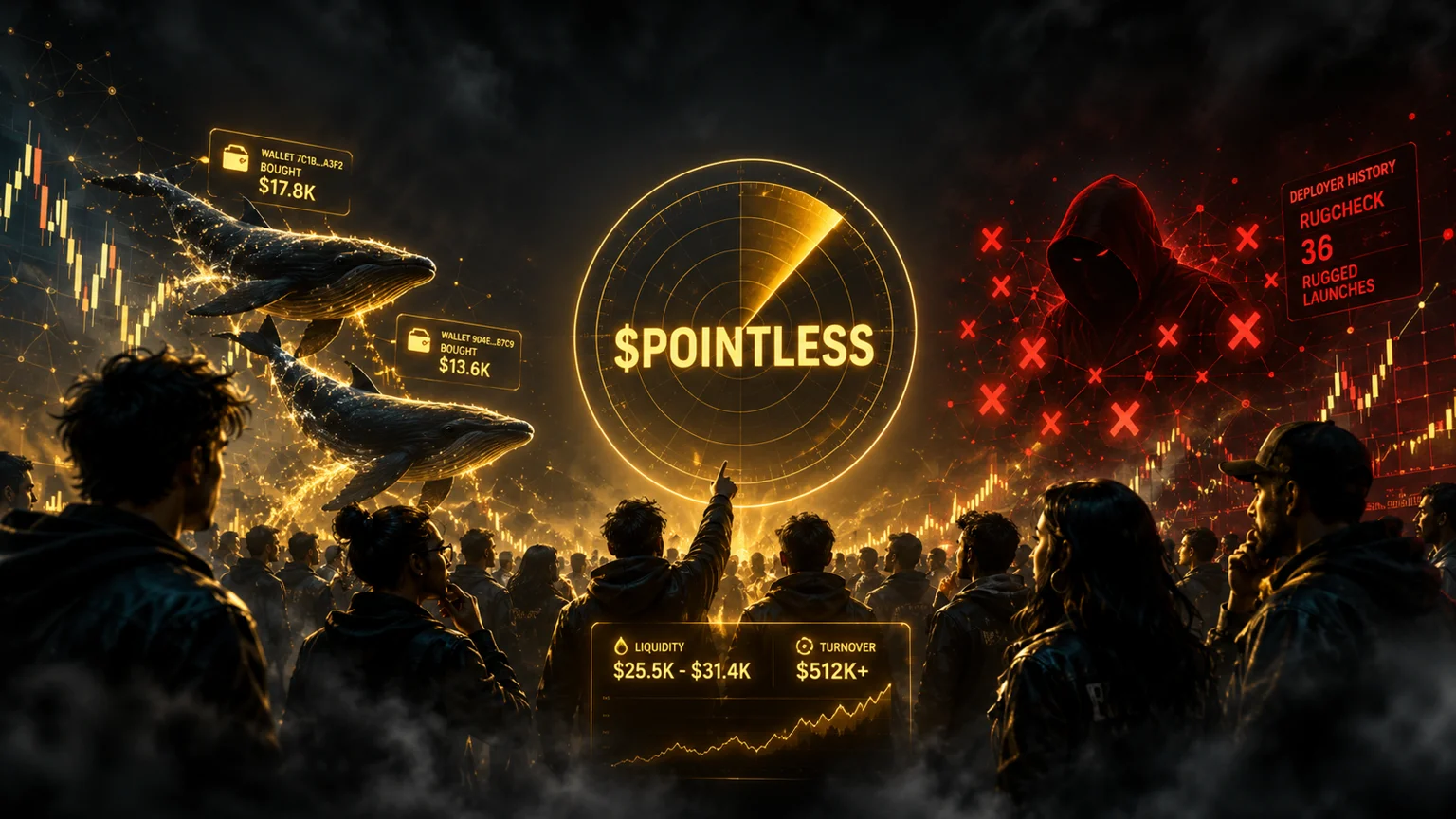
The holder map is comparatively loose for a fresh Solana meme, with the top visible wallet under 10% and the top three around 14.3% combined. The real red flag is creator history: Rugcheck scores the token at 79 and links the deployer to dozens of prior rugged launches.
The easiest way to misunderstand $POINTLESS is to focus only on how fast it found an audience. The token did the eye-catching part quickly: two watched wallets showed up before the board became standard feed material, the main pool built past the mid-five-figure liquidity zone, and turnover ripped into the high six figures almost immediately. On a normal Solana day, that is enough to earn the token a straightforward momentum write-up. What stops this one from becoming straightforward is not the visible holder map. It is the deployer history sitting behind the contract.
At the latest live read, $POINTLESS was trading near a $161K market cap with roughly $31.4K of visible liquidity and about $638K of turnover on the busiest pool. The one-hour line alone had done more than $537K. Those are meaningful numbers for a fresh board. They tell you there was real urgency, not just a thin candle printed into an empty room. But Rugcheck also scores the token at 79 and links the creator to dozens of prior rugged launches. That single fact changes the entire editorial posture. A fast tape with a loose holder map can still be interesting. A fast tape attached to a serial wrecking-ball deployer has to be read with much harder boundaries.
- → $POINTLESS moved fast enough to matter, with the main pool trading roughly $638K of volume and sprinting about 388% over its opening six-hour window.
- → The visible holder map is not the first problem. Freeze authority is off, mint authority is off, the top visible wallet sits under 10%, and the top three visible holders combine for only about 14.3%.
- → The actual caution sits in creator history: Rugcheck ties the deployer to roughly 43 prior launches and scores the profile at 79, which means traders are being asked to trust momentum on a board whose builder already carries a very bad reputation.
Why the Early Wallets Mattered
Fresh Solana runners do not become stories just because they pump. They become stories when the order of arrival suggests somebody was watching before the timeline was. That is why the watched-wallet angle matters on $POINTLESS. The scanner read flagged two monitored buyers before the board became a broader CT signal. In practical terms, that means the move did not begin as a pure retail dogpile. Some traders who spend their day surfing newborn tape clicked early enough to leave a footprint.
That does not make the token good. It makes the move legible. There is a real difference between a chart that accidentally catches a few late buyers and a chart that gets touched by people who actively look for asymmetry at launch. The former can still pump. The latter at least tells you there was a reason for speed beyond luck. With $POINTLESS, the market got an early hint that this was going to be a tradable event. The question changed almost immediately from whether the token could move to whether the move was being built on a foundation worth trusting.
The Tape Is Real Even If the Name Is a Joke
Those numbers matter because they show a real argument taking place on-chain. When a token worth roughly $161K can process more than half a million dollars of turnover in its opening stretch, traders are not just admiring the chart. They are fighting over inventory. The one-hour volume line above $537K is especially important because it says the move was not merely a stale cumulative total. The board was still noisy in real time.
There is also enough liquidity here to keep the trade from feeling completely fictional. Roughly $31.4K is not deep in absolute terms, but it is thick enough for a meme this small to look more serious than the average flash pump that dies on contact. That is why the board can tempt traders into forgetting the ugly part. A liquid-enough chart with a loose holder map and early-wallet sponsorship is exactly the sort of setup people want to believe is cleaner than it is.
What the On-Chain Data Shows
If you only judged $POINTLESS by the first-pass contract checks, the token would read better than the average fresh Solana board. Freeze authority is disabled. Mint authority is disabled. The top visible wallet holds about 9.54% of supply, and the top three visible holders combine for roughly 14.3%. That is a much looser opening distribution than the market often gets on day one, and it is exactly why the move cannot be dismissed as obvious insider theater. The holder profile is orderly enough to force a more careful read.
The problem is that on-chain diligence is not only about holder concentration. It is also about who built the thing. Rugcheck links this deployer to roughly 43 creator tokens and flags creator history of rugged launches as a danger-level issue. The normalized score of 79 is not a cosmetic warning. It is the center of the article. A token can have a loose opening holder map and still be carrying severe reputational risk if the same deployer has already burned the market enough times. That is exactly what makes $POINTLESS dangerous in a more subtle way than a straight one-wallet trap.
That subtlety matters because it changes how traders should interpret strength. On a cleaner board, a 388% sprint with watched-wallet participation might be the start of a bigger argument about how far the narrative can run. Here, the same numbers become a test of discipline. The chart can absolutely keep going. Fast markets tied to bad creators do that all the time. But the upside is inseparable from the need to assume trust can evaporate instantly once the crowd remembers who built the room.
Why the Shadow Matters More Than the Meme
The name Pointless Coin almost invites traders to lower their standards, which is part of why the setup can travel. In meme land, absurd branding often functions as a shortcut to attention because it tells everyone not to ask for a serious roadmap. That is fine. Nobody is buying these boards for discounted cash flow. The issue is that a jokey presentation can also hide the difference between harmless chaos and repeat-offender chaos. When the deployer history is this bad, the market has to treat every joke like a possible distraction device.
That does not erase the bull case. Watched wallets arrived early, the holder spread is workable, and the opening volume was strong enough to prove people wanted the trade. If the token keeps broadening ownership and survives the next wave of profit-taking, traders will keep finding reasons to press it. But the token is not being judged in a vacuum. It is being judged under the shadow of a creator profile that already taught the market to be cynical.
Verdict
🟡 $POINTLESS earns a speculative tag because the tape is real enough to matter and the holder map is materially cleaner than the average fresh meme sprint. Roughly $638K in turnover, about $31.4K in liquidity, disabled freeze authority, disabled mint authority, and top-three concentration near 14.3% all support keeping the token on screen. What stops the badge from turning greener is the creator history: Rugcheck links the deployer to dozens of prior rugged launches and scores the profile at 79.
FAQ
What is $POINTLESS?
$POINTLESS is Pointless Coin, a Solana meme token trading at contract address D4pi5eJNqT5mCzQcxAGfMavgVYLspfYkAQKKvQ8Xpump.
Why did $POINTLESS get covered so quickly?
The token had early watched-wallet participation and enough immediate turnover to prove the move was real, with the busiest pool clearing roughly $638K in volume during the opening stretch.
Does $POINTLESS look concentrated on-chain?
Not by fresh-launch standards. The top visible wallet sits under 10% and the top three visible holders combine for only about 14.3%, which is much looser than many same-session Solana runners.
What is the main risk on $POINTLESS?
Creator history. Rugcheck scores the deployer profile at 79 and links it to roughly 43 prior launches associated with rugged behavior, which means the market is trading momentum under a very poor trust backdrop.
Why is the rating still speculative instead of outright bearish?
Because the tape, liquidity, and visible holder map are strong enough to keep the token relevant in the short term. The caution is severe, but it sits in the deployer history rather than in an obvious freeze authority or one-wallet supply choke.