$MANIFEST Still Has Solana Attention After the Cooldown, but the Next Leg Has to Escape a Liquidity Trap
At the 2026-06-30 22:15 UTC reference point, $MANIFEST was trading near an $18.45M market cap with about $2.48M in 24-hour volume and roughly $815K in liquidity after a 20.3% daily pullback. CryptoGodJohn kept the name in circulation, the contract permissions still look unusually clean, and more than 13,000 holders prove the board is real, but 42.8% in the top three wallets means the bounce only matters if new demand arrives hard enough to overwhelm old inventory.
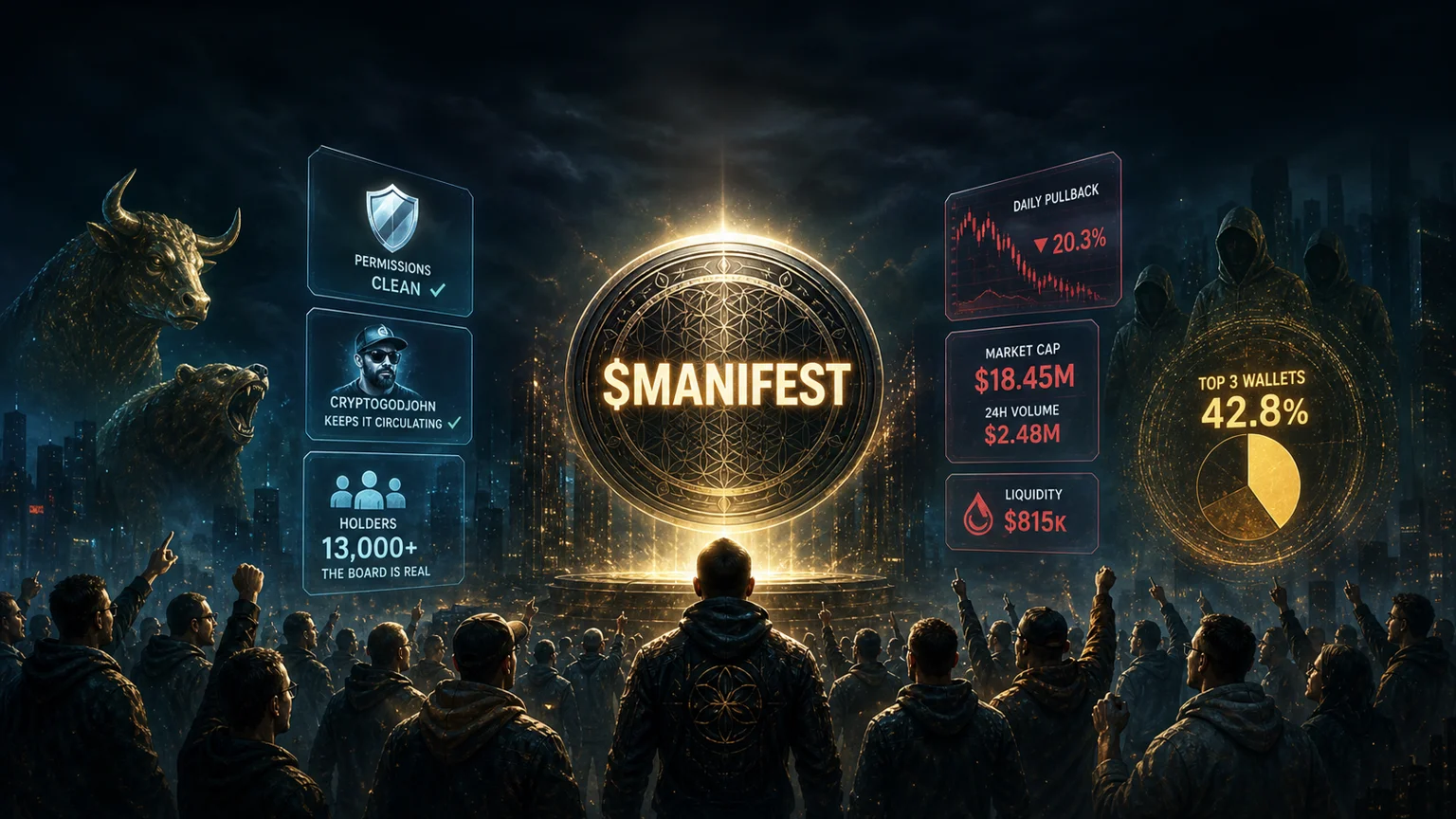
$MANIFEST has freeze authority disabled, mint authority disabled, and a rug score of 1, but the holder map is still heavy. The top wallet controls 22.99% and the top three wallets hold 42.8% combined, which means a liquid-looking board can still behave like a trap if fresh demand does not keep absorbing that inventory.
The easiest way to misread $MANIFEST right now is to focus on the fact that it cooled off. Cooldowns by themselves do not tell you much in meme markets. Plenty of good boards cool off because the first wave got too vertical. Plenty of bad boards cool off because there was never a second audience coming. The useful question is what survives after the heat drops. At the 2026-06-30 22:15 UTC reference point, $MANIFEST was still trading near an $18.45M market cap with roughly $2.48M in 24-hour volume and about $815K in liquidity after a 20.3% daily pullback. That is not a dead board trying to cosplay relevance. It is a live board in the uncomfortable middle phase where the chart has to prove whether demand is rotating in or only rotating out.
CryptoGodJohn matters here less as a discoverer than as a pressure gauge. Everyone already knows the ticker exists. The real value of a fresh mention from a high-reach CT trader is that it tests whether the market still wants to believe the board deserves premium attention after the easy money phase has passed. In other words, the call is not the story by itself. The response to the call is the story. If volume stays active during the cooldown and liquidity holds up, the market is telling you there is still unfinished business on the board. If attention fades the second the rebound stalls, then the call was just another excuse to recycle old inventory into hopeful late hands.
- → $MANIFEST was still pushing about $2.48M in 24-hour volume with roughly $815K in liquidity after a 20.3% daily pullback, which is a serious amount of activity for a board that was supposed to be cooling off.
- → The contract permissions remain clean with freeze authority disabled, mint authority disabled, and a Rugcheck score of 1, so the debate is no longer about hidden admin risk. It is about structure and supply.
- → That structure is the trap: the top wallet controls 22.99% of supply and the top three wallets hold 42.8% combined, so every bounce has to absorb heavy legacy inventory before it can become a true second leg.
Why the Pullback Is the Most Honest Part of the Chart
A board only tells the truth once it has disappointed somebody. During the first burst, almost every candle can look profound because nobody has had time to get trapped yet. After a meaningful pullback, the chart becomes more informative. Weak hands have already sold something. Chasers have already felt pain. Bigger holders have already seen the market hesitate. That is why the current $MANIFEST read is more valuable than a cleaner looking candle from an earlier day. The board has already survived enough discomfort to reveal what kind of market it really is.
The encouraging part is that the market did not leave. Roughly $2.48M in daily turnover on an $18.45M capitalization means traders are still interacting with the pair at real size. The liquidity pool around $815K also keeps the board in a tier where meaningful positions can still move through it without every trade feeling theatrical. That does not make the board safe. It does mean the market is still paying to have an opinion. For a cooldown story, that is what separates a repair attempt from a slow funeral.
The less encouraging part is that a liquid-looking board can still fail for structural reasons. $MANIFEST has enough depth to look healthy on the surface, but not enough to completely ignore where the inventory sits. A chart can stay active, a KOL can keep it in conversation, and the contract can stay clean, yet the next leg still gets smothered if too much supply remains parked with early wallets waiting for a better exit. That is why the pullback should not be read as either simple weakness or simple opportunity. It is a sorting mechanism.
What the On-Chain Data Shows
The clean-contract argument remains intact. Freeze authority is disabled. Mint authority is disabled. Rugcheck scores the token at 1. The creator wallet balance is effectively zero, and there is no visible serial-deployer history attached to this read that needs to dominate the article. Those details matter because they remove the cheap fear trade. Readers are not looking at a board where the obvious bear case is some hidden permissions bomb. The base-layer contract setup is about as calm as meme traders could reasonably ask for once a token has already become a recognizable Solana board.
The holder map is a different conversation entirely. The largest visible wallet controls 22.99% of supply. The second and third largest holders bring the top-three cluster to 42.8% combined. That is a lot of inventory sitting in very few hands for a token already worth nearly $20M. It does not automatically kill the trade, but it absolutely changes how the trade should be understood. A concentrated board can feel liquid when momentum is flowing in one direction. The trap appears when the same wallets that helped create the mystique start asking the market to buy them out at higher levels.
The holder count helps explain why the story is still alive instead of already broken. More than 13,000 holders means this is no longer a tiny private game. There is a real audience here. That audience is what keeps the concentration issue from becoming an automatic disqualifier. If the board only had a few hundred holders, the top-wallet problem would overwhelm every other input. With a five-figure holder count and an active liquidity base, $MANIFEST still has room to digest and broaden. The market just has to do that work before the concentrated inventory becomes the headline again.
How a Clean Board Still Turns Into a Liquidity Trap
The trap is psychological before it is mechanical. A token with clean permissions and strong brand memory invites traders to believe that every pullback is automatically a reload. Sometimes that is true. Other times the clean profile only makes it easier for the market to ignore supply problems that have not actually gone away. That is the current danger with $MANIFEST. The board looks reputable by meme standards. It has enough liquidity to make the chart feel institutional compared with the average trench launch. It has a recognizable CT sponsor and enough prior upside to keep believers emotionally attached. All of that can become fuel for a second leg, but it can just as easily become the story traders tell themselves while heavier wallets quietly distribute into strength.
This is why active volume during a drawdown is both bullish and inconclusive. Bullish, because the board clearly still matters. Inconclusive, because volume by itself does not tell you whether buyers are truly broadening the ownership base or merely churning against entrenched supply. The next decisive clue will not be a tweet or a slogan. It will be whether the board can keep defending liquidity while price tries to climb without immediately running into the same visible inventory wall. If that happens, the concentration risk starts to shrink in importance. If it does not, then the cooldown was never a reset. It was only a pause between distribution windows.
What Changes the Read From Here
The strongest upgrade would be boring strength. Not a vertical candle. Not another euphoric slogan wave. The market needs to see $MANIFEST hold a firmer base, maintain meaningful liquidity, and keep processing millions in volume while the chart stops looking panicked. That would suggest the board is actually transferring ownership instead of endlessly revisiting the same loyal crowd. A cleaner structure does not need all concentration to vanish. It only needs concentration to stop being the first thing traders mention when the move hesitates.
The downgrade case is just as clear. If the board keeps producing attention but every rebound dies in the same zone, then traders should stop pretending they are watching a neutral reset. They would be watching a concentrated market struggle to attract enough truly new capital to overpower old supply. That is the textbook version of a liquidity trap in meme terms: a board looks big enough, loud enough, and clean enough to tempt more buyers, yet never actually escapes the inventory that came with its first fame cycle.
🟢 $MANIFEST still earns a clean rating in the narrow MemeDesk sense because the contract permissions remain solid, the board still has real liquidity, and the turnover after the pullback proves attention has not evaporated. The reason this is a cautious green rather than a celebration is the holder map. With 42.8% of supply in the top three wallets, the next leg only counts if fresh demand can keep absorbing legacy inventory. Respect the activity. Do not ignore the trap sitting inside it.
FAQ
Why is $MANIFEST still worth watching after a 20.3% pullback?
Because the board stayed active during the cooldown. At the 2026-06-30 22:15 UTC reference point, $MANIFEST still had about $2.48M in 24-hour volume and roughly $815K in liquidity, which means traders were still paying real attention instead of abandoning the pair.
What does the on-chain profile look like for $MANIFEST now?
The basic contract read is clean. Freeze authority is disabled, mint authority is disabled, Rugcheck scored the token at 1, and the creator wallet does not carry an obvious retained balance problem. The main issue is not permissions. It is supply concentration.
What makes this a liquidity-trap setup?
The top wallet controls 22.99% of supply and the top three visible wallets hold 42.8% combined. That means a board can look healthy on volume and liquidity while still repeatedly stalling if new buyers are mostly absorbing old inventory instead of building a broader base.
What would improve the bullish case for $MANIFEST from here?
A better read would be steady base-building with continued liquidity and millions in daily volume while the market proves it can climb without instantly getting sold back into the same concentrated supply. That would suggest the cooldown really was inventory transfer rather than a disguised ceiling.