
$XCAT Rips 6,532% in Its First Hour as Solana Cat Liquidity Gets Tested
$XCAT has the cleanest contract read a brand-new pump.fun cat meme can ask for, but a $23K liquidity pool turns every bigger order into a stress test.
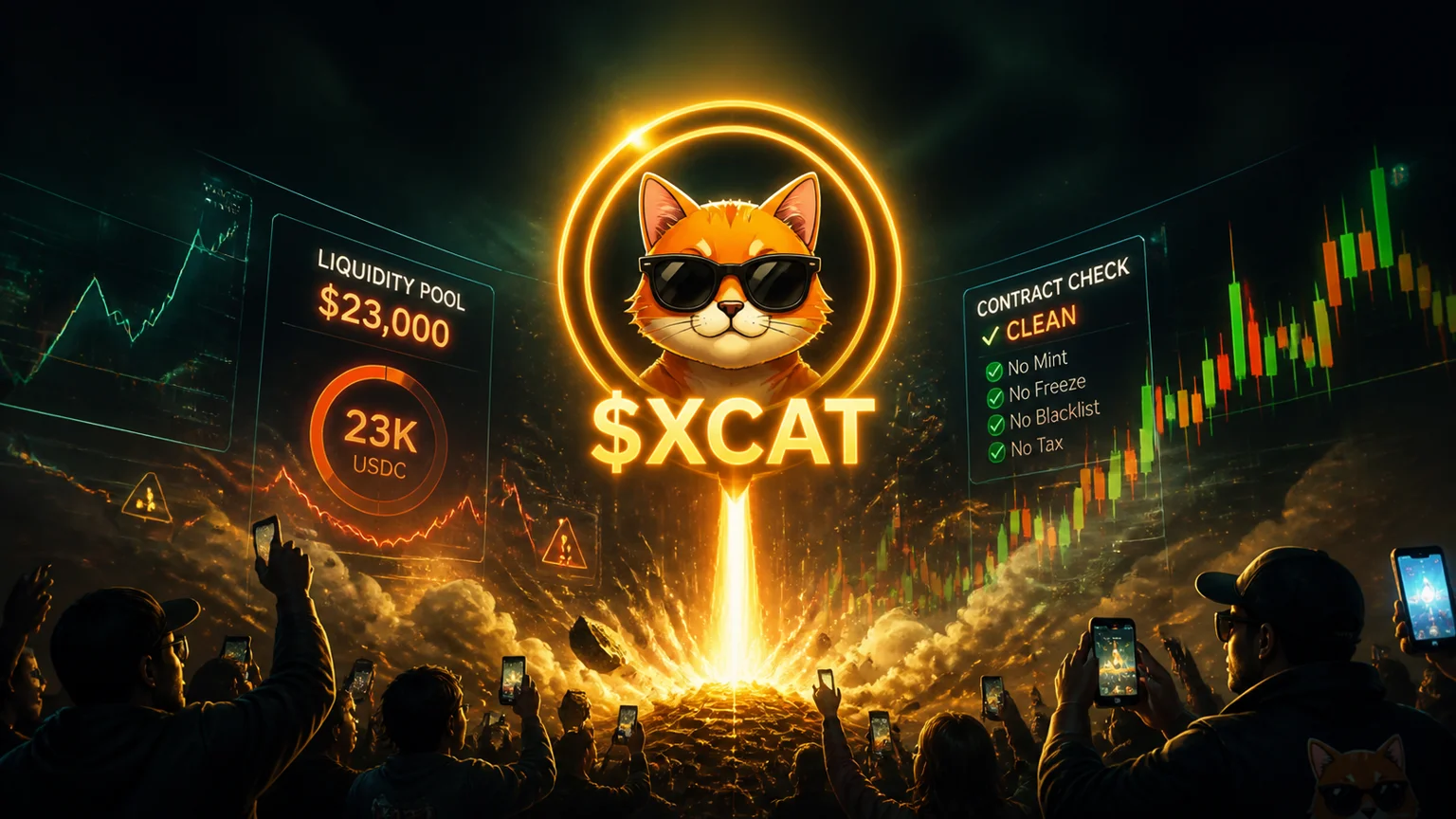
No major concentration risks from the top three holder read; the main risk is market depth, not contract authority.
$XCAT did the thing every tiny Solana cat ticker tries to do and almost none of them sustain: it turned a fresh pump.fun launch into a real first-hour tape. The token was only about 20 minutes old when the market data snapped into view, yet it had already printed a 6,532% one-hour move, roughly $1.17M in volume, more than 22,000 transactions, and a market cap hovering near $299K. That is not normal background churn for a microcap launch. It is a live auction where the crowd has arrived before the story has had time to harden.
The cleanest read is also the most dangerous read. $XCAT has a better early on-chain profile than many one-hour Solana memes: mint authority is disabled, freeze authority is disabled, the deployer does not appear to be sitting on a visible token stack, and the top-three holder concentration is not screaming disaster. The problem is not the contract read. The problem is whether a cat meme sitting on roughly $23.4K of liquidity can absorb the attention that a 6,532% candle attracts.
- → $XCAT launched through pump.fun and quickly moved to about $299K market cap after a 6,532% first-hour surge.
- → The tape shows roughly $1.17M in volume, 22,364 transactions, and about 2,014 holders, which is unusually busy for a launch this young.
- → The on-chain read is cleaner than average, but $23.4K liquidity means the exit door is still narrow if larger holders rush it.
The Cat Bid Arrived Fast
Cat tickers are never really just cat tickers on Solana. They are speed tests for how quickly a simple mascot, a readable symbol, and a working chart can become a coordination point. $XCAT has no complex thesis to sell. The symbol is short, the meme lane is obvious, and the market cap is low enough that small flows can still move the chart violently. That combination is exactly why the first wave can look explosive before there is any deeper proof of staying power.
The early transaction count matters more than the percentage candle by itself. A 6,532% move can be manufactured on weak liquidity with a handful of prints. More than 22,000 transactions in the opening window changes the read. It says $XCAT was not just a lonely chart spike; it had broad enough participation to keep the pair active while the first speculative crowd rotated through. The buy ratio near 53% is not euphoric, which is useful. It shows aggressive selling already met aggressive buying instead of the chart moving in a one-sided vacuum.
That is why the angle here is an organic volume anomaly, not a victory lap. $XCAT's organic score sat around 49.9, a middle read rather than a pristine one. In plain English, the activity looks noisy but not empty. The market is showing enough real participation to deserve attention, while still giving no reason to pretend the token has matured beyond its launch phase. For a meme this young, that is the right kind of tension: enough demand to matter, enough fragility to punish late entries.
What the On-Chain Data Shows
$XCAT's contract profile is the strongest part of the file. The mint authority is disabled, which removes the obvious unlimited-supply trap that still catches late buyers in sloppy launches. Freeze authority is also disabled, so the token does not show the basic transfer-freeze risk that turns some Solana launches into one-sided games. Rugcheck's normalized score came back at 1, with no listed risks in the report used for this read. That does not make a meme coin safe, but it moves the most obvious contract-level concerns out of the center of the story.
The holder map is also not where the biggest warning sits. Rugcheck showed the largest visible holder at about 10.2%, with the next two around 2.55% and 2.52%. That puts the top three near 15.3% in the live Rugcheck read, while the broader market enrichment showed top-holder concentration in the high-teens. For a just-launched meme, that is not perfectly distributed, but it is far from the classic one-wallet stranglehold. The first holder is big enough to matter. It is not big enough, on its own, to define the whole chart.
The creator profile is quieter than usual. The creator wallet listed in the report is not showing a visible creator balance, and the available creator-token count is zero. That means this read does not lean on a serial-deployer warning or a deployer-bag overhang. The market still has plenty of ways to break, but the obvious early failure modes are more about liquidity and crowd behavior than a dirty authority setup. If $XCAT fails from here, the data points first toward a normal meme-coin unwind rather than an immediately visible contract trap.
The Liquidity Is the Real Test
A $299K market cap with $23.4K in liquidity is exciting until size shows up. That pool can support retail rotations and fast flips, but it cannot yet support a wave of holders trying to exit at the same time. This is the number that should keep the read grounded. $XCAT can look strong on a percentage chart while still being structurally easy to move. A few larger wallets leaning in can make the candle look heroic. A few larger wallets leaning out can make the same chart feel broken in minutes.
The 24h volume-to-liquidity relationship is the whole story. About $1.17M of volume against roughly $23.4K of liquidity means the token is turning over many multiples of its pool depth. Sometimes that is early demand discovering price. Sometimes it is churn, bots, and fast hands repeatedly passing inventory back and forth. The market does not need to choose one explanation yet. The better editorial read is that $XCAT has graduated from invisible launch to active speculation, but it has not graduated into a deep enough market to deserve a clean green read.
$XCAT's contract and holder reads are cleaner than the usual one-hour Solana flyer. The liquidity read is not. With only about $23.4K sitting in the pool, price discovery can stay violent even if the crowd keeps showing up.
Why This Still Belongs on Radar
The case for watching $XCAT is not that it has proven itself. It has not. The case is that the first-hour tape combined three things that usually do not appear together this quickly: holder breadth, transaction intensity, and a cleaner-than-average authority profile. A token can run on pure symbol recognition for a while if the chart keeps creating new believers. The cat lane has that advantage because it requires almost no explanation. Traders do not need a roadmap to understand what the meme is trying to be.
There is also a clean narrative simplicity here. The market has spent years teaching Solana degens to chase short, readable tickers that can travel through screenshots. $XCAT is exactly that kind of object. It is not trying to be clever. It is trying to be instantly understood. When a token with that kind of symbol gets a million-dollar volume print before the first hour has cooled, the next question becomes whether the holders who arrived early are building a base or only creating exit liquidity for the first wave.
The next useful signal is not another huge green candle. It is compression without collapse. If $XCAT can hold a meaningful slice of the move while liquidity deepens, the read improves fast. If volume stays high but liquidity remains stuck near current levels, the token stays in danger of becoming a beautiful chart with no door wide enough for everyone inside. That is the difference between a meme finding a base and a launch merely renting attention.
The Bear Case
The bear case is simple: $XCAT may already have done too much too fast. A 6,532% first-hour move pulls in momentum traders, copy-traders, and impatient holders who judge every five-minute candle like a referendum. That crowd can be useful on the way up and brutal on the way down. If the chart stops rewarding immediate entries, the same transaction intensity that made $XCAT look alive can turn into sell pressure.
Liquidity also limits how generous the market can be. Thin pools make every narrative more fragile because they exaggerate both confidence and panic. Even with disabled mint and freeze authority, a token can still fail if the first wave loses discipline. The top holder near 10.2% is not an emergency by itself, but it is still a wallet worth watching. If larger balances start distributing into a pool this small, the cleaner contract read will not save the chart from slippage.
$XCAT earns a speculative watch, not a clean pass. The contract read is better than average, holder concentration is manageable for a brand-new Solana meme, and the first-hour volume is real enough to matter. The weak point is liquidity. Until the pool gets deeper and the market proves it can absorb sellers after the first burst, $XCAT is an organic volume anomaly with upside attention and very little room for sloppy exits.
What is $XCAT?
$XCAT is a fresh Solana meme token launched through pump.fun with the contract address 6khz9z3k4CzxUBA5mWzZghPJDxmqLT7qsKmYTXYeaRQj.
Why is $XCAT on MemeDesk radar?
$XCAT printed a 6,532% first-hour move with about $1.17M in volume, more than 22,000 transactions, and roughly 2,014 holders while showing disabled mint and freeze authority.
What is the biggest risk for $XCAT right now?
The biggest visible risk is liquidity depth. About $23.4K in liquidity is thin compared with the volume already moving through the token, so exits can become volatile quickly.
Does $XCAT have obvious contract red flags?
The available Rugcheck read shows disabled mint authority, disabled freeze authority, a normalized score of 1, and no listed risks. That is cleaner than average, but it does not remove normal meme-coin market risk.