
$X Turned the Internet's Simplest Ticker Into a Violent Solana Liquidity Test
$X was less than an hour old at the saved 03:14 AM UTC read, up about 772% with $2.15M in volume, 33,101 transactions, and only $8.6K in liquidity behind the whole board.
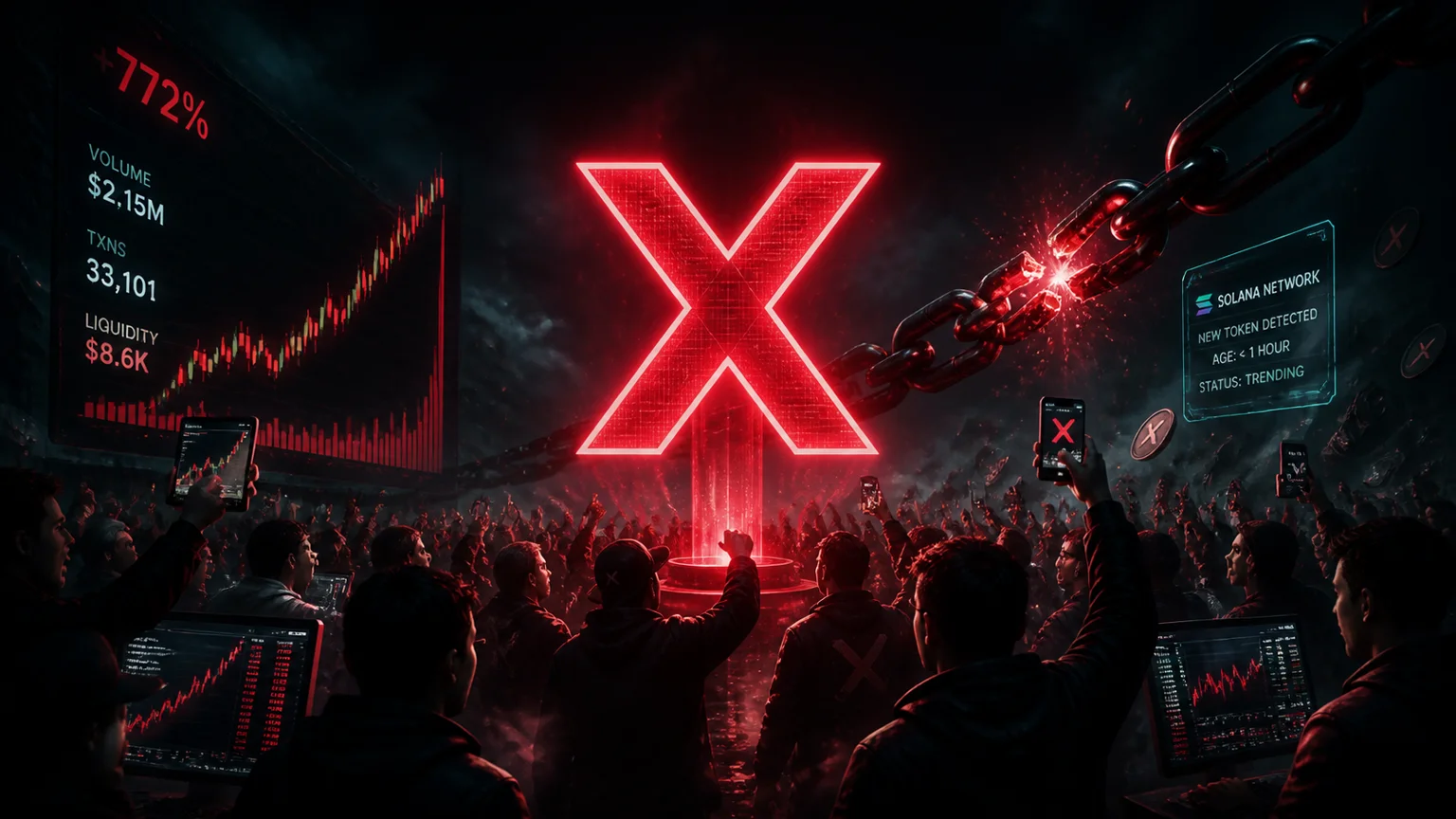
$X shows disabled freeze and mint authority, Rugcheck score 1, no listed risks, a zero creator balance in the saved profile, and top-three holder concentration near 26.0%.
$X is the kind of Solana launch that makes the whole board stop scrolling, partly because the ticker is almost too obvious. At the saved 03:14 AM UTC read on August 25, 2026, $X Coin was only about 47 minutes old and already up roughly 772% across every visible time window. The market cap was still just $45.6K, but the token had already pushed about $2.15M in tracked volume through 33,101 transactions. That is not a sleepy launch finding its first bid. That is a tiny pool getting discovered by a crowd that understands how powerful a single-letter cashtag can be.
The question is whether that simplicity creates durable demand or just a perfect trap for impatient buyers. $X has the clean parts traders want to see early: disabled mint authority, disabled freeze authority, a Rugcheck score of 1, no listed risks in the saved profile, and a creator wallet that reads at zero. The problem is not the contract shell. The problem is scale. A $2.15M volume print sitting on only $8.6K of liquidity is not a calm market. It is a speed run where every larger exit can become part of the chart.
- → $X was roughly 47 minutes old at the saved read and had already printed about $2.15M in volume around a $45.6K market cap.
- → The ticker is the whole hook: a one-letter cashtag that can collide with broader internet culture and travel faster than a normal pump.fun joke.
- → The on-chain profile looks cleaner than the liquidity does, with disabled mint and freeze authority, Rugcheck score 1, and top-three holder concentration near 26.0%.
The Cashtag Is Doing the Heavy Lifting
Most early meme coins need a pitch. $X does not. The token gets its first advantage from being instantly recognizable, searchable, and ambiguous. It can be read as a platform reference, a single-letter flex, a chart marker, or just a ticker so short that it feels bigger than the project behind it. That does not make the token important by itself, but meme markets do not wait for white papers. They reward symbols that spread quickly, and $X is engineered by accident or design to fit that behavior.
The market reaction makes that visible. The saved window showed 17,171 buys against 15,930 sells, a near-balanced fight with the buy side slightly ahead. That is a better read than a one-sided spoof pump because sellers were already present, profits were already being taken, and the token was still trading enough to keep repricing. A launch can fake a candle more easily than it can fake tens of thousands of interactions in under an hour. $X had the interaction count. Now it has to prove that the interaction count was not just first-hour ticker tourism.
A Huge Board on a Tiny Base
The volume-to-liquidity gap is the center of the article. Roughly $2.15M in turnover against $8.6K in liquidity means the board is active, but it also means the chart is extremely sensitive. Small fresh buys can look heroic. Slightly larger sells can look brutal. That is why the same number can be bullish and dangerous at once. $X has enough motion to deserve launch-radar attention, but the depth is too thin to treat the first candle as proof of strength.
The holder count gives the setup a more serious edge. More than 1,000 holders inside the first hour is not normal background noise, especially at a market cap still below $50K. It suggests the token widened quickly beyond the earliest wallet cluster. But early holder counts on Solana can be messy. Some wallets are tiny, some are fast flips, and some only exist because bots and manual traders both chase the same obvious ticker. The real test is whether holders keep growing after the first wave has already seen the headline move.
What the On-Chain Data Shows
The Solana authority read is the best part of the $X profile. Freeze authority is disabled, mint authority is disabled, and Rugcheck scored the token at 1 in the saved profile. That removes the most direct contract-level fears from the first pass. A token with a live freeze switch or open mint would deserve a much harsher read because the deployer could change the rules after buyers arrive. $X does not show those obvious controls in the current data.
Holder concentration is more mixed. The largest visible holder sits at 19.63%, while the next two are 3.51% and 2.84%, putting the top three near 26.0%. None of those top holders are marked as insiders in the saved profile, and the creator balance reads at zero, which keeps the structure from looking immediately toxic. Still, a nearly 20% largest holder is not a detail to ignore when liquidity is this light. Even if that wallet is not an insider, the market still has to absorb whatever large balances decide to do next.
There is also no serial-deployer warning in the saved profile. Creator-token history is blank, listed risks are empty, and the dev wallet is not sitting on a visible balance. That helps the speculative rating stay constructive instead of sliding into a rug-risk warning. The weakness is not that $X looks like an obvious admin trap. It is that the token is so early and so thin that normal profit-taking can behave like a structural event.
Why This Can Flip Fast
$X is strongest when the market treats the ticker as a cultural shortcut. It becomes weaker the moment traders start asking what else exists beyond the symbol. The launchpad tag explains the speed, but it does not give the token a deeper community, a wider story, or a second-day reason to care. Sometimes the simplest memes do not need any of that. Other times the simplicity is only enough to produce the first stampede.
That is why liquidity matters more here than usual. A token can be clean on permissions and still be a rough trade when the pool is narrow. $X has already shown that buyers can arrive quickly. What it has not shown yet is whether the pool can handle slower, more deliberate trading once the easy volatility cools. The bear case is not complicated: early winners sell into a shallow bid, the market cap snaps back toward the liquidity base, and the cashtag becomes a reminder that obvious tickers attract fast exits too.
$X is not a contract-warning story right now. It is a liquidity-pressure story wrapped in the cleanest possible ticker.
The Editorial Read
The right way to read $X is as a cashtag collision with enough early activity to matter and enough fragility to stay honest. The bullish read is simple: the ticker travels instantly, the transaction count is huge for the age, the authority checks are clean, and the holder base got wide quickly. The skeptical read is just as simple: the market is trying to price a one-hour meme on less than $9K of visible liquidity.
That combination earns a speculative launch-radar slot rather than a clean badge. $X is not being dismissed, because the saved data is better than a random low-float blink. It is also not being treated like a settled runner, because the first move already carried a 772% gain and the next serious sell cluster may reveal how little depth is underneath. If the token keeps expanding holders, adds liquidity, and sustains volume after the ticker novelty fades, the read improves. If volume stays huge while liquidity stays tiny, the trap door remains the story.
🟡 Speculative — $X has a cleaner-than-average contract read for a brand-new Solana launch, with disabled mint authority, disabled freeze authority, Rugcheck score 1, no listed risks, and a zero creator balance in the saved profile. The reason it does not get a cleaner rating is liquidity: $2.15M in volume, 33,101 transactions, and a 772% move are all sitting on a pool near $8.6K. The ticker is powerful, but the board still has to prove it can survive exits.
What is $X Coin on Solana?
$X Coin is a pump.fun-launched Solana meme token using contract address FS5Y6q6hXiAeH5nyzA2L6qWEn8yiqbBTdGZwzaxrSLN9.
Why did $X get attention so quickly?
$X combines an extremely simple one-letter cashtag with a violent first-hour move, about $2.15M in tracked volume, and more than 33,000 transactions at the saved read.
Is the $X contract showing obvious authority risks?
The saved profile shows freeze authority disabled, mint authority disabled, Rugcheck score 1, no listed risks, and a creator wallet balance of zero.
What is the main risk on $X right now?
Liquidity. The token had only about $8.6K in visible liquidity at the saved read, so price can move violently in both directions even if the contract profile looks clean.