
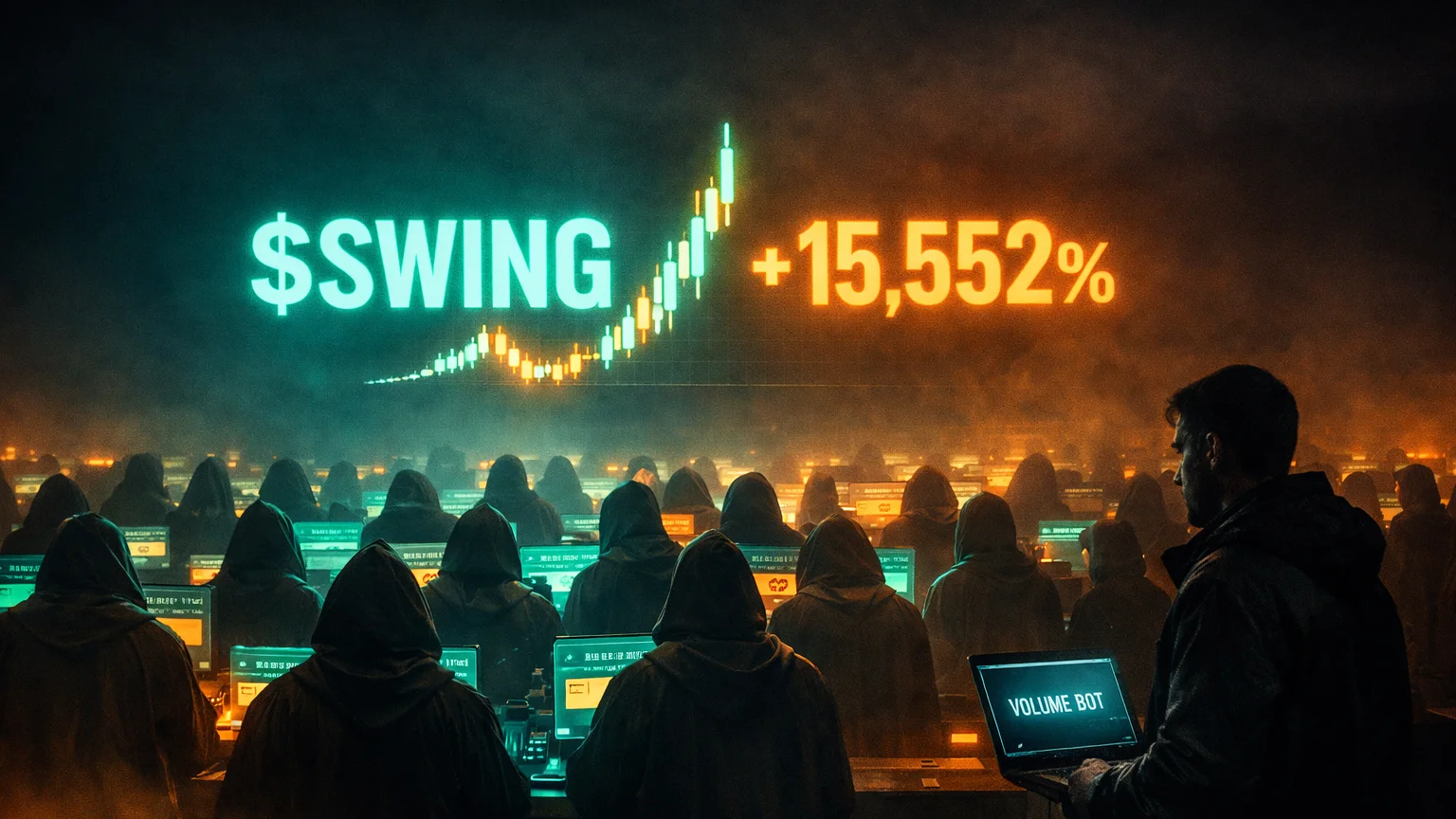
+15,552% in Six Hours: SWING Is a Live Demo of Jupiter's Volume Bot Playbook
The Last Swing isn't a meme coin story. It's a blueprint. Jupiter Studio's no-code volume bots are now accessible to anyone with $50 and an afternoon — and what just happened to $SWING is what Solana's scanner ecosystem looks like when the tooling goes mainstream.
Top holder owns 20.69% of supply
The token is called The Last Swing. The 6-hour chart reads +15,552%. The 1-hour number is +3,889%. The market cap, at the time of this writing, sits just under $365,000.
None of those numbers are organic.
What happened to $SWING tonight isn't a meme going viral, a whale discovering a low-cap gem, or retail momentum finding a narrative. It's a near-perfect demonstration of what Jupiter Studio's no-code volume bot infrastructure looks like in live execution — and why trading off DexScreener hot pairs in Q1 2026 requires a completely different mental model than it did twelve months ago. The tooling that used to require coding skill and capital now requires neither. Anyone with a working wallet and about $50 can manufacture a price chart that triggers every scanner on the Solana ecosystem simultaneously.
- → $SWING's +15,552% move in 6 hours is a textbook demonstration of manufactured scanner momentum — not organic market discovery
- → $364K market cap against $1.21M in 24h volume is a 3.3x volume-to-mcap ratio that only makes structural sense if the volume isn't net new buyers
- → Jupiter Studio's no-code tooling has removed the technical barrier from volume manipulation — this is the new Solana meme default
What Happened
The Last Swing launched on pump.fun — a fresh Solana contract, no prior community, no narrative infrastructure, no doxxed team. Just a token name vaguely evocative of a final bet, and a chart that started printing vertical candles within hours of launch.
The mechanics followed a pattern that Solana forensics accounts have been documenting with increasing frequency since late 2025. Volume concentrates in a tight window, the price action prints a near-vertical candle series, and within minutes the token surfaces on Jupiter's trending section, DexScreener's hot pairs feed, and CT aggregator accounts that scan for unusual price velocity. The amplification loop runs automatically: scanner hit triggers CT post, CT post drives clicks, clicks drive perceived FOMO, FOMO drives more volume.
$SWING moved from near-zero volume to over a million dollars in 24-hour trading across a window where the 6-hour gain hit 15,552% and the 1-hour read 3,889% at peak. The move was steep enough and concentrated enough to trigger the automated detection systems feeding every major Solana aggregator simultaneously. That simultaneity isn't a coincidence — it's the optimization target. The bot isn't trying to make the chart look good to human eyes; it's trying to make it look good to algorithms.
The Degen Translation
Jupiter Studio released volume bot tooling that made coordinated trading accessible without writing a single line of code. The architecture is straightforward: deploy a token on pump.fun, point the bot infrastructure at it, configure a buy/sell rhythm that produces the visual signature of organic momentum — sustained buy pressure with periodic retracements that keep the chart from looking robotic, enough liquidity cycling to register on volume scanners as significant activity.
The result is a token that looks, from the outside, exactly like a grassroots discovery. The volume is real in the sense that transactions are executing on-chain. The price movement is real in the sense that the chart is technically accurate. What isn't real is the signal: there's no crowd of retail degens independently finding this token and aping in because they believe in the thesis. There's software executing a playbook against scanner algorithms.
This has materially changed the information value of DexScreener hot pairs. In 2024, a hot pairs hit carried a reasonable prior probability of organic momentum. In Q1 2026, after Jupiter Studio tooling has been circulating and iterating for several months, every scanner hit requires an additional layer of analysis: is this discovery or fabrication? The chart no longer answers that question. The volume no longer answers that question. You need the on-chain wallet data and the timing signature to distinguish them — and even then, it's not always clear.
$SWING doesn't answer the question. It just demonstrates how completely the manufacturing mimics the discovery — and how accessible the manufacturing has become.
The Numbers
The volume-to-market-cap ratio is the diagnostic number here. At 3.3x — $1.21M in volume against a $364K market cap — the math only holds if the same capital is cycling repeatedly rather than net new buyers accumulating. Organic meme momentum can produce ratios above 1x in early discovery phases. The 3x+ range at sub-$500K market cap is almost exclusively a manufactured signal signature. It means the token has traded its entire market cap three times over in 24 hours, which requires either an extraordinary number of retail participants or a small number of coordinated actors running volume.
Liquidity sits at $81,838 — notably higher than you'd expect for a pure bot operation. Most volume-manufacturing setups run thin liquidity to maximize price impact per dollar spent; heavier liquidity provision suggests either a more sophisticated setup, more initial capital deployment, or genuine organic participation alongside the manufactured layer. This is one of the few data points on $SWING that cuts against a pure bot narrative.
Who's Behind It
The deployer wallet — 7HUG8bNkLEADb8NTpkYWPHHWHpLSCZ7TwxDLXBT83h1b — shows zero prior token deployments. First-time deployer, clean technical setup, no freeze authority, no mint authority. Rugcheck gives the contract a risk score of 1 out of 100 — essentially a perfect technical health score.
This is consistent with a Jupiter Studio bot operation: the technical parameters are deliberately clean to pass automated screening. The signal risk isn't in the smart contract — it's in the off-chain coordination. A first-time deployer with a perfect Rugcheck score and a +15,552% chart tells you nothing about whether the volume is real. It just tells you the operator knows how to set up a clean contract.
Top holder concentration is moderate: 20.69% in the largest wallet, 6.96% second, 3.76% third. Combined, the top three wallets hold 31.4% of supply. At $364K market cap, that's approximately $114,000 concentrated across three addresses. Not extreme for a fresh pump.fun launch, but meaningful — particularly the 20.69% top wallet, which has enough supply to move price significantly if it decides to exit.
Is This Sustainable?
On the meta level: the Jupiter Studio volume bot tooling is documented, widely discussed in CT, and not going anywhere. The no-code accessibility means the barrier to entry for manufactured momentum is now effectively a low three-figure investment and a few hours. The weekly volume of new Solana tokens is already enormous; the fraction using manufactured momentum tooling will only grow as more operators learn the playbook.
For $SWING specifically: the pump is either still building or approaching the unwind window. There's no fundamental narrative, no community, no organic catalyst to sustain price after the bot activity normalizes. The token name — The Last Swing — is either a coincidence or the operator being darkly self-aware about the arc. Either way, the fundamental scenario for holders who bought into the pump is a race to the exit.
The broader question $SWING surfaces is more interesting than the token itself: at what point do DexScreener and Jupiter build detection directly into their ranking algorithms? The volume bot tooling is publicly documented. The signature patterns are known to anyone paying attention. The platforms have both the data and the incentive to filter manufactured signals — the question is whether they've decided it's worth doing. Until they do, every hot pairs chart requires manual verification of what you're actually seeing.
For degens who trade the DexScreener feed: $SWING is a useful education. The volume-to-mcap ratio, the vertical candle structure, the simultaneous multi-scanner pickup — these are the observable signatures of the playbook. Learn to see them in real time, and you're ahead of the majority of retail traders who still treat scanner hits as organic discovery.
🟡 Speculative — The manufactured nature of $SWING's pump is structurally clear. The volume-to-mcap ratio, the bot-consistent candle signature, and the zero-narrative deployment all point to a Jupiter Studio volume play. Whether there's a momentum window left before the unwind is genuinely uncertain — the bot may still be running. The trade, if any, is a knife-catch with a hard stop. The real value of covering $SWING is the meta insight: this is what Solana's scanner ecosystem looks like now. Build your read accordingly.
What is The Last Swing ($SWING) token?
$SWING is a Solana pump.fun token (contract: 2izfNJ5bACaQDKyqGUYicSKhFE963TnkBo9tWxiqpump) with no narrative, community, or prior history that generated a +15,552% move in 6 hours on $1.21M in 24-hour trading volume. It has no official website, team, or project. The interest it generated comes entirely from scanner pickup of its manufactured price action.
What is a Jupiter Studio volume bot?
Jupiter Studio offers no-code tooling that allows anyone to deploy coordinated trading bots against a Solana token. The bots execute buy/sell patterns designed to mimic organic momentum, triggering DexScreener hot pairs rankings and Jupiter trending sections. The tooling requires no coding knowledge and relatively low capital to operate, making volume manufacturing accessible to operators who previously couldn't deploy it.
How do you identify a volume bot play on Solana?
Key indicators include: volume-to-market-cap ratio above 2-3x (capital cycling rather than net accumulation), vertical candle structure without pullbacks, simultaneous multi-scanner pickup, thin liquidity relative to volume, first-time deployer with a clean technical setup, and no organic community or narrative preceding the price move. No single indicator is definitive — the pattern across all of them is the signal.
Is $SWING safe to buy?
Based on the structural analysis, $SWING's price action is manufactured rather than organic. Buyers at elevated prices are entering into a supply held by early wallets — including a 20.69% top holder — who have every incentive to exit into retail buying pressure. There is no underlying project to sustain price after bot activity stops. This is a high-risk knife-catch at best.