Naming Your Token 'Trash Can' Turned Out to Be the Ultimate Marketing Play — 18,651% in 9 Hours
A pump.fun launch called TRASHCAN just ripped past $500K market cap with $3M in volume. Self-aware garbage branding is either the peak of meme evolution or the final symptom of a market that's lost the plot entirely.
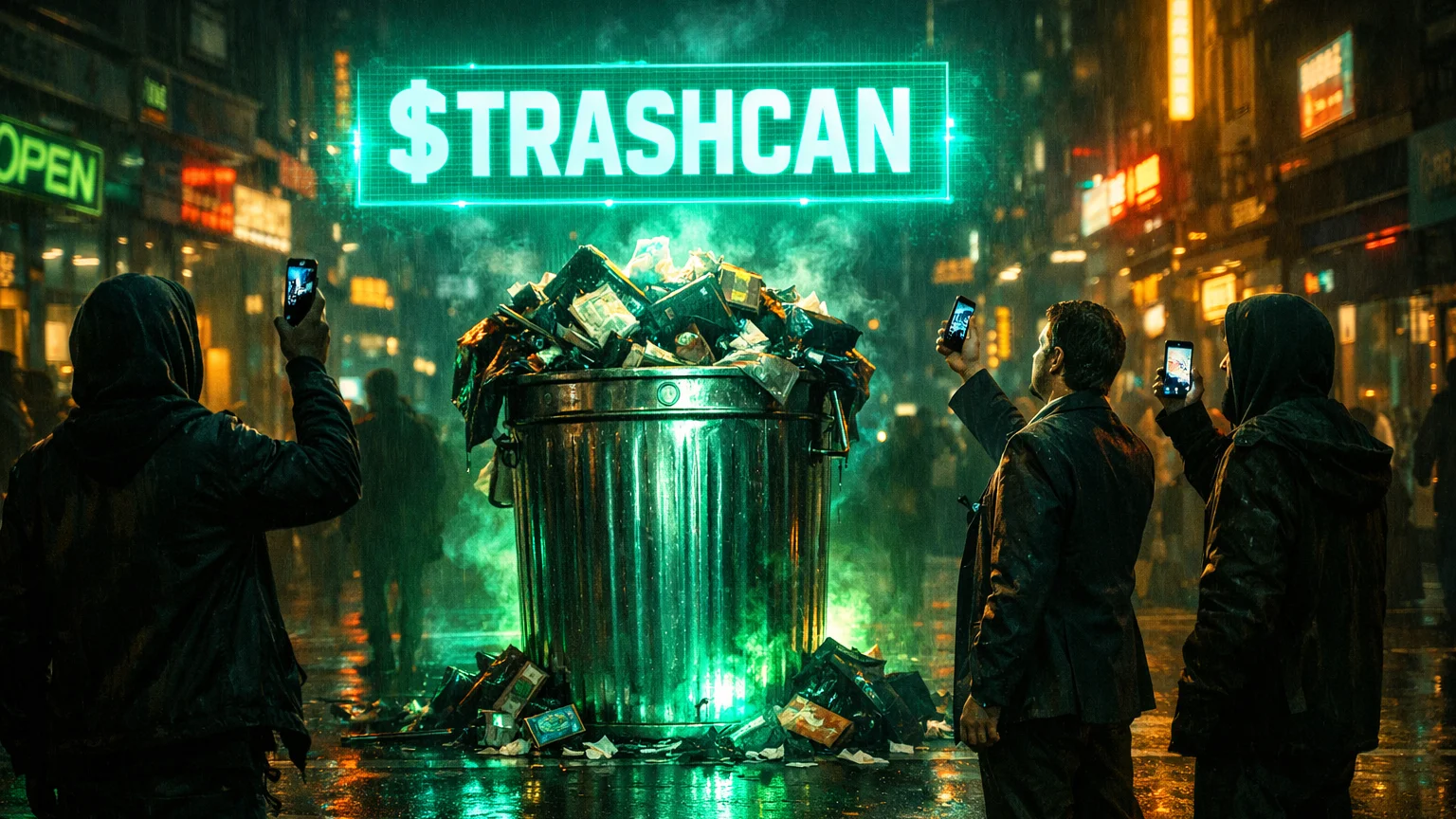
At approximately 12:30 AM UTC on March 29, a token called trash can launched on pump.fun. Not ironically. Not as part of some meta-commentary project with a whitepaper and a DAO vote. Someone minted a coin, called it TRASHCAN, and sent it into the Solana mempool like a flaming bag of opportunity. Nine hours later, it's sitting at a $511K market cap with over $3 million in 24-hour volume and more than 60,000 transactions. The trash, it turns out, has been taken out — and it's printing.
- → TRASHCAN pumped 18,651% in under 9 hours after a pump.fun launch — now sitting at $511K market cap with $3M in daily volume
- → Over 2,000 holders and 60,000 transactions suggest genuine retail frenzy, not a single-wallet manipulation play
- → Top wallet holds 20.69% — manageable concentration, but the liquidity-to-mcap ratio at $107K tells you this is still a sneeze away from vaporization
What Happened
There was no mainstream catalyst. No Elon tweet. No viral TikTok. TRASHCAN's cultural moment is entirely self-generated — a product of the meme coin meta where the name IS the marketing. The thesis is brutally simple: in a market drowning in thousands of daily pump.fun launches, the tokens that break through are the ones that make you stop scrolling. And nothing makes you stop scrolling quite like a coin called trash can.
This follows the lineage of self-deprecating meme branding that's become increasingly dominant in 2026. We've seen it with tokens named after literal garbage, bodily functions, and existential dread. The pattern is consistent: the more aggressively a token signals that it's worthless, the more the market rewards it with attention and volume. It's contrarian marketing weaponized at the protocol level.
The Degen Translation
CT didn't discover TRASHCAN through research. It showed up on Jupiter's cooking list — the real-time leaderboard of what's moving right now — and traders piled in because the chart was vertical and the name was impossible to ignore. That's the entire discovery funnel in 2026 meme markets: launch → volume spike → cooking list → CT screenshots → more volume → more screenshots. It's a reflexive loop where attention IS the fundamentals.
The self-aware branding removes the pretense that kills most meme launches. There's no roadmap to disappoint. No utility promise that ages badly. No team to dox or undox. TRASHCAN is a trash can. It does trash can things. Buy it or don't. That radical honesty — if you can call naming yourself garbage 'honesty' — creates a Teflon coat against the usual FUD cycles. Hard to call something a scam when it never claimed to be anything.
The Numbers
The volume-to-market-cap ratio is absurd — TRASHCAN is turning over roughly 6x its entire market cap in a single day. That's the kind of velocity you see in the first 12 hours of a token that either goes to $5M or goes to zero, with very little in between. The 53% buy ratio suggests slightly more buying pressure than selling, but it's close enough to neutral that the price action is being sustained by volume churn rather than one-directional accumulation.
The holder count at 2,038 is solid for a 9-hour-old token. It indicates real distribution beyond the initial snipers and suggests word is spreading through organic channels. The 60,100 transactions in under a day means each holder is averaging 29 transactions — an indicator of active trading and flipping rather than passive holding. This is a trader's token, not a community token. At least not yet.
Liquidity at $107K against a $511K market cap gives a liquidity ratio of roughly 21%. That's not terrible for a pump.fun graduate, but it means a $50K sell order would move the price significantly. Anyone sitting on a 100x bag from launch needs to understand that the exit door is narrower than it looks.
What the On-Chain Data Shows
The top wallet holds 20.69% of supply — that's the Raydium migration allocation, standard for pump.fun graduates. Second wallet sits at 6.89%, third at 4.67%. Total top-3 concentration is 32.2%, which is moderate. No freeze authority, no mint authority, and Rugcheck gives it a score of 1 out of 100 on the risk scale — essentially a clean bill of health by on-chain metrics.
No insider flags on any of the top holders. The distribution curve beyond the top 3 is relatively flat, which is what you want to see — it suggests organic accumulation rather than a small group of wallets farming the supply. For a token that's not even half a day old, the holder structure looks healthier than most pump.fun launches that make it to $500K.
Is This Sustainable?
The honest answer: probably not at this velocity. 18,651% in 9 hours isn't a growth curve — it's a detonation. The question is whether TRASHCAN transitions from a volume event into a community asset. The best-case comparison would be something like BONK's early days, where absurd branding and organic volume attracted enough holders to create a self-sustaining floor. The more likely comparison is the hundreds of pump.fun tokens that spike to six figures and bleed out over 48-72 hours as early holders take profit.
What TRASHCAN has going for it: the name is unforgettable, the volume is real, and the holder count is growing. What it doesn't have: any catalyst beyond novelty. There's no team building utility, no KOL army promoting it, no cultural moment beyond the meta-joke of the name itself. Meme coins can survive on vibes alone — Dogecoin did it for years — but they need the vibes to compound, not just spike.
The next 24 hours will tell the story. If TRASHCAN holds above $300K market cap through the Sunday trading lull and comes out the other side with growing holders, it's a legitimate contender for the weekly alpha list. If volume craters below $500K and holders plateau, it was a fun story and a profitable trade for anyone who caught the first 4 hours.
🟡 Speculative — The volume is undeniable and the on-chain structure is clean, but this is a 9-hour-old token running entirely on naming novelty. The 6x daily volume-to-mcap ratio screams active trading, not conviction. Clean Rugcheck, decent holder distribution, no authority flags — the fundamentals are as good as a trash-themed meme coin can have. But $107K liquidity backing a $500K market cap means the exit math gets ugly fast if the music stops. This is a day-trade, not a position. Treat it accordingly.
What is TRASHCAN crypto?
TRASHCAN (trash can) is a Solana meme coin launched on pump.fun that uses self-deprecating, garbage-themed branding as its core identity. It has no utility, roadmap, or team — the entire thesis is that naming yourself trash is the ultimate attention hack in a saturated meme market.
Is TRASHCAN a rug pull?
On-chain data shows a Rugcheck score of 1 (minimal risk), no freeze authority, no mint authority, and no insider-flagged wallets. The top holder controls 20.69%, which is standard for pump.fun migrations. While no meme coin is risk-free, the technical indicators don't suggest an imminent rug.
Where can I buy TRASHCAN token?
TRASHCAN trades on Jupiter (Solana's main DEX aggregator) and Raydium. The contract address is 7LiXn3k8ZS2QYsHVJGdUudgrwiczo6iMtxUbt8e2j8ky. Always verify the contract before trading — scam tokens with similar names are common.
Why is TRASHCAN pumping?
TRASHCAN's 18,651% move is driven by its appearance on Jupiter's cooking list (trending by volume), which creates a reflexive attention loop: more volume attracts more eyes, which generates more volume. The self-aware branding makes it memorable in a sea of generic launches.