$POPDOG Turns a Tiny Pump.fun Launch Into a $2.2M Volume Culture Bid
$POPDOG is still a micro-cap dog coin, but the first hours showed unusually deep participation, clean authority flags, and a holder map that is less ugly than most fresh Solana meme launches.
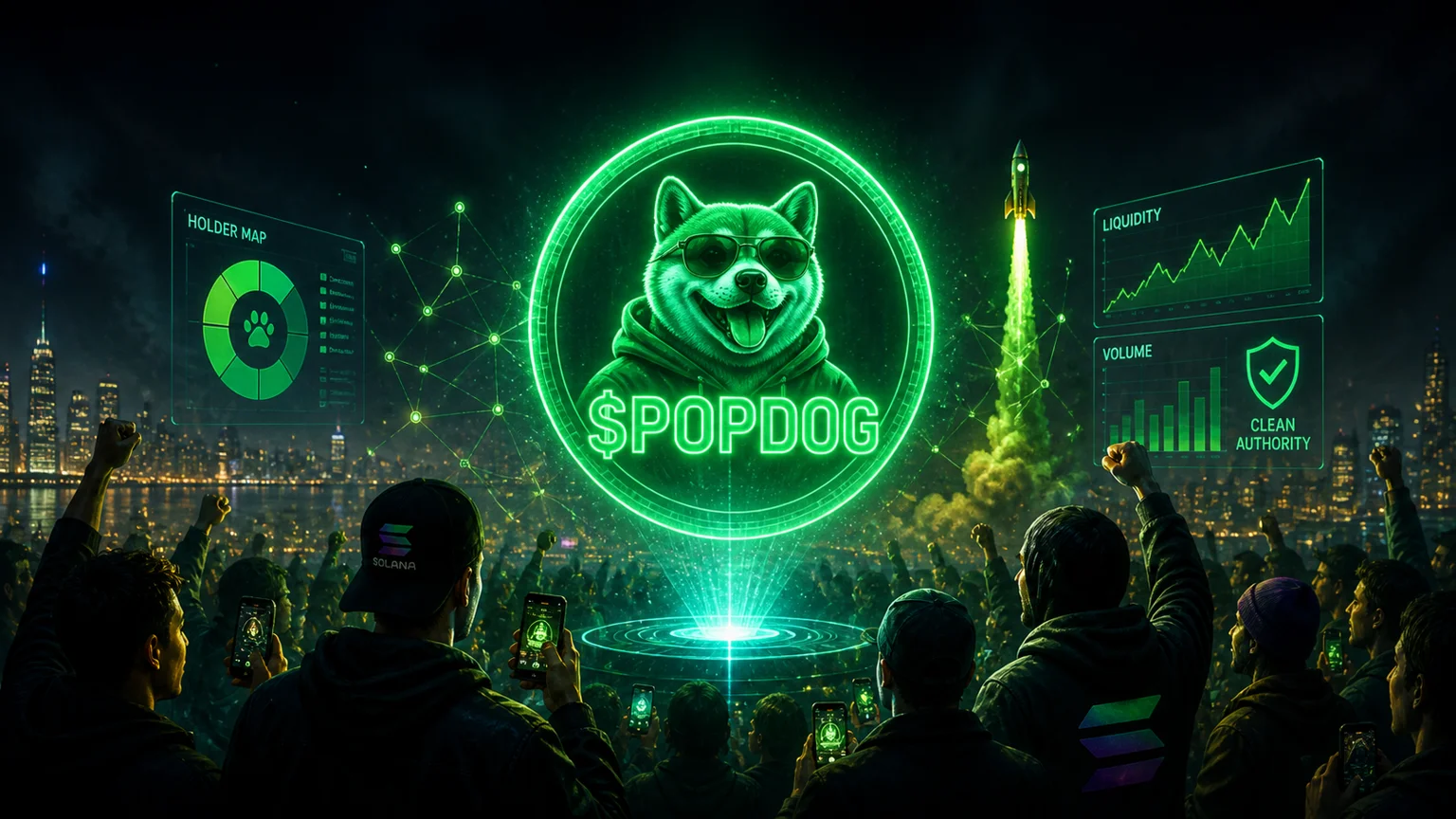
No major concentration risks in the first three holder slots; mint and freeze authority are disabled.
$POPDOG is the kind of Solana dog ticker that usually gets dismissed in one glance: tiny market cap, pump.fun origin, goofy branding, and a chart that has already moved too far for anyone to call it early with a straight face. The difference this morning is the amount of money that actually showed up. At 5:21 AM UTC, $POPDOG was only about two hours old and already showing roughly $2.2 million in 24-hour trading volume against a $354,000 market cap. That is not a normal ratio for a throwaway mascot launch. It means the token did not just print a green candle; it forced a lot of wallets to make a decision quickly.
The editorial angle here is a culture-meme bid with a cleaner-than-average first on-chain read. That does not make $POPDOG safe. It does mean the first data pass is different from the usual low-liquidity dog coin where three wallets own the board, authorities are messy, and volume looks like a wash loop. $POPDOG has a small liquidity pool, but the holder count, authority flags, and top-wallet spread give it enough structure to deserve a launch-radar note before the market decides whether this was a one-session joke or the start of a stickier dog rotation.
- → $POPDOG reached about $354K market cap while printing roughly $2.2M in 24-hour volume during its first hours on Solana.
- → The on-chain profile is cleaner than the usual micro-cap launch: mint authority disabled, freeze authority disabled, and the top three holders around 13.3%.
- → The main risk is liquidity depth. A $31.4K pool can move fast in both directions, so $POPDOG still needs steadier bid support after the first burst.
Why the Dog Trade Got Attention
Dog memes are the most crowded lane in Solana, which is exactly why the tape matters more than the mascot. A ticker like $POPDOG does not need a complex thesis; it needs enough early participation to prove that traders are willing to treat the joke as liquid inventory. The first read gave that signal. A 1.66-hour-old pair showing more than 41,700 transactions across the first 24-hour window is not quiet discovery. It is a busy room, and busy rooms are where Solana culture coins either form a real holder base or become exit liquidity in public.
The move was not built on price alone. $POPDOG showed a 56.5% buy ratio in the latest hourly snapshot, with 10,468 buys versus 8,075 sells. That is not one-sided euphoria, but it is enough demand pressure to keep the chart from looking like a single wallet mark-up. The token also had 2,222 holders early, which matters because many pump.fun launches can show loud volume while the holder base remains paper-thin. A wider holder count does not guarantee durability, but it lowers the chance that the entire move is simply one cluster passing tokens around.
The Numbers Behind the Burst
The cleanest part of the market structure is the volume-to-cap ratio. $POPDOG was trading more than six times its market cap in daily turnover, which is usually where a meme either finds a real crowd or burns through every buyer too quickly. The bullish version is simple: high turnover at a low cap can reprice the token violently if liquidity keeps improving and sellers fail to flatten each bounce. The bearish version is just as important: a $31.4K liquidity base means a few impatient exits can undo hours of grind in minutes.
That liquidity number is the center of the risk. It is deep enough to make $POPDOG tradable for small Solana wallets, but it is not deep enough to absorb careless size. The market cap can look meaningful on a screenshot while the actual exit door is still narrow. That is why the next useful data point is not another vertical candle. It is whether liquidity rises with the market cap, whether the buy share holds near balanced demand instead of going parabolic, and whether holders keep expanding without the top wallets tightening their grip.
What the On-Chain Data Shows
$POPDOG has the on-chain read traders want to see before they even consider respecting a micro-cap launch. Mint authority is disabled, freeze authority is disabled, and the dev balance is shown as zero in the available profile. Rugcheck gives the token a normalized score of 1, which is a clean first pass rather than an invitation to ignore risk. The top holder controls 8.32%, while the next two visible holders sit at 2.56% and 2.41%. Together, the top three are around 13.3%, which is meaningfully lower than the kind of 40% or 60% concentration that turns a launch into a holder-map warning.
The detail that matters most is how ordinary the risk table looks. There are no listed insider flags in the top three holders, no freeze authority left active, no mint authority hanging over the market, and no creator-token history showing a serial launch pattern. That combination does not remove meme-coin risk, but it changes the editorial read. $POPDOG is not being covered because it is bulletproof. It is being covered because the first few hours show a rare mix for this size: loud turnover, thousands of holders, and a holder map that has not immediately disqualified the trade.
$POPDOG still has to prove that liquidity can grow with attention. Clean authority flags are useful, but a thin pool can turn even a fair holder map into a nasty exit if volume dries up.
Where the Trade Can Break
The obvious failure path is post-burst exhaustion. A token that moves nearly 7,886% over six hours can be early in a repricing, or it can be late in a first-cycle blowoff. The difference will show up in the next round of liquidity and holder behavior. If $POPDOG keeps printing volume while the market cap chops sideways and the holder count expands, the launch starts to look like a real culture bid. If volume fades, liquidity stays near $31K, and the chart needs larger candles just to hold the same market cap, then the first burst was probably the easy part.
The other risk is category fatigue. Solana sees new animal tickers every hour, and most of them briefly look alive before attention rotates to the next cleaner joke. $POPDOG has to become more than a ticker on a hot board. The strongest outcome would be a second wave where the meme travels beyond the first wallets, the pool thickens, and the chart avoids the classic staircase-down pattern after launch-day volume peaks. Without that, the dog trade turns from culture bid into liquidity trap quickly.
What Would Upgrade the Read
The upgrade path for $POPDOG is mechanical. First, liquidity needs to move higher without the market cap running too far ahead of it. Second, the holder count needs to keep growing while the top three remain contained near the current 13.3% area. Third, the buy share should cool into healthier two-way trading instead of relying on constant aggressive buying. A meme coin does not need perfect fundamentals, but it does need enough market structure to survive its first real sell wave.
$POPDOG gets a clean launch-radar read, with the usual micro-cap caveat written in bold. The authority flags are clean, Rugcheck risk is low, and holder concentration is not the problem right now. The problem is liquidity depth versus speed. If the pool grows and the holder base keeps widening, $POPDOG can keep its culture-meme bid alive. If the pool stays thin while volume cools, the same setup can turn into a fast unwind.
Why is $POPDOG on MemeDesk radar?
$POPDOG combined a $354K market cap with roughly $2.2M in 24-hour volume, more than 2,200 holders, and a cleaner authority profile than many new Solana launches.
Is the $POPDOG contract clean?
The available profile shows mint authority disabled, freeze authority disabled, a Rugcheck score of 1, and top-three holder concentration around 13.3%. That is a clean first read, not a safety guarantee.
What is the biggest $POPDOG risk?
Liquidity. The pool was about $31.4K during the snapshot, so the token can still move sharply if early buyers rush for the same exit.