$NAMNOI Turns a Thai Meme Into a $1M Solana Volume Sprint
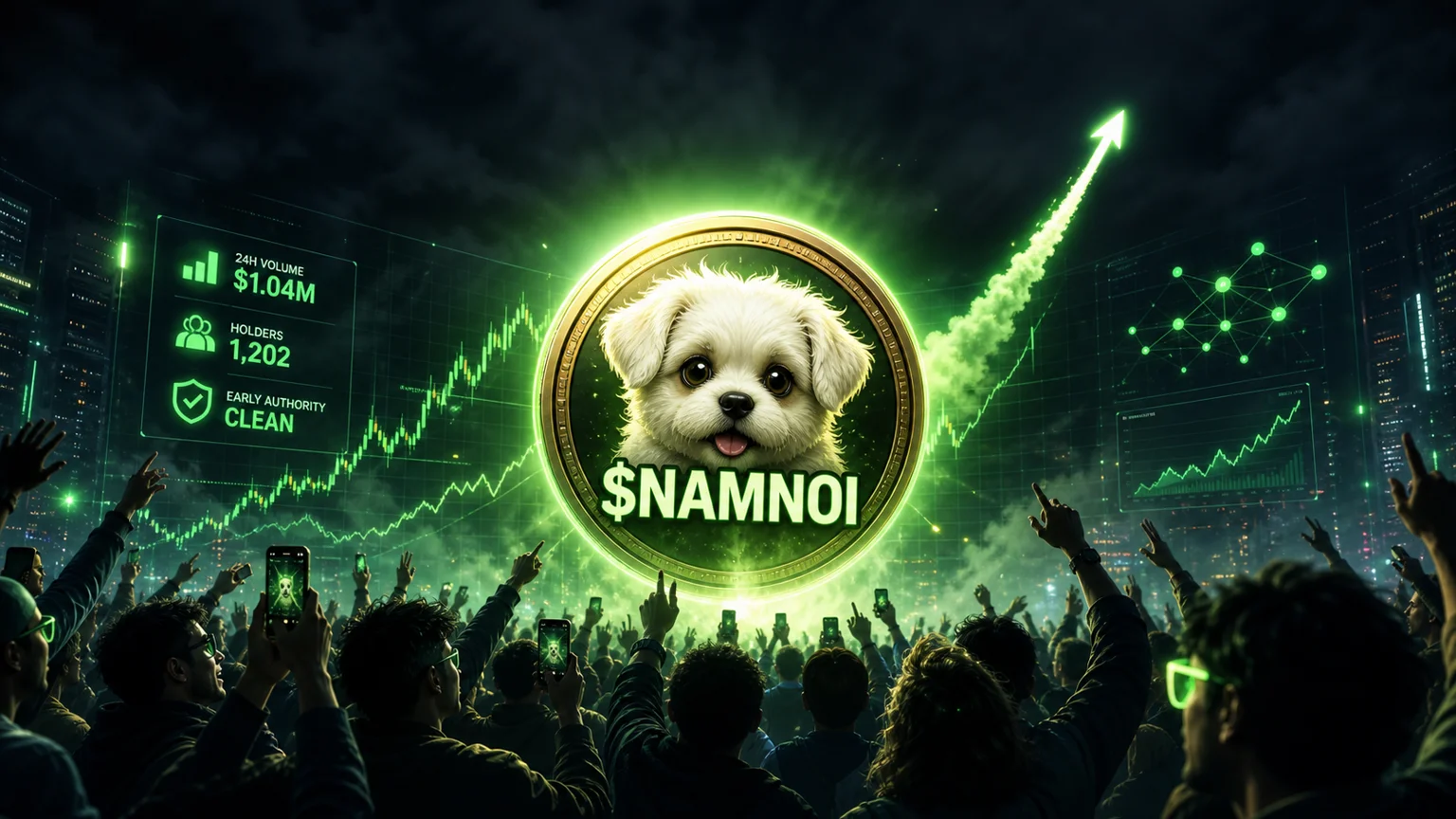
$NAMNOI is only a few hours old, but the tape already has a real culture-meme bid: $1.04M in 24-hour volume, 1,202 holders, and a clean early authority profile.
Rugcheck shows a low score, disabled freeze and mint authority, no listed risks, and a top-three holder stack near 13.6%.
$NAMNOI is the kind of Solana launch that does not need a whitepaper to explain why traders clicked. The name reads local, weird, and instantly memetic, and the chart did the rest. In roughly three hours, Nong Nam Noi pushed to a $177.2K market cap, cleared more than $1.04M in 24-hour volume, and pulled 1,202 holders onto the board. That is not mature conviction. It is a first-session culture-meme sprint. But in meme tokens, that first sprint is often the whole audition: can the joke travel fast enough for liquidity to matter before attention rotates somewhere else?
The early read is cleaner than the average tiny pump, mostly because the on-chain profile is not screaming over the market data. $NAMNOI has disabled freeze authority, disabled mint authority, a Rugcheck score of 1, and a top-three holder stack near 13.6%. The caution is liquidity. A $17.5K pool beside seven-figure daily volume is a narrow exit door, especially after a 4,675% six-hour move. The story is not whether $NAMNOI has already proven itself. It has not. The story is whether a Thai meme with real first-session volume can turn speed into a base before the earliest wallets decide the punchline has paid enough.
- → $NAMNOI is trading near a $177.2K market cap after a violent first-session run on Solana.
- → The tape is unusually active for its size: $1.04M in 24-hour volume, 25,202 transactions, and a 55.3% buy ratio across the latest sample.
- → The cleanest datapoint is the control profile: freeze authority and mint authority are both disabled, with no listed Rugcheck risks.
A Local Meme With Global Tape
Most micro-cap launches try to sound universal and end up sounding interchangeable. $NAMNOI takes the opposite route. It leans into a Thai-sounding identity, the kind of name that feels like it came from a very specific internet corner instead of a token-name generator. That matters because culture memes do not need every trader to understand the reference. They need enough traders to recognize that the reference is sticky, exportable, and strange enough to survive outside the first Telegram chat.
The market reaction says the hook worked, at least for the opening burst. The signal timestamp sits at 7:29 AM UTC on August 3, and by then $NAMNOI was already showing a 79.6% one-hour move and a 4,675% six-hour mark. That kind of speed usually means two things at once: the meme found buyers before the wider board had time to think, and the next few candles become harder to trust because everyone who bought early is suddenly sitting on a decision. Culture can attract bids. Only repeated bids can hold a chart together.
The Volume Is Real, The Pool Is Thin
The strongest market number is not the percentage move. Percent gains are cheap when a token is young enough. The stronger number is participation. More than 25,000 transactions in the 24-hour window and 1,202 holders give $NAMNOI a wider early footprint than most launches hovering under $200K market cap. The buy ratio at 55.3% is constructive without being cartoonish. It shows demand was still leaning green in the latest sample, but not so one-sided that it looks like a board with no sellers.
The weak number is the pool. $17.5K in liquidity is usable for small wallets and dangerous for anyone pretending this is already deep. When volume is almost sixty times liquidity, the chart can move beautifully until the wrong wallet turns a market sell into a mood change. That is the main reason $NAMNOI cannot be treated as a clean green light despite the better authority profile. The first job for the next session is not another absurd percentage print. It is proving that liquidity can thicken while the holder base keeps growing.
What the On-Chain Data Shows
The Solana control profile is the part that keeps $NAMNOI from reading like a throwaway launch. The dev profile shows freeze authority set to false and mint authority set to false. In plain English, the deployer does not appear to retain the obvious levers that let a token freeze transfers or expand supply after buyers arrive. Rugcheck lists a normalized score of 1 and no active risk items in the provided profile. That does not make $NAMNOI safe. Meme coins are still reflexive, thin, and brutal. It does mean the obvious contract-level trap is not the lead concern right now.
Holder concentration is also better than the usual first-day mess. The largest visible holder controls 8.63%, while the next two sit at 2.69% and 2.3%. The top three combine for roughly 13.6%, and none of those top wallets are flagged as insiders in the supplied profile. That is the kind of distribution that can support a culture bid if demand keeps showing up. It is not a guarantee. A token can have a clean top-three map and still fail from weak liquidity, attention decay, or early-wallet distribution. But it shifts the bear case away from immediate supply hostage risk and toward market stamina.
The deployer data is quiet rather than notable. The dev balance reads as zero in the selection data, and the creator-token count is listed as zero. There is no serial-deployer pattern to lean on, no visible freeze-authority problem, and no mint-authority warning. That makes the next read more mechanical: does the holder map stay broad as volume cools, do new buyers arrive above the initial pump range, and does liquidity deepen enough to stop every sell from turning into a headline?
Why The Thai Meme Angle Matters
The edge in $NAMNOI is not that every Solana trader knows Nong Nam Noi. The edge is that the name feels like it belongs to a real meme lane instead of another abstract ticker. Localized memes can move harder than generic ones because they give early communities an identity to defend. If Thai crypto circles, Asia-hours traders, and broader Solana meme hunters all decide the same joke is worth bidding, the token can get a second wave that is not just chart-chasing.
That is also the risk. Local culture memes can be explosive and short-lived because the reference either travels or it does not. If $NAMNOI remains a three-hour curiosity, the seven-figure volume becomes evidence of extraction rather than conviction. If it becomes a recognizable Solana mascot for the next session, the current market cap leaves room for repricing. The right way to judge this setup is to watch whether the meme spreads while the chart is not vertical. Real culture bids survive boring candles better than pure pump mechanics do.
The Bull Case
The bullish case starts with breadth. $NAMNOI has more than 1,200 holders, a buy ratio above 55%, and enough transaction count to show that the market did more than pass tokens among a tiny cluster. Pair that with disabled freeze and mint authority, a low Rugcheck score, and a top-three holder stack below 15%, and the setup is cleaner than most launches born in the same market-cap range. If liquidity grows from $17.5K toward a more durable level while volume stays active, the chart can stop looking like a single candle and start looking like a real culture rotation.
The other bullish angle is timing. A three-hour-old token does not need a perfect chart yet. It needs evidence that buyers are still willing to show up after the first mania pass. If $NAMNOI bases above the early breakout zone, keeps adding holders, and avoids a top-wallet dump into the next green candle, the market will have a reason to keep tracking it. The lower the obvious contract risk, the more traders can focus on the meme itself and the quality of new demand.
The Bear Case
The bear case is liquidity. A $17.5K pool cannot comfortably support a $1.04M volume day forever. It can support fast movement, but it can also turn a normal exit into a violent wick. That matters more after a 4,675% six-hour move because early buyers may not need much more upside to start selling. If volume cools before liquidity deepens, $NAMNOI can look healthy by holder count while still becoming painful to exit.
The second bear case is narrative exhaustion. Culture-meme bids live on repetition. The name has to keep appearing, the image has to keep circulating, and new wallets have to treat pullbacks as entries instead of warnings. If the Thai meme angle does not travel beyond the first crowd, the token becomes another fast Solana launch with a clean profile and no second act. Clean controls reduce one kind of risk. They do not manufacture attention.
🟢 Clean — $NAMNOI has the rare first-session combination of real volume, broad early holders, disabled freeze and mint authority, a low Rugcheck score, and a top-three holder stack near 13.6%. The setup still depends on liquidity catching up. This remains a watchlist culture bid, not a safety claim.
What is $NAMNOI?
$NAMNOI is the ticker for Nong Nam Noi, a Solana meme token launched through Pump.fun with a Thai culture-meme identity.
Why is $NAMNOI moving?
$NAMNOI is moving because early Solana buyers pushed the token through a high-volume first-session sprint, with more than $1.04M in 24-hour volume and 25,202 transactions in the latest data.
Does $NAMNOI have obvious on-chain red flags?
The provided profile shows disabled freeze authority, disabled mint authority, a low Rugcheck score, no listed risks, and top-three holder concentration around 13.6%. The main remaining risk is market structure, especially liquidity depth.
What would make $NAMNOI stronger?
$NAMNOI gets stronger if liquidity grows, holders keep rising from 1,202, and price can hold a base after the first explosive move instead of relying on one vertical candle.