The Chinese 'Slacker' Meme Coin Just Rallied 442% — And the Anti-Hustle Narrative Is Just Getting Started
摸鱼 (Moyu) turns workplace rebellion into a tradeable asset. $1.1M in volume says the joke is landing. The sell pressure says not everyone's laughing.
Top holder owns 99.87%. 5 high-risk flags.
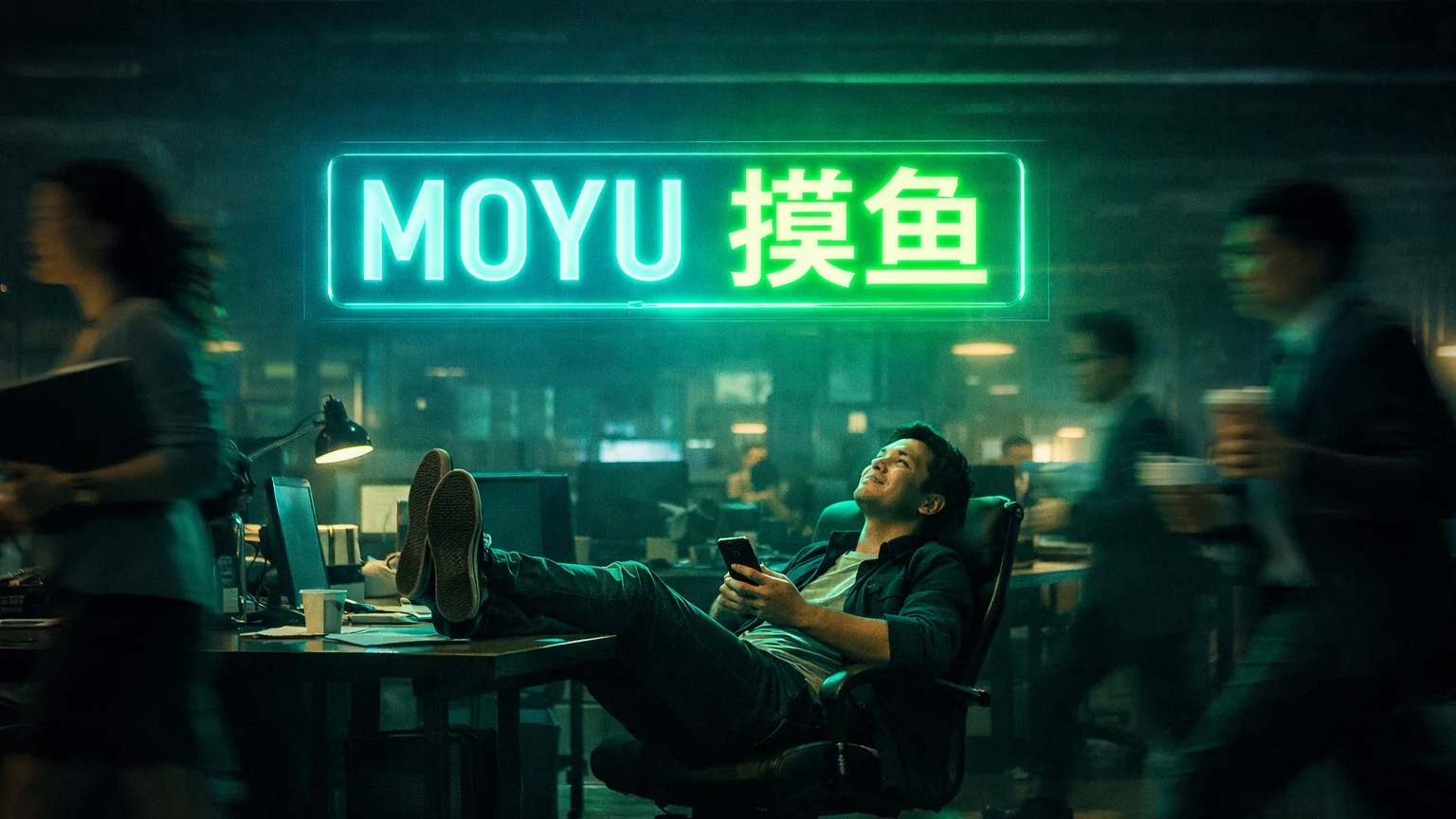
摸鱼 — 'touching fish' in Mandarin — is Chinese internet slang for slacking off at work. Pretending to be productive while doing absolutely nothing. Browsing Taobao during a Zoom call. Watching Douyin in the bathroom for 45 minutes. Every Chinese worker knows it. Most practice it daily. And as of 6:00 PM UTC on March 8, 2026, someone turned it into a meme coin that's up 442% with over a million dollars in trading volume.
- → Moyu (摸鱼) pumped 442% in 3.2 hours — $1.1M volume on a pump.fun Solana launch
- → Buy ratio has flipped to 41.5% — sellers are starting to outnumber buyers
- → The 'anti-hustle culture' narrative taps into a massive Chinese internet subculture with crossover appeal
What Makes This One Different
Most meme coins are born from English-speaking CT culture — Pepe derivatives, political tokens, AI agent grifts. Moyu comes from a completely different cultural ecosystem. 摸鱼 isn't just slang; it's a movement. In China's tech sector, where 996 culture (9 AM to 9 PM, 6 days a week) has been the norm, 'touching fish' became an act of quiet resistance. Workers share moyu tips on Weibo and Xiaohongshu like they're trading alpha. The phrase went so mainstream that even state media has acknowledged the phenomenon.
This gives Moyu something most pump.fun launches don't have: a pre-existing cultural narrative with genuine emotional resonance. The anti-hustle sentiment isn't limited to China — 'quiet quitting' went viral in the West, 'lying flat' (躺平) became a generational philosophy, and every TikTok about 'acting your wage' is speaking the same language. Moyu just happens to be the catchiest version, and now it has a token.
The Numbers So Far
The volume numbers are impressive — $1.1 million in trading volume in 3.2 hours puts Moyu ahead of most pump.fun launches. But the buy ratio tells a different story. At 41.5%, sellers now outnumber buyers. This is the critical inflection point for any micro-cap meme coin: the early apes who got in at launch are starting to take profit, and the question is whether new buyers are arriving fast enough to absorb the selling.
The volume-to-liquidity ratio is even more extreme than typical. $1.1M in volume against $36K in liquidity means the token is churning through roughly 30x its pool. This level of velocity on thin liquidity creates the staircase chart pattern — sharp pumps followed by sharp drops, with each cycle shaking out weaker hands. The 15,631 transactions across 3.2 hours averages out to about 81 transactions per minute, which is substantial retail activity.
The Cultural Backstory — And Its Baggage
Moyu's cultural strength is also its complication. The term has deep roots in Chinese internet culture, but it also has history in crypto. Previous attempts to tokenize Chinese internet memes have had mixed results. Some found niche communities that sustained modest market caps. Others were outright scams leveraging cultural familiarity to lure Chinese-speaking retail investors into exit liquidity traps.
The research flagged that the Moyu narrative 'revives a culturally-loaded backstory tied to past crypto scams.' This doesn't mean this specific token is a scam, but it means the name carries baggage in Chinese crypto communities. Experienced Chinese degens will approach this with more skepticism than Western traders who just see a funny foreign word. That skepticism could limit the token's ability to build a sticky Chinese-speaking community — the exact demographic it should theoretically appeal to most.
The Crossover Potential
Where Moyu gets genuinely compelling is in its crossover appeal. The anti-work, anti-hustle sentiment isn't Chinese-specific — it's global. 'Quiet quitting' dominated Western media cycles in 2023-2024. 'Lying flat' (躺平) was covered by the New York Times, BBC, and every major outlet. The Great Resignation was a worldwide phenomenon. Moyu distills all of this into a single, memeable concept with a cute name and a universally relatable premise: work is overrated, and you know it.
If Moyu can bridge the gap between Chinese and English-speaking crypto communities — getting coverage from CT influencers who appreciate the cultural depth — it could tap into a narrative that's much bigger than a typical animal coin or political meme. The anti-hustle trade isn't seasonal. It's structural. Every Monday morning, half the workforce is moyu-ing and they don't even know the word for it yet.
Who's In
The Bull Case
The anti-hustle narrative is a cultural macro trend, not a momentary joke. If Moyu gets picked up by a single mid-tier English-speaking KOL who appreciates the cultural angle, the crossover potential is enormous. The term itself is inherently memeable — fish emojis, slacker imagery, 'touching fish at work' memes — and it has the kind of depth that sustains community formation. Tokens that represent a lifestyle or philosophy (not just a picture of an animal) tend to build stickier communities. The volume proves the demand exists. If liquidity grows and the buy ratio stabilizes, Moyu could establish itself as the definitive anti-work meme coin.
The Bear Case
The 41.5% buy ratio is a flashing warning light. When sellers outnumber buyers three hours into a launch, the initial momentum is already fading. The $36K liquidity pool means this token has no structural floor — when it drops, it drops fast. The cultural baggage around previous Moyu-adjacent crypto scams could prevent exactly the Chinese-speaking community it needs from adopting it. And without KOL coverage from either Chinese or English-speaking influencers, there's no amplification mechanism beyond organic discovery. Organic is beautiful when it works, but it doesn't scale the way a coordinated CT push does.
🟡 Speculative — Moyu has the best cultural narrative of any pump.fun launch this week. The anti-hustle meme isn't a fad — it's a generational sentiment with global resonance. But at 3.2 hours old with sell pressure already building and $36K in liquidity, the token is racing against its own momentum. The volume is there ($1.1M is no joke), but the buy ratio has already flipped. This is a narrative play, not a chart play — and narratives need amplifiers. Without KOL coverage to bridge the Chinese cultural origin to the English-speaking CT audience, Moyu risks remaining a niche play that fades before its story gets told properly. Watch the buy ratio closely over the next 6 hours. If it stabilizes above 45%, the story has legs. If it keeps sliding, the fish got caught.
What does Moyu (摸鱼) mean?
Moyu literally translates to 'touching fish' in Mandarin Chinese. It's internet slang for slacking off at work — pretending to be productive while doing nothing. The concept is similar to 'quiet quitting' in Western culture and has become a widespread meme across Chinese social media platforms.
What blockchain is Moyu on?
Moyu is on the Solana blockchain, launched through the pump.fun token launchpad. It trades as Moyu/SOL on decentralized exchanges tracked by DexScreener.
Is Moyu a scam?
There's no direct evidence that this specific Moyu token is a scam, but the 'moyu' narrative has been associated with past crypto projects that turned out to be fraudulent. The token has no verified team, no doxxed developers, and only $36K in liquidity. Treat with extreme caution.
Why is Moyu's buy ratio declining?
At 41.5%, more traders are selling than buying. This typically happens when early buyers start taking profit after the initial pump. For a token only 3.2 hours old, it signals the first wave of momentum may be peaking. The next few hours will determine whether new buyers arrive to absorb the selling pressure.