The $MOCHI Identity Crisis: How One Cat Meme Spawned a Liquidity Carousel on Jupiter
Multiple MOCHI-branded tokens are creating a meta-game where Jupiter snipers cycle through cat-themed SPL tokens like a slot machine. The house edge? 57% supply concentration and $18K in liquidity.
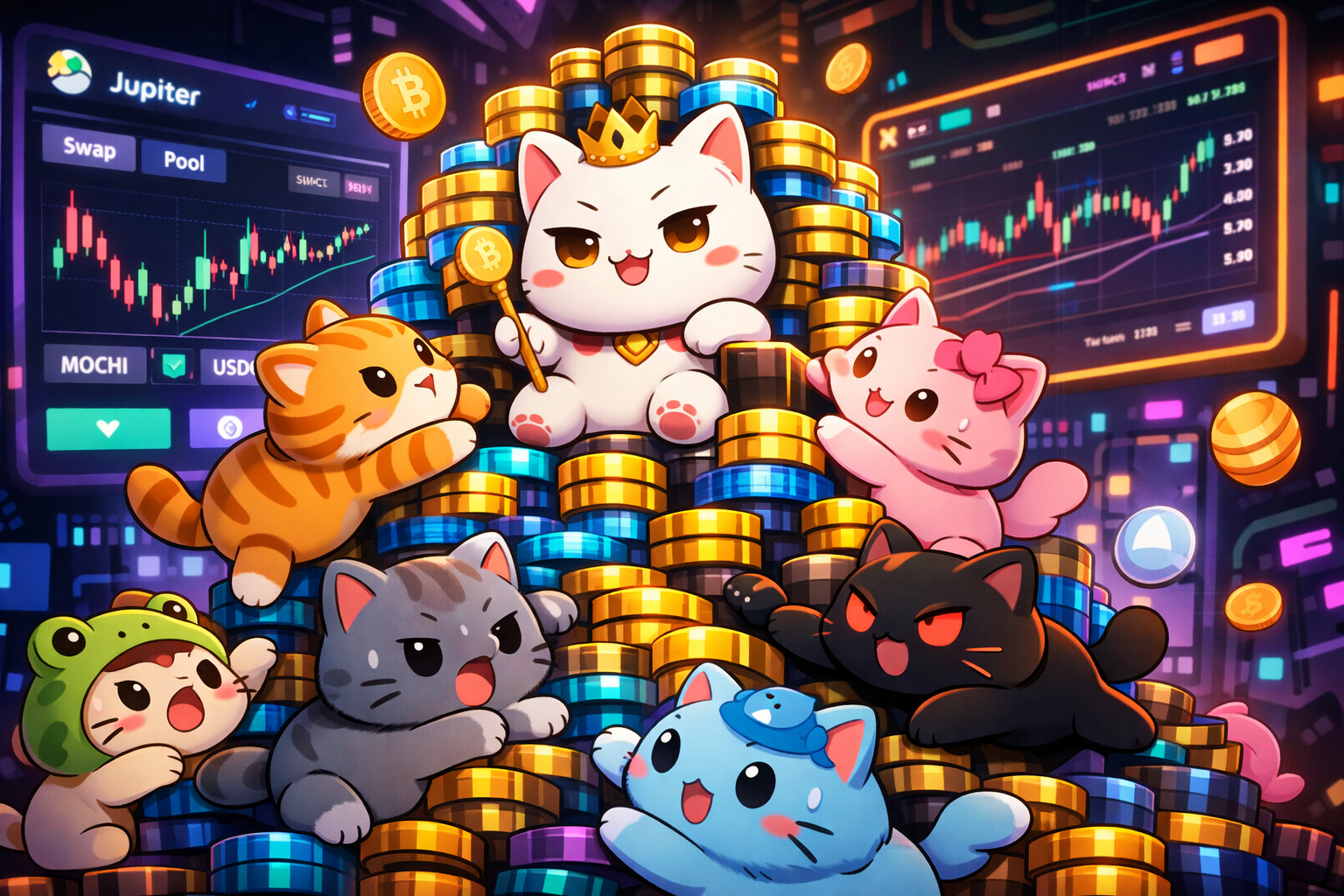
There are at least three tokens called MOCHI trading on Solana right now. One's a cat. One claims to be inspired by Sui's ecosystem. One appears to be a rebranded lab experiment. None of them care that the others exist — and that confusion is the entire point.
The MOCHI that's moving today — もち, the Japanese-named cat token on pump.fun — ripped 4,214% in six hours on Friday afternoon UTC. Not because of a team announcement, a KOL call, or a Binance listing rumor. It moved because Jupiter-native traders discovered it as the latest vehicle in an increasingly popular game: cycling liquidity through micro-cap cat-themed SPL tokens, treating each one as a disposable lottery ticket.
- → $193K market cap with $587K in 24h volume — a 3x volume-to-mcap ratio that screams rotation vehicle
- → Top 3 wallets control 57.9% of total supply — one address alone holds 26.58%
- → Part of a broader MOCHI identity split across Solana and Sui, creating a meta-meme about low-cap cat coins and Jupiter-centric sniping
What Happened
The cat-coin meta never really died on Solana — it just went underground. While the spotlight chased AI agents and political tokens, a subset of Jupiter power users kept running the same playbook: find a sub-$500K cat token on pump.fun, ape in with size, ride the 2-10x, rotate out to the next one. MOCHI (もち) became the latest stop on this carousel.
What makes this iteration interesting isn't the token itself — it's the meta-game around it. Multiple MOCHI-branded tokens existing simultaneously creates a strange attractor effect. Traders searching for 'MOCHI' on Jupiter or DexScreener stumble across three or four different contracts, each with different chains and narratives. The confusion generates clicks, clicks generate volume, and volume generates the appearance of momentum. It's a self-reinforcing loop built entirely on brand collision.
The Degen Translation
Here's how CT reads this: MOCHI isn't a project. It's a liquidity slot. Jupiter traders are using it the way poker players use chip denomination — as a unit of action. You don't buy もち because you believe in the cat. You buy it because it's the lowest-cap token with enough liquidity to enter and exit in the same session. The 68% hourly candle isn't conviction — it's throughput.
The split-identity narrative adds another layer. When a token name exists on multiple chains with multiple contracts, it creates arbitrage of attention. A pump on the Solana version gets screenshotted and shared, but viewers who search 'MOCHI crypto' might land on the Sui version, or the rebranded one, or a completely different cat token. Each misclick is another trade. The meta-meme isn't the cat — it's the confusion itself being monetized.
The Numbers
The volume-to-mcap ratio here is absurd. $587K in 24-hour volume against a $193K market cap means the entire supply has theoretically changed hands three times today. That's not organic accumulation — that's rotation trading at speed. Liquidity sits at just $18.3K, which means any position over a few hundred dollars is going to move the price. This is a playground for small-stack snipers, not a serious hold.
What the On-Chain Data Shows
The holder distribution tells the real story. Three wallets control 57.9% of the total supply. The largest single holder — AcYqW46X — sits on 26.58%, more than a quarter of every token in existence. The second wallet holds 20.69%. Between two addresses, nearly half the supply is concentrated.
No freeze authority. No mint authority. Rugcheck gives it a score of 34, which is relatively clean for a pump.fun micro-cap. But the concentration numbers override the clean authority flags. When two wallets can coordinate a dump that wipes 47% of circulating supply from the order book against $18K in liquidity, the absence of freeze authority is a footnote. The deployer wallet is a fresh single-token address with zero balance — standard pump.fun template, nothing notable there.
Is This Sustainable?
No — and it's not trying to be. That's the honest read. MOCHI isn't building a community, shipping a roadmap, or courting exchange listings. It exists as a unit of action in Jupiter's micro-cap rotation game. Its sustainability is measured in hours, not weeks.
The broader question is whether the cat-coin carousel itself has legs. And here, the answer is more nuanced. Cat-themed tokens have been a persistent Solana meta since early 2025. They're the comfort food of meme trading — familiar narrative, low cognitive overhead, endlessly forkable. Every time the meta appears dead, a new cat token rips and the cycle restarts. MOCHI is this week's version of a pattern that's survived multiple market cycles.
The Jupiter-cooking angle is the more interesting signal. If traders are consistently using cat tokens as rotation vehicles — buying for the trade, not the thesis — it suggests Jupiter's aggregator is becoming a meta-game engine in its own right. The platform's routing efficiency makes it possible to enter and exit micro-caps with slippage that would've been prohibitive six months ago. MOCHI is a symptom of infrastructure improvement, not narrative innovation.
The Bear Case
Three wallets holding 57.9% of supply with only $18K in liquidity is a mathematical setup for a rug, intentional or not. If the top holder decides to market-sell even a fraction of their 26.58% stake, the price impact would be catastrophic against that thin liquidity. The 4,214% daily move looks electric on a chart — but the same mechanics that enabled the pump make the dump equally violent.
There's no social infrastructure here. No verified Twitter presence in the selection data. No Telegram community driving organic buys. The volume is almost certainly driven by a small cluster of Jupiter snipers running the same playbook simultaneously. When they rotate out — and they will, because that's the entire strategy — there's nobody holding the floor.
🟡 Speculative — MOCHI is a case study in how Jupiter's micro-cap infrastructure has turned cat tokens into trading instruments. The 4,214% move is real, but so is the 57.9% supply concentration and $18K liquidity depth. This isn't a token to hold — it's a token to understand. The meta-game of cycling liquidity through disposable SPL tokens is the actual signal here, and MOCHI is just the latest chip on the table. If you're in, you're a tourist — act like one.
What is MOCHI (もち) crypto?
MOCHI (もち) is a cat-themed meme token on Solana launched via pump.fun. It's one of several MOCHI-branded tokens across different chains, and is primarily being used as a micro-cap rotation vehicle by Jupiter traders.
Why are there multiple MOCHI tokens?
Token names aren't unique in crypto. Multiple teams can launch tokens with the same ticker on different chains or even the same chain. The MOCHI brand collision creates a meta-meme where confusion itself drives volume as traders search and stumble across different contracts.
What is Jupiter cooking in crypto?
Jupiter 'cooking' refers to active rotation trading on Jupiter, Solana's leading DEX aggregator. Traders use Jupiter to rapidly swap in and out of micro-cap tokens, treating them as short-term trading vehicles rather than long-term holds.
Is MOCHI a rug pull?
While MOCHI doesn't have freeze or mint authority (common rug mechanics), the top 3 wallets control 57.9% of supply against just $18K in liquidity. This concentration makes it extremely vulnerable to a dump, whether coordinated or not. Treat any position as money you're willing to lose.
What is the cat coin meta on Solana?
Cat-themed tokens have been a recurring meme narrative on Solana since early 2025. Unlike dog coins which tend to concentrate around one or two leaders, cat coins are endlessly forked and rotated, creating a carousel of micro-cap plays that Jupiter snipers cycle through for quick trades.