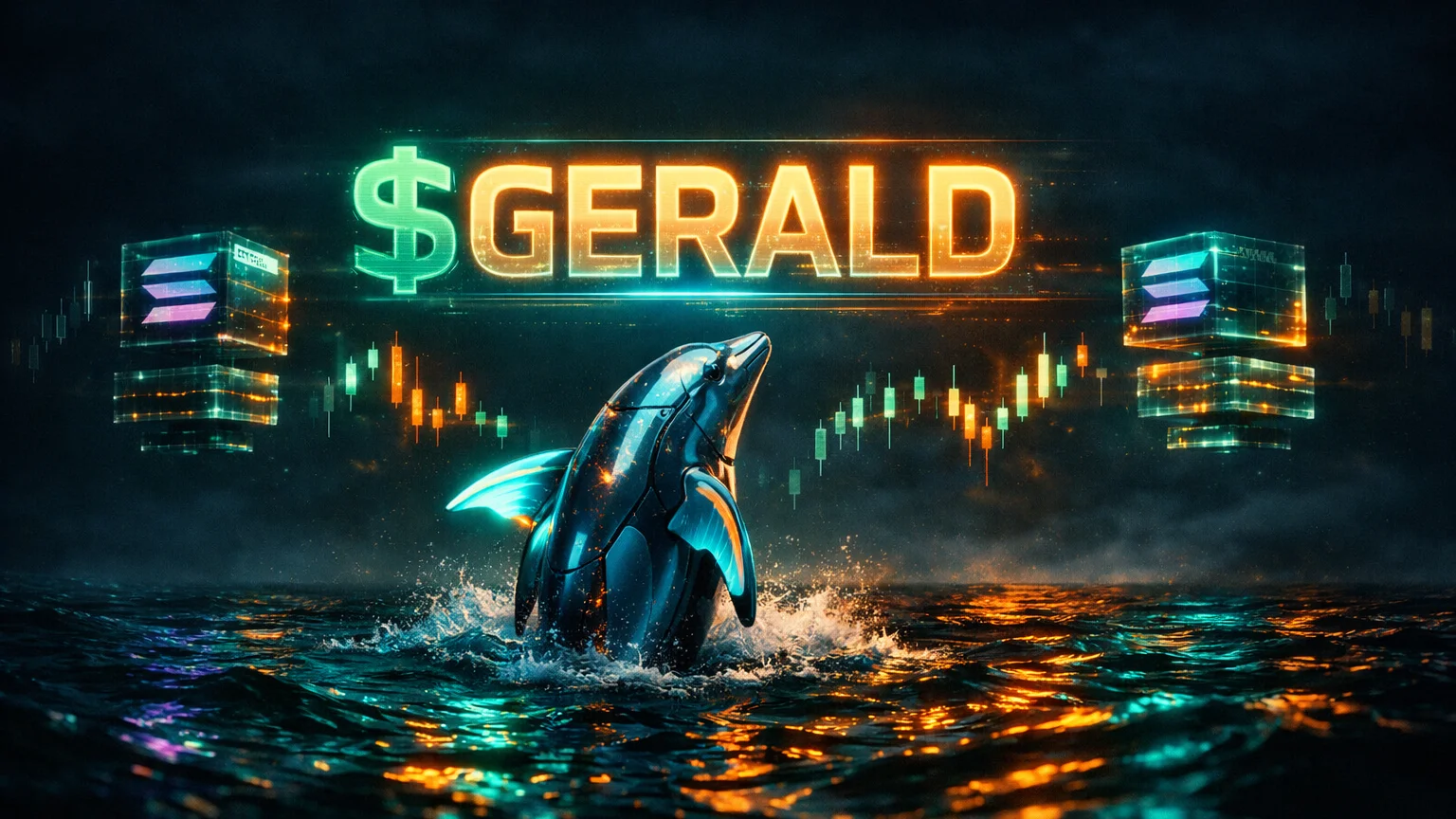
Meet Gerald — The Pump.fun Dolphin That Survived 5 Days and Is Still Swimming at $875K
In a dog-and-cat-dominated meme market, a dolphin token is carving out its own lane with 134% daily gains, nearly 1,000 holders, and the kind of organic staying power that makes trend-chasers pay attention.
No major concentration risks
Five days is a lifetime in pump.fun years. Most tokens launched on Solana's dominant launchpad don't survive five minutes of real trading — they spike on sniper bots, bleed as the initial wave sells, and flatline into irrelevance before anyone even notices they existed. Gerald The Dolphin launched on March 12th and is still here on March 17th, sitting at an $875K market cap with $631K in daily volume, 959 holders, and a 134% gain over the past 24 hours. In the animal meme meta that produced WIF, POPCAT, and a zoo's worth of imitators, a dolphin is a genuinely novel play — and the market appears to be noticing.
- → Gerald The Dolphin ($GERALD) is a 5-day-old pump.fun graduate holding $875K market cap with accelerating momentum — +119% in 6h, +134% in 24h
- → Rugcheck score of 1 (the lowest possible risk rating), no freeze/mint authority, top 3 wallets hold just 10.9% of supply — an exceptionally clean profile
- → The dolphin branding is distinctive in a market saturated with dogs and cats — differentiation matters when attention is the only currency
What Happened
The animal meme token meta has been one of the most durable narratives in Solana's meme economy. WIF (dogwifhat) went from pump.fun obscurity to billions in market cap. POPCAT turned a viral cat meme into a nine-figure token. The thesis is simple: animals are universally memeable, they don't carry political baggage, and they tap into a deep vein of internet culture that predates crypto by decades. The market has responded by launching thousands of animal-themed tokens — dogs, cats, penguins, frogs, hamsters — most of which die on the vine.
Gerald entered this crowded field with one advantage: no one had done a dolphin yet. Not a serious one, anyway. The name "Gerald" gives it the vaguely absurd, slightly anthropomorphic quality that works in meme culture — it's not "Dolphin Token" or "SolDolphin" or any of the lazy naming conventions that signal a low-effort launch. It's a dolphin with a name, which sounds ridiculous and is exactly why it works. Meme tokens succeed when they create a character people want to rally around, and Gerald has that odd specificity that invites community projection.
The Degen Translation
The degens tracking Jupiter's trending feed spotted GERALD showing a +39% hourly gain at the time of signal capture — a notable acceleration for a token that's already five days old. Most pump.fun graduates that survive their first 48 hours settle into a slow bleed as early holders take profits and no new catalyst appears. What makes GERALD's chart interesting is that the acceleration is happening on day five, not day one. The 6-hour change of +119% suggests a fresh wave of buying pressure, possibly triggered by the token appearing on Jupiter's trending lists and catching the algorithmic attention of CT scanners and copy-trade bots.
The buy-sell dynamics support this reading. In the last hour at signal capture, GERALD recorded 1,024 buys against 900 sells — a 53/47 ratio that's tilted bullish but not suspiciously so. When you see 80/20 buy ratios on a micro-cap, that's typically coordinated accumulation or wash trading. A 53/47 ratio at this transaction volume looks more like organic FOMO mixed with profit-taking — the natural rhythm of a token gaining real traction.
The Numbers
The volume-to-market-cap ratio of 0.72x is healthy for a 5-day-old token — it shows sustained interest without the kind of hyperactive churn that typically indicates wash trading. Liquidity at $60.3K is still thin by any traditional standard, but it's more than double what most pump.fun graduates hold at this stage, and it provides enough depth for small-to-medium position sizes to enter and exit without catastrophic slippage.
The 7,464 daily transactions across 959 holders suggests an average of roughly 8 transactions per holder per day. That's high engagement — these aren't passive bags sitting in cold storage. People are actively trading GERALD, which is what keeps a meme token alive. When transaction counts drop and the chart goes flat, that's when the death spiral begins. Right now, the pulse is strong.
What the On-Chain Data Shows
This is where GERALD gets genuinely interesting. Rugcheck assigns a risk score of 1 out of 100 — the absolute lowest risk tier possible. That's not just good; it's rare. Most pump.fun tokens score in the 30-60 range, and anything above 50 raises serious flags. A score of 1 means the automated analysis couldn't find a single meaningful risk factor.
The top three wallets hold a combined 10.9% of supply: 4.93%, 3.37%, and 2.61%. None are flagged as insiders. This is one of the most distributed holder profiles you'll find on a sub-$1M pump.fun token — no whale can single-handedly crash the price, and there's no obvious insider cluster that could coordinate a dump. Freeze authority and mint authority are both disabled. The deployer wallet holds zero tokens and has no other token launches on record.
Put simply: the on-chain data is about as clean as a meme token gets. No red flags, well-distributed supply, all the safety mechanisms in place. That doesn't guarantee success — plenty of clean tokens go to zero because they never find an audience — but it removes the most common failure modes (rug pulls, dev dumps, supply manipulation) from the equation.
Is This Sustainable?
Gerald's five-day survival is meaningful. The pump.fun graduation filter removes the weakest tokens at day zero. Surviving days 1-3 filters out the ones that graduate but can't hold any buyer interest. Making it to day five with accelerating volume and price action means GERALD has cleared the two hardest filters in the Solana meme token lifecycle. What comes next is the community test.
The bull case: the dolphin branding is fresh in a tired animal meta, the on-chain profile is pristine, and the day-five acceleration pattern resembles the early trajectories of tokens like BONK and POPCAT before they went parabolic. If Gerald can cross the $1M market cap psychological barrier and attract even one mid-tier CT account to post about it, the reflexive attention loop kicks in — more visibility creates more buyers creates more visibility.
The bear case: $875K is a no-man's land for meme tokens. It's too big for the micro-cap degens who want 100x potential, and too small for the momentum traders who only enter above $5M. The 73.4 organic score — classified as "medium" — suggests Jupiter's algorithm sees some bot activity mixed in with the organic flow. And without any identifiable CT coverage, Gerald is currently relying entirely on grassroots community growth and algorithmic discovery. That works until it doesn't, and the transition from organic growth to organic decay can happen in a single bad 4-hour candle.
🟡 Speculative — Gerald has two things working in its favor that most pump.fun tokens don't: time and distribution. Five days of survival with accelerating momentum is genuinely uncommon, and a Rugcheck score of 1 with 10.9% top-3 concentration is as clean as it gets. The dolphin angle offers real differentiation in the crowded animal meta. But sub-$1M market cap tokens are fragile creatures — one large holder exit could drain the $60K liquidity pool and trigger a cascade. The next 48 hours will tell the story: if GERALD crosses $1M with growing holder count, the early bet thesis is validated. If volume collapses while price stalls, the window is closing. Set alerts at $1M and $500K — the breakout and the breakdown levels that define what Gerald becomes.
What is Gerald The Dolphin ($GERALD) crypto?
Gerald The Dolphin is a meme token on Solana that launched via pump.fun on March 12, 2026. It graduated to Jupiter (Solana's main DEX aggregator) and has built a community around the dolphin meme narrative, distinguishing itself from the more common dog and cat meme tokens in the space.
Is $GERALD a rug pull?
Gerald has the lowest possible Rugcheck risk score (1/100), no freeze or mint authority, and a well-distributed holder base with no insider-flagged wallets. While no meme token is risk-free, the on-chain data shows no structural rug pull indicators. The primary risk is natural price decline from fading interest, not a malicious exit.
What is the animal meme token meta?
The animal meme meta refers to the category of meme tokens based on animal characters — the most successful examples being dogwifhat (WIF) and POPCAT on Solana. These tokens leverage universal meme appeal and community culture rather than utility or technology. Gerald The Dolphin is positioning itself as a marine-themed entry in this category.
How long do pump.fun tokens usually last?
The vast majority of pump.fun tokens die within hours, never generating enough buy pressure to complete the bonding curve and graduate to Jupiter. Of those that do graduate, most lose momentum within 48-72 hours. Tokens that survive beyond five days with growing metrics, like Gerald, represent a small fraction of total launches — though survival alone doesn't guarantee long-term price appreciation.