Chinese Tech Workers Tokenized Their AI Rage — and It Pumped 2,200% in Four Days
A Douyin meme about getting replaced by AI spawned 码奸 on BSC. With $1.7M in daily volume and 7,000+ transactions, this is either a cultural flash-in-the-pan or the first on-chain expression of the world's biggest workforce anxiety.
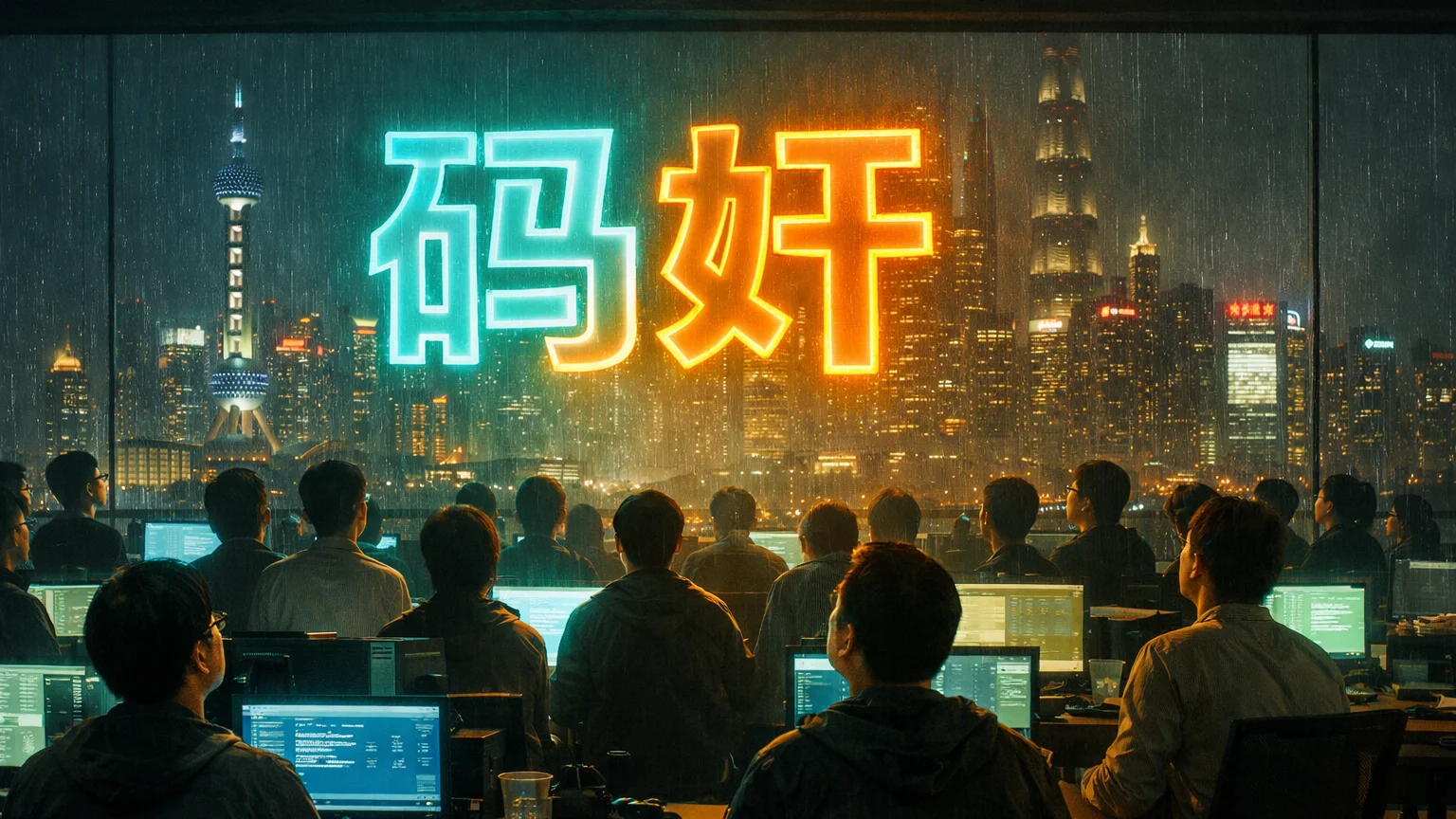
Somewhere in Shenzhen, a tech worker watched a Douyin video about AI replacing their entire team. Instead of updating their résumé, they opened BSC and aped into a token called 码奸 — literally "code traitor." By March 25, 2026, that token had done 2,200% from launch, racked up $1.7 million in 24-hour volume, and processed over 7,900 transactions in a single day. The Chinese internet's darkest workplace humor just found its way on-chain.
- → 码奸 (Code Traitor) launched on BSC 4 days ago and is up 2,200% with $184K market cap
- → $1.7M in daily volume against $46K liquidity — a 37:1 volume-to-liquidity ratio that screams momentum trading
- → Origin: a viral Douyin video about AI automation anxiety among Chinese tech workers. Over 7,100 transactions in 24 hours.
What Happened
The catalyst was a Douyin video that struck a nerve across Chinese tech communities. The premise: AI isn't coming for your job someday — it already took it, and the person who helped train the model that replaced you is the real traitor. The Chinese internet coined the term 码奸 — a compound of 码 (code) and 奸 (traitor) — to describe developers who build the AI systems that automate their own colleagues out of work.
The video exploded across Douyin's tech-adjacent communities in the third week of March, racking up shares and spawning a wave of commentary. In China's tech sector, where mass layoffs at Alibaba, Tencent, and ByteDance have become a recurring reality, the meme didn't land as comedy. It landed as catharsis.
Within days, someone deployed 码奸 on BNB Smart Chain. The timing was surgical — dropping while the meme was still trending, before the discourse cycle moved on.
The Degen Translation
Crypto Twitter has spent all of 2025 and 2026 trying to tokenize AI narratives. Most of those plays ($AGIX, $FET, the entire AI agent meta) bet on the upside — AI as opportunity. 码奸 is the mirror image. It bets on the downside: the fear, the resentment, the gallows humor of watching a language model do your job better and cheaper.
That inversion is what makes this play distinct from the thousand other Douyin-to-BSC pipelines that die at $10K market cap. The emotion backing 码奸 isn't greed — it's rage. And rage trades differently. It's stickier, more viral, more shareable. Every tech worker who's been told "AI will handle that now" is a potential community member.
The buy-sell ratio tells the story: 4,455 buys against 3,480 sells in the last 24 hours. That's a 56/44 split — net accumulation, not exit liquidity. Someone is buying this dip.
The Numbers
The numbers here tell a chaotic story. A 37:1 volume-to-liquidity ratio means this token is being traded nearly forty times its available liquidity in a single day. That level of turnover on a sub-$200K market cap token means the order book is razor-thin and volatility is extreme in both directions. Liquidity at $46.7K means a single $5K sell can move the price several percent.
The pair launched roughly four days ago and has already processed over 7,100 transactions in the last 24 hours. That transaction density is unusual for a BSC micro-cap and suggests genuine interest rather than a single whale washing volume — the buy and sell counts are distributed across thousands of wallets.
What the On-Chain Data Shows
This is a BSC token, which limits the on-chain forensics available. Rugcheck doesn't cover BNB Smart Chain, so the usual dev wallet analysis isn't available here. What we can observe: the contract address (0xA06FDdaBD7...4444) has been active for about four days, liquidity sits at $46.7K, and there's no verified team or doxxed deployer — par for the course on BSC meme launches.
The lack of transparency cuts both ways. There's no freeze authority or mint authority to flag (BSC standard tokens don't have these Solana-specific mechanisms), but there's also no way to verify whether the deployer is sitting on a significant allocation waiting to dump. Proceed with the assumption that they are.
Is This Sustainable?
The honest answer: probably not at this velocity. Douyin memes have a notoriously short shelf life — the Chinese internet discourse cycle moves faster than Western CT, and what's trending today is forgotten by next week. The question is whether 码奸 transcends the meme and becomes a symbol.
The bull case writes itself: AI workforce displacement isn't a temporary meme. It's a generational anxiety that's only going to intensify as models get better. Every new round of tech layoffs, every "AI can do this job" headline, every viral video of ChatGPT replacing a developer — that's all fuel for 码奸. The meme has a potentially infinite content cycle because the source material (AI taking jobs) isn't going away.
The bear case is equally straightforward: $184K market cap with $46K liquidity is a sandcastle. One coordinated sell of $10K would crater the price. The token has no utility, no roadmap, no team, and no ecosystem. It's pure sentiment — and sentiment on Chinese internet memes doesn't have a great track record of sustaining on Western-dominated DEXes. There's also the Great Firewall factor: most of the organic audience for this meme can't easily access BSC DEXes without VPN shenanigans.
The middle ground: 码奸 could see a second wave if the meme crosses from Douyin to English-language CT. "Code Traitor" is a powerful phrase that translates well. If a mid-tier CT account picks this up and repackages it for Western audiences, the next leg could be significant. But right now, this is a Chinese internet meme trading on a globally accessible chain with a language barrier in the middle.
🟡 Speculative — 码奸 is tapping into a real, powerful emotion: the fear of being replaced by AI. That gives it more memetic depth than most Douyin-to-BSC plays. But $184K market cap with $46K liquidity is a high-wire act. The volume is impressive, the narrative is resonant, and the timing is impeccable — but this needs to break out of its Chinese internet origins to have staying power. Watch for CT crossover posts in the next 48 hours. If the "Code Traitor" meme catches on in English, the current price is a footnote. If it doesn't, this is a four-day firework.
What is 码奸 (Code Traitor)?
码奸 is a meme token on BNB Smart Chain inspired by a viral Douyin video about AI replacing tech workers. The name combines 码 (code) and 奸 (traitor), referring to developers who build AI that automates their colleagues' jobs. It launched in late March 2026 and gained over 2,200% in its first four days.
Why is 码奸 pumping?
The token is riding a wave of virality from Chinese social media platform Douyin, where the "code traitor" meme resonated deeply with tech workers facing AI-driven layoffs. The combination of emotional resonance and low market cap created a momentum trade with $1.7M in daily volume.
Is 码奸 safe to buy?
码奸 is an unaudited BSC meme token with $46K in liquidity and no verified team. The extreme volume-to-liquidity ratio means price swings are severe in both directions. This is a high-risk speculative play — only allocate what you're prepared to lose entirely.
What chain is 码奸 on?
码奸 trades on BNB Smart Chain (BSC). You can find it on DexScreener by searching the contract address: 0xA06FDdaBD74dDFe8e860faE52621e88b4fFA4444.
What is the AI layoff meme from Douyin?
The meme originated from a viral Douyin video discussing how AI is replacing human developers in Chinese tech companies. It spawned the term 码奸 (code traitor) to describe engineers who build the AI systems that eliminate their coworkers' positions — a dark humor response to real workforce anxiety in China's tech sector.