
$CRIMECAT Turns a Pump.fun Cat Launch Into an Organic Volume Anomaly
$CRIMECAT ripped through $8.9M in first-day volume with high organic activity, clean authorities, and one holder-map warning that keeps the trade speculative.
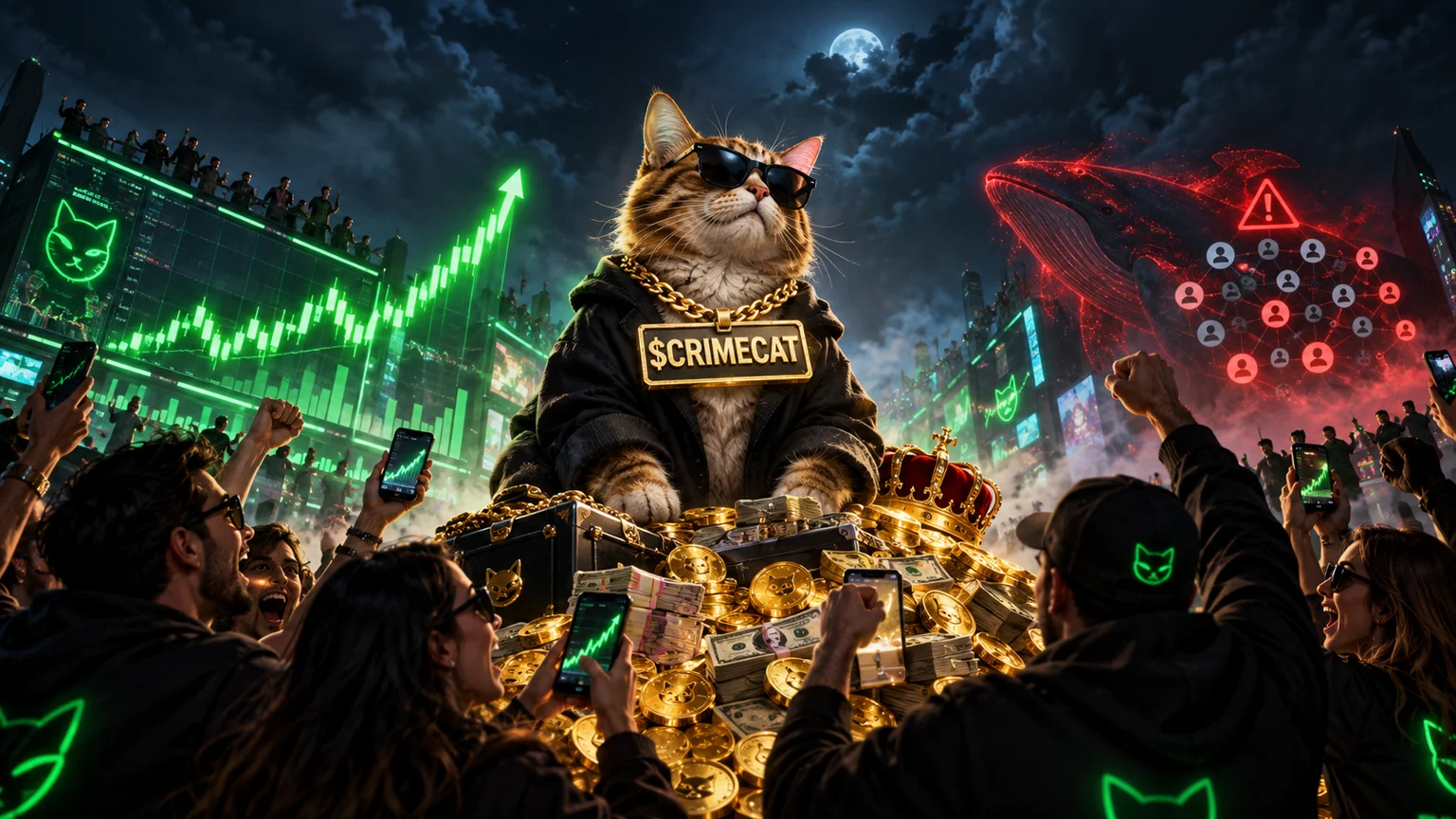
$CRIMECAT is what happens when the Solana cat trade gets a cleaner activity read than the average pump.fun sprint. The meme itself is simple: a crime-cat character, a launchpad origin, and a chart that moved before the market had much time to overthink it. The reason it matters is the size of the first-day response. At roughly five hours old, $CRIMECAT had already posted about $8.88M in 24-hour volume, a $1.39M market cap, $90.4K in liquidity, and 4,221 holders.
That is not a normal sleepy cat launch. It is a high-velocity culture bid, and the best part of the read is not just the percentage move. The organic label is high, the organic score is 85.6, and the trade was still positive over the most recent hour at the snapshot. The caution is the holder map. One top wallet shows 22.44% of supply, and the top three visible holders combine for 30.5%. That does not automatically break the setup, but it keeps $CRIMECAT in speculative territory.
- → $CRIMECAT produced $8.88M in 24-hour volume while sitting near a $1.39M market cap, a major turnover signal for a five-hour pump.fun meme.
- → Jupiter data marked the activity as high organic, with an 85.6 organic score and 87,961 total transactions in the 24-hour window.
- → The contract authority read is clean, but the holder map is not invisible: the largest listed wallet controls 22.44% and the top three show 30.5% combined.
The Cat Meta Gets a Crime Scene
Solana traders keep proving that the cat meta still has room when the character is readable in one glance. $CRIMECAT does not need a complicated pitch. It gives the market a mischievous mascot, a ticker that sounds like a joke people can repeat, and a launchpad chart with enough speed to make traders treat it as a live rotation rather than a background token.
The culture angle matters because these trades are rarely about technical novelty. They are about whether the market can agree on a character quickly enough to create reflexive volume. $CRIMECAT found that agreement faster than most launches. A five-hour-old meme doing nearly $9M in volume is not simply drifting into visibility. It is being actively passed around, bought, sold, and re-entered by wallets that understand the joke without needing a manifesto.
Why the Volume Stands Out
$CRIMECAT's volume-to-market-cap relationship is the main reason it deserves a sharper look. The token was listed around $1.39M in market cap with $8.88M in 24-hour volume. That is more than six times the market cap changing hands on a very young pair. In meme-token terms, that kind of churn can mean broad attention, aggressive bot traffic, or a crowded flip arena. The organic score helps separate the read from pure noise.
The one-hour flow also stayed active. The selected data showed 3,342 buys and 2,843 sells over the hour, a buy ratio around 54%. That is not the same lopsided bid you see on a vertical first candle, but it is useful because it suggests two-sided trading rather than a dead chart coasting on old volume. The market was still negotiating price, not just admiring a past pump.
The Organic Activity Read
Organic labels are not magic, but they are useful when a launch is already moving this fast. A high organic score means the trade looks less like a single mechanical wash of activity and more like a broad set of wallets interacting with the token. $CRIMECAT's 85.6 score gives the bulls something better than a screenshot of a green candle. It suggests the volume had enough real distribution to matter.
That is why the setup is more compelling than the headline percentage alone. The 24-hour move was listed above 34,000%, but early percentage moves on pump.fun are often cartoon numbers. The more useful signal is that price, transactions, volume, holders, and organic activity all appeared at once. When those fields line up, the market is not just looking at one whale candle. It is looking at a meme that found an audience quickly.
What the On-Chain Data Shows
The Solana contract read is mixed in a way that deserves precision. On the clean side, freeze authority is disabled and mint authority is disabled. That removes two obvious authority risks from the front of the checklist. Rugcheck's normalized score is 1, and the selected profile did not list named risks. The dev wallet is identified, with dev balance percentage around 0.90% in the market-data enrichment, which is not the kind of dominant creator position that would become the whole story by itself.
The holder map is the counterweight. The largest visible holder controls 22.44% of supply, while the next two visible holders show 4.34% and 3.75%. Together, the top three concentration is 30.5%. None of the listed wallets is marked as insider in the selected profile, but concentration still matters. In a fast meme launch, a single large holder can change the chart faster than the community can explain it.
The creator history is also worth treating carefully. The provided profile shows two creator tokens, not a sprawling serial-deployer trail. That is less alarming than a wallet with a long cemetery of launches, but it is not the same as a doxxed team or a mature project history. For $CRIMECAT, the on-chain conclusion is clean authorities, low Rugcheck score, strong activity, and a holder map that forces the rating to stay yellow.
$CRIMECAT has the activity profile of a real culture bid and the concentration profile of a token that still needs to prove large holders will not dominate the next move.
Where the Trade Can Break
The easiest way for $CRIMECAT to fail is not a complicated contract issue. The obvious authorities are already disabled in the selected read. The more realistic break is exhaustion. A launch can trade multiples of its market cap in a few hours and still roll over if the next buyers decide the joke is already fully priced. The difference between a culture bid and a round trip is whether fresh volume keeps arriving after the first viral window.
Liquidity sits near $90.4K, which is usable but still fragile relative to the amount of volume moving through the token. If the largest wallets begin selling into thinner periods, the chart does not need a malicious contract lever to hurt late buyers. It only needs ordinary meme-coin gravity: early entries taking profit, dip buyers hesitating, and the character losing its novelty before the community has built a reason to stay.
What Would Make It Cleaner
$CRIMECAT would earn a cleaner read if the holder map loosens while liquidity deepens. The ideal follow-up is more holders, lower top-wallet concentration, and continued high organic activity without price needing constant vertical candles to keep attention. A token can survive a concentrated early map, but it has to distribute into strength rather than wait for one large wallet to define every candle.
The cultural side needs the same kind of proof. The cat is readable, the crime gag is easy to remix, and the launch has already found volume. Now the market needs to see whether $CRIMECAT becomes a character traders keep using or just another mascot attached to a fast pump.fun print. The next durable signal is a steady base with active volume, not another cartoon percentage headline.
$CRIMECAT earns a speculative culture-moment read. The positives are real: high organic activity, huge early volume, more than 4,000 holders, clean freeze and mint authority data, and a low Rugcheck score. The reason it is not clean is holder concentration. A 22.44% largest wallet and 30.5% top-three concentration give one side of the market too much power until distribution improves.
What is $CRIMECAT?
$CRIMECAT is Crime Cat, a Solana meme coin launched through pump.fun with cat-meme branding and rapid first-day trading activity.
Why is $CRIMECAT getting attention?
$CRIMECAT drew attention after posting about $8.88M in 24-hour volume, 4,221 holders, and a high organic activity score while still only a few hours old.
What is the biggest concern with $CRIMECAT?
The biggest concern is holder concentration. The largest visible holder controls 22.44% of supply, and the top three visible holders combine for 30.5%.