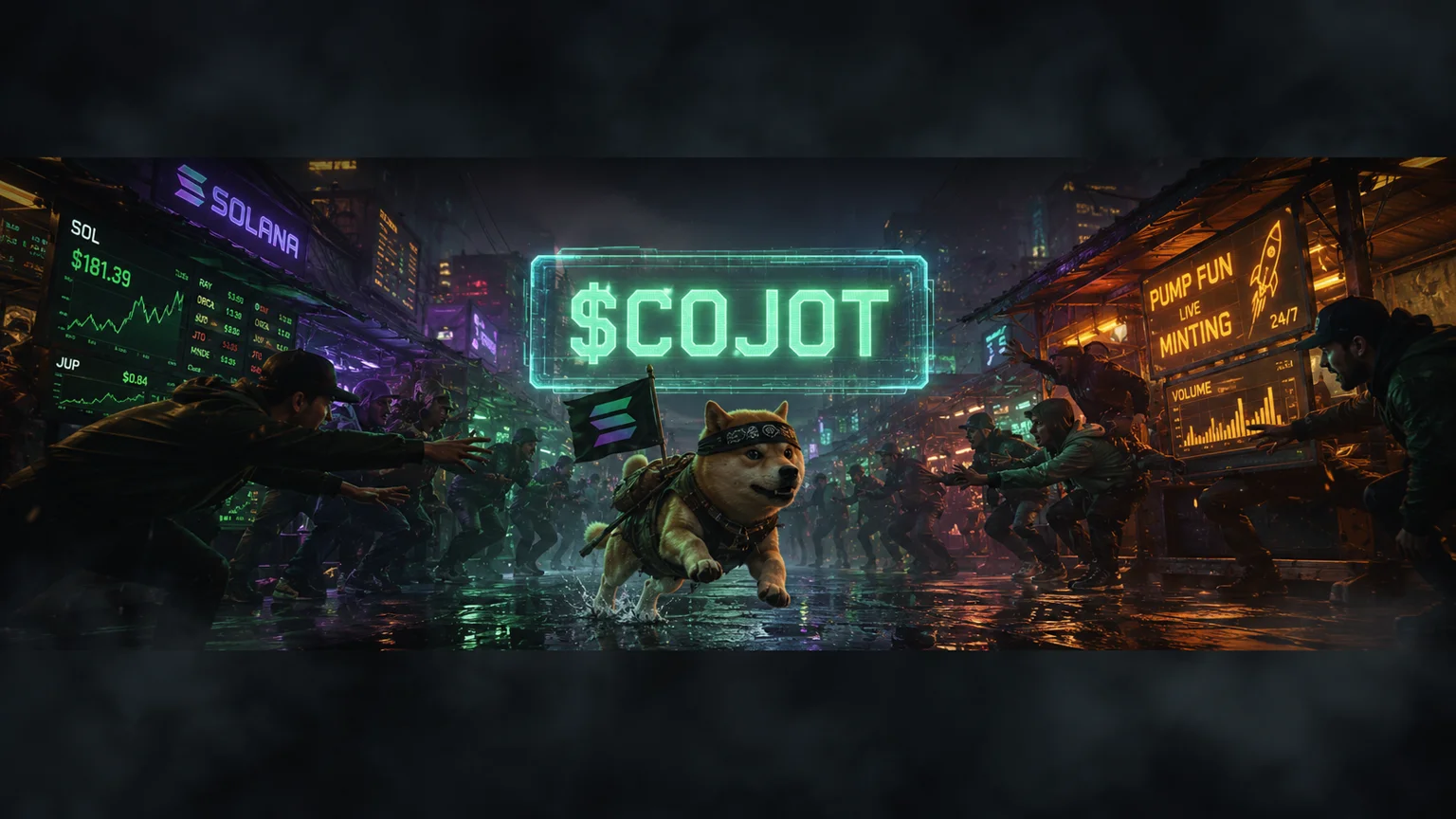
Cousin Jotchua Turned an Old Internet Dog Meme Into a $635K Solana Sprint Before Sunrise UTC
$COJOT is monetizing a reaction-image meme that already had its own weird little internet archive before pump.fun found it. If traders keep treating the Jotchua family as a reusable culture prop, this five-hour-old board can keep squeezing. If the meme has already spent its first laugh, roughly $40K of liquidity leaves late buyers with very little padding.
Rugcheck scored $COJOT at 16 with both authority keys disabled and no insider concentration showing up in the top holders, but liquidity is still being supplied by a very small set of participants, which matters more than the contract shell if momentum stalls.
Some Solana launches work because the chart is violent. Others work because the internet already taught a certain kind of trader to recognize the joke instantly. $COJOT looks like the second kind. Cousin Jotchua was trading around a $326K market cap with roughly $635K in first-session volume, a 47.5% one-hour lift, and close to 19,600 tracked transactions while the pair was still under five hours old. That is enough flow to say the market was not simply flipping a random dog ticker. Traders were responding to a meme that already felt familiar.
That matters because pump.fun launches do not get much time to explain themselves. If the meme needs a paragraph, the board is probably already dead. Jotchua does not. The name points to one of those long-circulating dog reaction-image pockets that has lived on Reddit, Pinterest boards, GIF dumps, and old meme pages for years. $COJOT is basically packaging that low-resolution, already-online feeling into a ticker while Solana traders are still willing to pay for recognizable weirdness.
- → $COJOT pushed roughly $635K in 24-hour volume on a $326K board in under five hours, which is enough turnover to treat this as a live culture trade instead of decorative launch spam.
- → The hook is not novelty alone. Cousin Jotchua taps an older reaction-image ecosystem that already has meme memory behind it, and that kind of familiar weirdness often travels faster than a totally new mascot.
- → The contract read is cleaner than the average first-day pump.fun board: Rugcheck scored it 16, mint and freeze authority are disabled, and the top three visible holders only account for about 7.17% combined.
What Happened
Selection first caught $COJOT after the board had already stopped behaving like a tiny launchpad experiment and started behaving like a real speed trade. The enriched snapshot showed more than $651K in volume, roughly 8,030 holders at the time, and a 59.9% buy ratio during the opening wave. The fresher DexScreener read kept the story intact: about $634.9K in volume, 14,845 buys against 4,735 sells, and another one-hour move near 47.5%. The chart did not just spike once and flatline. The board kept attracting enough flow to stay visible.
That is the real cultural signal. A lot of dog tokens lean on generic cuteness and die the moment a newer animal shows up. $COJOT feels different because it is not selling dogness alone. It is selling recognition. Jotchua already had internet residue, enough that the token does not feel like it was invented from nothing at launch time. In meme markets, inherited context is an edge because it lets traders believe they are buying into a living reference instead of just another upload.
The Degen Translation
What Solana is really pricing here is not a dog. It is a specific flavor of internet nostalgia: low-resolution, slightly cursed, easy to remix, and impossible to explain to normies without sounding insane. That aesthetic has become one of the cleaner launch ingredients of the year. Traders trust memes that already feel old enough to have survived different corners of the web, because age creates the illusion of legitimacy even when the token itself is only hours old. $COJOT benefits from that instinct. It looks like a coin that arrived late to its own meme, which paradoxically makes the launch feel less forced.
That is also why the board can print a medium organic label and still feel stronger than the raw number suggests. An organic score around 37.1 is not a purity certificate. But paired with nearly 19,600 transactions and a buy-heavy opening tape, it does suggest there was a real crowd interacting with the board instead of a purely synthetic loop. When meme traders recognize a joke instantly, they do not need anyone to narrate it for them. They just need enough volume to believe other people are seeing the same thing.
The Numbers
The turnover is the headline statistic. About $635K in volume against a $326K market cap means the market traded nearly twice the size of the board in one session. That is the kind of churn that forces attention, especially on a token that is still too young to rely on whales or headline catalysts. A lot of first-day launches print loud percentage gains on tiny engagement. $COJOT had the opposite problem: enough traffic that traders had to decide whether they were watching the first chapter of a culture-meme bid or the whole event compressed into one opening window.
The catch is that $40.4K of liquidity is still microcap-thin. Early volume can be both the bull case and the danger sign at once. Strong turnover tells you the meme connected. Thin liquidity tells you every incremental buyer is helping build a ladder that can disappear quickly if the mood turns. A board can look broadly owned and still be structurally fragile, especially when the thesis is emotional rather than event-driven. If the joke feels stale for even half a day, a five-hour-old board with this level of liquidity can unwind much faster than the holder count makes it seem.
What the On-Chain Data Shows
The contract-level read is cleaner than average. Rugcheck scored $COJOT at 16. Freeze authority is gone. Mint authority is gone. The creator wallet balance is effectively zero in the current saved profile, which removes one obvious dump-overhang concern. Just as importantly, the holder map is not screaming insider trap. The top visible holder sits around 6.12%, with the next two rows at 0.66% and 0.39%, leaving top-three concentration near 7.17%. For a token that has only been live a few hours, that is a materially healthier starting point than the usual pump.fun board where one or two wallets quietly own the future.
The more interesting warning comes from liquidity structure, not wallet concentration. Rugcheck only flags one issue here: a low number of LP providers. That means the contract can be technically clean while the trade still behaves like a trap for slow exits. If profit-taking shows up and only a small set of participants are really supporting the pool, the board can gap lower without any insider scandal. So the useful read on $COJOT is not “safe,” because nothing in this lane is safe. It is “clean enough on-chain that the main risk has shifted back to market structure and attention decay.”
Is This Sustainable?
Sustainability here has almost nothing to do with roadmap fantasies and almost everything to do with replay value. Can traders keep finding new ways to use the meme? Can the image keep showing up in replies, profile pictures, edits, and sticker packs? Cousin Jotchua has a better shot than the average launch because it does not depend on one specific headline. It belongs to a broader family of internet dog absurdism that can be reused as long as people still enjoy the look of it. That flexibility is why old reaction-image memes remain dangerous in token form.
But replay value is not immunity. If the board keeps climbing, traders will call the meme timeless. If it stalls, they will decide it was too niche all along. The honest middle ground is that $COJOT has already cleared the hardest first hurdle: it got strangers to care quickly. The next hurdle is tougher. It has to prove the Jotchua meme can support another round of participation once the first buyers are sitting on obvious profits and everyone else knows they are no longer early to the joke.
Verdict
🟡 Speculative — $COJOT has the ingredients of a real culture-meme bid: inherited internet context, a fast opening tape, a cleaner-than-average contract shell, and a holder map that does not immediately look like a landlord special. That is enough to make the board worth tracking. The problem is still microstructure. Roughly $40K of liquidity and a thin LP base mean the chart can go from “widely recognized meme” to “hard exit” faster than the holder count suggests. Treat Cousin Jotchua as a live signal on internet recognition, not as proof that nostalgia automatically turns into durability.
FAQ
What is $COJOT on Solana?
$COJOT is the Solana meme coin for Cousin Jotchua, a token built around the older Jotchua dog-meme ecosystem. At writing time it was trading near a $326K market cap with roughly $635K in first-session volume.
Why did $COJOT get attention so quickly?
Because the meme already feels familiar to a certain part of the internet. Instead of inventing a mascot from scratch, $COJOT tapped a reaction-image style that had already circulated across meme archives, which helped the board pair instant recognition with heavy early turnover.
Does $COJOT look like an obvious contract trap?
Not from the saved on-chain profile. Rugcheck scored the token 16, mint and freeze authority were disabled, and top-holder concentration was relatively light for a board this young. The larger risk is liquidity structure, not a visible admin-key problem.
What is the biggest risk on $COJOT right now?
Liquidity depth and attention decay. About $40.4K of liquidity is enough for a lively first session but not enough to make exits comfortable if momentum cools and only a few LP participants are really supporting the pool.
What would strengthen the $COJOT setup from here?
The setup improves if the token keeps doing real turnover after the first profit-taking wave and if the meme keeps resurfacing across social feeds in a way that attracts new buyers instead of recycling the same opening crowd.