The Answer to Life, the Universe, and Everything Just Pumped 71% on Solana — $42's Philosophical Meme Won't Die
Douglas Adams' cosmic joke became a $60K market cap experiment in collective belief. Despite net outflows, 50,000 traders keep the riddle alive. Either this is the most cultured degen play on Solana or the universe's most elaborate exit liquidity setup.
Dev launched 48 other tokens. 1 high-risk flag.
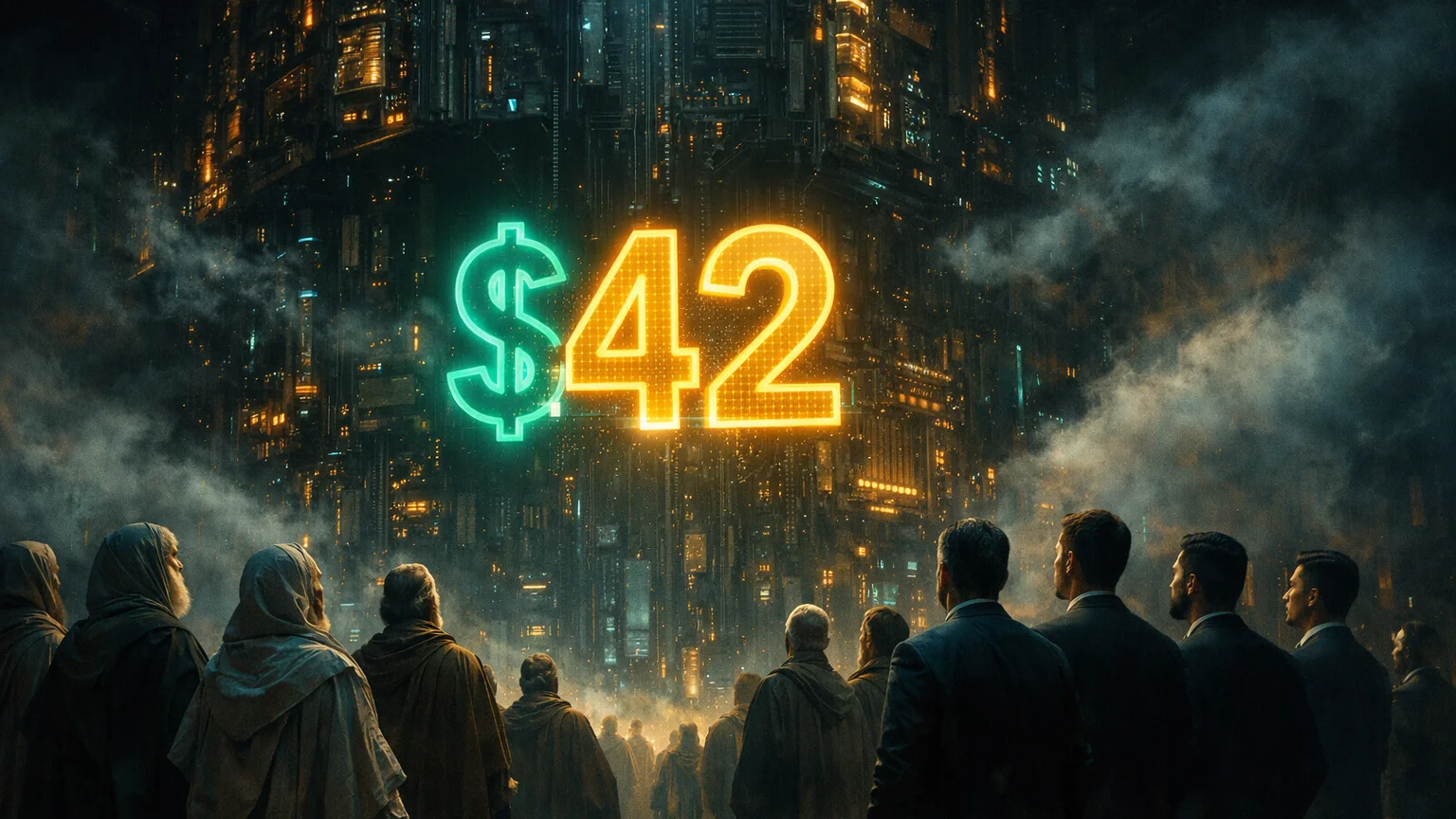
In Douglas Adams' Hitchhiker's Guide to the Galaxy, a supercomputer called Deep Thought spends 7.5 million years calculating the Answer to the Ultimate Question of Life, the Universe, and Everything. The answer: 42. Nobody knows why. Nobody knows what the question actually was. The joke — and perhaps the point — is that the answer is meaningless without understanding the question. On March 8, 2026, over 50,000 Solana traders decided that was a good enough thesis to trade on.
- → $42 token surged 71% with $2M in 24h volume and a 77% buy ratio — despite confirmed net outflows from the token
- → The Douglas Adams reference gives $42 a cultural moat that most meme tokens can only dream of — the concept is universally recognized across tech, science, and pop culture
- → At $60K market cap with $21K liquidity, this is nano-cap territory — but the 50,897 transactions suggest real human interest, not bot farms
What Happened
The number 42 occupies a strange and permanent place in internet culture. It's the answer Deep Thought gives in Adams' 1979 novel — an answer so anticlimactic that it became the ultimate inside joke for anyone who's ever asked big questions and gotten unsatisfying answers. The number appears everywhere: it's the error code for 'service unavailable' in HTTP, it's the jersey number retired by the Dodgers for Jackie Robinson, and it's the angle at which light hits water droplets to create a rainbow. Whether Adams intended any of this is irrelevant. The culture adopted 42 as a symbol of absurdist meaning-making.
On Solana, someone turned this into a token. Not for the first time — $42 has appeared in various forms across chains — but this iteration has staying power that previous attempts lacked. The token is trading under the name 'Life, Universe, and Everything,' and its price action over the past 24 hours tells a story that Douglas Adams himself would appreciate: logically contradictory, emotionally compelling, and fundamentally absurd.
The Degen Translation
Here's where the data gets weird. $42 shows net outflows — more money leaving than entering — yet the price pumped 71% and the buy ratio sits at 77%. How? The answer lies in how Pump.fun's bonding curve mechanics interact with trader behavior. Large holders are selling into strength (net outflows), but a persistent wave of smaller buyers keeps replacing them at higher prices. It's a game of musical chairs where the music keeps getting louder even as players leave the room.
This pattern is unusual and significant. Most meme tokens with net outflows bleed downward. $42's ability to maintain upward momentum despite capital extraction suggests genuine, distributed demand — likely driven by the cultural narrative rather than coordinated pumping. People aren't buying $42 because an influencer told them to. They're buying it because the meme resonates. That's a fundamentally different demand profile, and one that tends to produce longer-lasting price floors.
The Numbers
$2.04 million in 24-hour volume against a $60,000 market cap gives $42 a volume-to-mcap ratio of roughly 34:1. That's high — very high — but not as extreme as some of the Pump.fun outliers that hit 80:1 or above. The 50,897 transactions suggest real trading activity from thousands of individual wallets rather than a handful of bots churning volume. At 77% buy ratio, buyers outnumber sellers nearly 4:1, which is extraordinary for a token experiencing net outflows.
Liquidity at $21K is thin but proportional to the market cap — roughly 35% of total mcap, which is actually healthy for a Pump.fun bonding curve token. Compare this to tokens where liquidity is 5-10% of mcap and you see why $42 has more price stability than its nano-cap status would suggest. A $21K liquidity pool can absorb small sells without catastrophic slippage, though any position above $2-3K will move the price meaningfully.
The Philosophical Meme Moat
What makes $42 different from the ten thousand other Pump.fun tokens launched this week is the cultural depth of its reference. 'The Hitchhiker's Guide to the Galaxy' has sold over 15 million copies. The 2005 film adaptation grossed $104 million. The number 42 is referenced in hundreds of books, papers, songs, and films. When programmers encounter the number 42 in code, they smile. When scientists see it in data, they take a screenshot. The meme isn't something that needs to be explained or marketed — it already lives rent-free in the collective consciousness of exactly the demographic that trades crypto.
This gives $42 a narrative moat that animal coins and political tokens can never replicate. BONK needs dog lovers. TRUMP needs political engagement. $42 just needs people who've read a book, watched a movie, or spent enough time on the internet to absorb the reference through cultural osmosis. The addressable market for '42 as a meme' is essentially every English-speaking internet user.
The anonymous Twitter accounts promoting $42 aren't selling it as a get-rich-quick scheme. They're positioning it as a philosophical experiment — 'what happens when collective belief meets bonding curve mechanics?' It's the kind of meta-narrative that appeals to the intellectual degen crowd: people who want their speculation to come with a side of existential commentary. Whether this translates into lasting demand depends on whether the community can sustain the joke. Adams' humor has lasted 47 years. The token needs to last 47 days to be considered a success.
Who's Calling It
No established KOL coverage detected. Promotion has come from anonymous Twitter accounts and organic community discovery rather than coordinated influencer campaigns. This is consistent with $42's philosophical positioning — it's a meme that spreads through cultural recognition rather than CT call groups. The lack of KOL involvement means there's no single point of failure (one influencer selling and crashing the price), but it also means there's no amplification catalyst waiting in the wings.
MemeDesk previously covered $42 on March 3rd when a community takeover following a dev dump pushed the token up 1,621%. The fact that it's appearing on scanners again six days later with fresh volume suggests the community survived that turbulent origin story — a significant signal. Tokens that recover from dev dumps and sustain trading activity have historically stronger community bases than those that launch cleanly.
Is This Sustainable?
The persistence of $42 is its most compelling feature and its biggest question mark simultaneously. Net outflows combined with price appreciation is a pattern that can't continue indefinitely — eventually, the outflows overwhelm the buyers. But the 77% buy ratio suggests that inflection point hasn't arrived yet. The cultural narrative provides a floor of interest that pure hype tokens don't have: people will keep discovering Douglas Adams' work, keep encountering the number 42, and keep making the connection to this token.
The risk is mathematical. At $60K market cap, $42 needs approximately $180K in net buying pressure to 3x. At $21K liquidity, that's achievable with moderate demand. But the net outflow pattern means existing holders are taking profits, requiring a constant stream of new buyers to maintain the price. This is the classic meme token treadmill — sustainable only as long as the meme keeps attracting fresh capital. The good news: Douglas Adams isn't going out of style. The bad news: attention spans in crypto are measured in hours.
The Bear Case
Net outflows are net outflows. No amount of philosophical narrative changes the fact that more capital is leaving $42 than entering it. The 77% buy ratio is impressive but likely reflects a high number of small retail buys against fewer but larger sells — the classic distribution pattern where whales sell into retail enthusiasm. At $60K market cap, this token is one bad hour from being effectively dead. The previous dev dump required a community takeover to save it — lightning rarely strikes twice at this market cap level.
🟡 Speculative — $42 is the rare meme token with genuine cultural depth. Douglas Adams' cosmic joke gives it a narrative moat that most tokens spend millions in marketing to build and never achieve. The numbers are contradictory — net outflows but rising prices, massive volume but nano-cap market cap — which makes this either a fascinating experiment in collective belief or the universe's most intellectually satisfying exit liquidity trap. The community survived a dev dump and came back stronger, which counts for something. At $60K mcap, the upside potential is enormous if the meme catches fire beyond Solana degens. But the net outflow pattern means the clock is ticking. Don't panic — but maybe bring a towel.
What is $42 crypto token?
$42 (Life, Universe, and Everything) is a meme token on Solana referencing Douglas Adams' Hitchhiker's Guide to the Galaxy, where 42 is revealed as the answer to the ultimate question of life. The token trades on Pump.fun and has built a community around philosophical meme culture.
Why is 42 the answer to everything?
In Douglas Adams' 1979 novel, a supercomputer called Deep Thought calculates for 7.5 million years and determines that 42 is the Answer to the Ultimate Question of Life, the Universe, and Everything. The joke is that nobody knows what the actual question was, making the answer meaningless without context.
Is the $42 token safe to buy?
$42 is an extremely speculative nano-cap meme token with just $21K in liquidity. Despite showing net outflows, the price has risen 71% due to persistent small buyer demand. It survived a dev dump via community takeover but remains high-risk. Only allocate funds you can afford to lose entirely.
What happened with the $42 dev dump?
Shortly after launch, the original developer dumped their token allocation, crashing the price. The community organized a takeover, reclaimed momentum, and pumped the token 1,621% from its post-dump low. This community resilience is unusual for Pump.fun tokens and suggests genuine grassroots support.