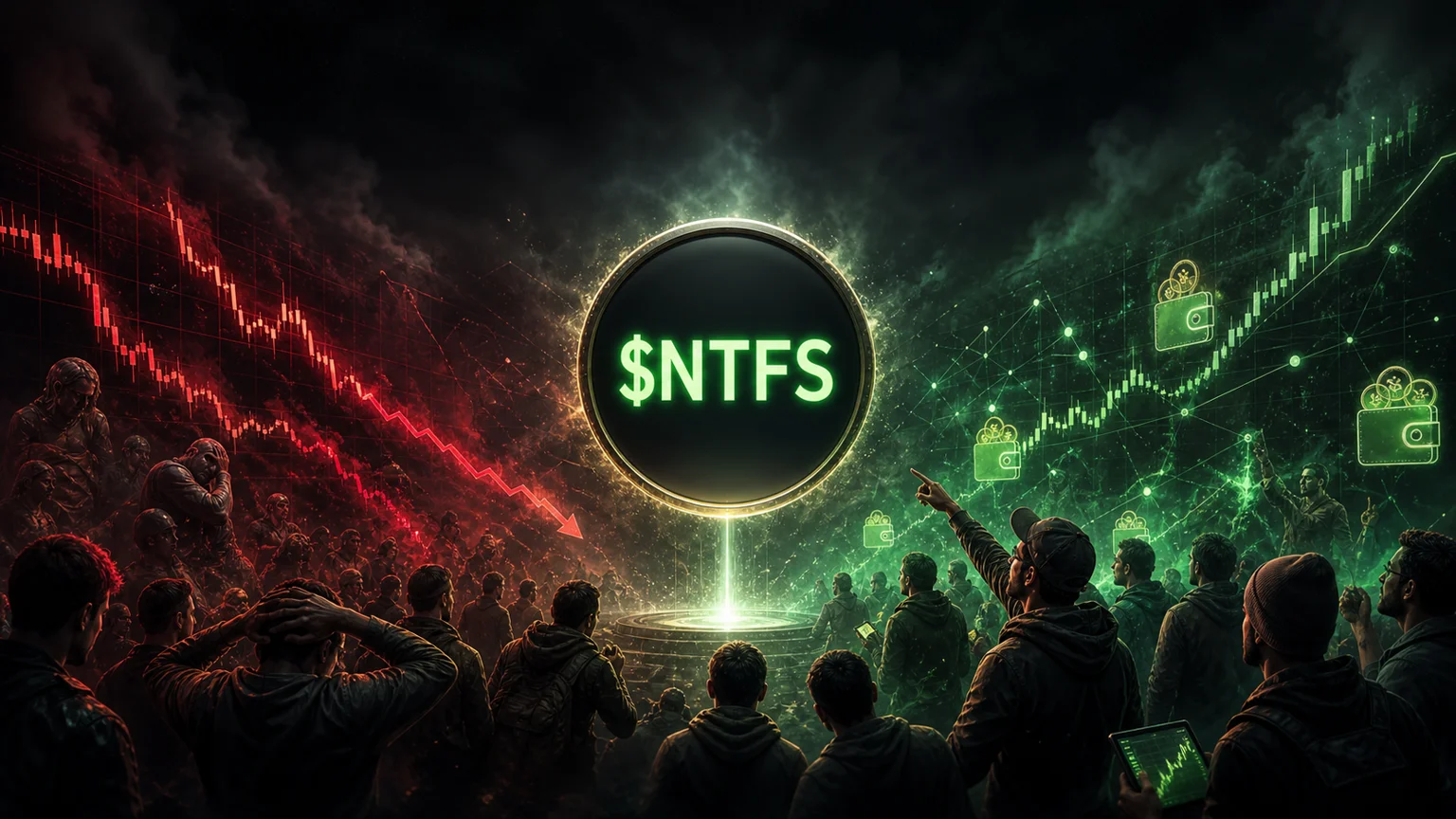
$NTFS Is Down 89% From Its First High. Now the Washout Is the Story
$NTFS graduated from pump.fun with a $1.38M market cap and 2,803 holders, but the real test is whether an 89% ATH drawdown becomes accumulation or just another exhausted launch chart.
$NTFS has disabled mint and freeze authority with a low Rugcheck score, while the top three listed holders account for about 3.4% of supply.
$NTFS is already past the easy part of the launch. National Trust Fund System came out of pump.fun, pushed hard enough to tag an all-time-high market cap near $12.97M, and then gave almost all of that move back. The current read is a $1.38M market cap, roughly $3.0K in reported 24-hour volume, and an 89.3% drawdown from that first high. That is not a normal cool-off. That is the point where the story stops being about discovery and starts being about whether trapped buyers can turn into a second bid.
That makes $NTFS a post-pump exhaustion trade, not a clean breakout. The market has already shown it can mark the token up aggressively. It has also shown that the first markup did not hold. When a meme coin drops this far this quickly, the next useful question is not whether the original move was real. The useful question is whether the remaining crowd is still organized enough to defend a new range, absorb supply, and make the washout look intentional instead of terminal.
- → $NTFS is sitting around a $1.38M market cap after falling 89.3% from its first reported ATH.
- → The holder count is still meaningful for a fresh Solana launch, with 2,803 wallets on the current read.
- → The on-chain profile is cleaner than the chart: mint authority and freeze authority are disabled, and Rugcheck shows a low score of 1.
The Move Already Happened
The mistake with charts like $NTFS is treating the current market cap as if it exists in a vacuum. A $1.38M meme coin can still look early on a screener, especially when it has a website, a Twitter account, and more than 2,800 holders. But the ATH context changes the read. This token was recently valued near $12.97M by the same market. Anyone buying now is not discovering untouched upside. They are stepping into the remains of a violent repricing and betting that the second group of buyers has a better reason to show up than the first.
That does not automatically make $NTFS dead. Meme markets are full of ugly first tops that later become clean bases. The difference is behavior after the flush. A healthy washout starts to show tighter downside, stronger reaction candles, rising liquidity, and volume that looks like new demand rather than the last rotation of trapped wallets passing bags around. A dead bounce gives one dramatic candle, fails near obvious resistance, and returns to drifting volume.
Why the Holder Count Matters
The strongest argument for continuing to watch $NTFS is not the price. It is the audience left behind. A token with 2,803 holders after an 89% drawdown has more optionality than a one-candle chart with 80 wallets and no social surface. Holders do not guarantee demand, but they create a base of people who can repost, defend, average down, or become exit liquidity for a rebound. In meme tokens, that social residue often matters as much as the next candle.
The weak side is that holder count alone can mislead. A wide wallet count after a pump can mean distribution, not community. If too many wallets entered near the highs, every rebound becomes a chance to reduce exposure. That creates a ceiling where the chart needs much more buying than the market cap suggests. For $NTFS, the watch is simple: does the holder base become a floor, or does it become a wall of sellers waiting for any recovery?
What the On-Chain Data Shows
The Solana risk profile is better than the price chart. Rugcheck data shows mint authority disabled and freeze authority disabled, which removes two of the nastier contract-level hazards that can wreck late buyers. The listed Rugcheck score is 1, with no explicit risks shown in the current profile. That does not make $NTFS safe. It means the obvious authority buttons are not the main problem today.
Holder concentration also looks lighter than many pump.fun graduates at this stage. The largest listed holder is around 2.76%, while the next two are roughly 0.31% each, bringing the top three to about 3.4%. The enrichment read also shows sniper ownership as a tiny 0.0001% slice and dev holdings around 0.0006%. Those numbers suggest the visible supply map is not dominated by one monster wallet. The practical concern is different: the chart has already burned enough buyers that ordinary sell pressure can still feel heavy.
The Liquidity Problem
The missing clean number is liquidity depth. The current selection gives market cap, price, holders, and volume, but not a reliable liquidity figure. That matters more here because $NTFS is already trading as a damaged chart. A token can show a million-dollar market cap and still have a thin exit door if the actual pool cannot support size. With only about $3.0K in 24-hour volume on the present read, traders should assume slippage and spread risk are part of the trade until the pool data proves otherwise.
This is where the washout thesis either earns a second look or fails. If liquidity builds while price stops falling, the drawdown starts to look like a reset. If volume stays thin and every bounce arrives on weak participation, the market is not accumulating. It is waiting. $NTFS needs stronger traded value, not just a lower entry price, because a cheaper chart with no depth is still a trap.
The Social Shell Is Real, But Untested
$NTFS does have more surface area than a throwaway ticker. The signal includes a project Twitter and a website, which gives the community something to rally around beyond a contract address. That is useful after a deep drawdown because post-pump coins need narrative repair. A chart that has already fallen 89% cannot simply say “new launch” and expect the same buyers to chase again. It needs a reason for people to believe the first top was the opening act, not the whole show.
The name helps a little because National Trust Fund System sounds like fake bureaucracy turned into a meme, and Solana traders understand that kind of absurd finance theater. But the name is not enough on its own. The next phase needs visible community activity, cleaner volume, and a chart that stops punishing every attempt to buy strength. Without that, the brand wrapper becomes decoration around a failed pump.
The Bear Case
The bear case is brutally simple: $NTFS already had its liquidity event. An 89.3% drop from ATH means early buyers had a chance to mark the token up, sellers overwhelmed the move, and the current chart is now asking new entrants to clean up the damage. Even with disabled mint and freeze authority, the market structure can still be hostile. Contract safety is only one category of risk. Exhaustion, low volume, and poor bounce quality can be just as unforgiving.
$NTFS does not look like an authority-risk warning from the available on-chain data. It looks like a chart-risk warning: the token needs real demand after a severe first-cycle collapse.
What Would Change the Read
The upgrade case for $NTFS is not complicated. First, volume needs to expand from the current low base while price holds above the washout zone. Second, liquidity needs to be visible enough that entries and exits are not just theoretical. Third, the holder base needs to stop acting like trapped supply. A higher low with better volume would say more than another vertical candle, because vertical candles are exactly what already failed.
The downgrade case is just as clear. If $NTFS keeps printing lower bounces on thin volume, the 2,803-holder count becomes a liability instead of a strength. A large audience can amplify a rebound, but it can also create constant supply when confidence breaks. That is why this is a watchlist name rather than a clean signal.
$NTFS earns a speculative washout read. The on-chain profile is cleaner than the crash suggests, with mint authority and freeze authority disabled, a low Rugcheck score, and light visible top-holder concentration. The chart is the problem. After an 89% ATH drawdown and only thin current volume, $NTFS has to prove that the remaining holders are building a base instead of waiting for exit liquidity.
Why is $NTFS on watch after falling 89%?
Because deep meme-token drawdowns can become tradable washouts when holder count, social activity, and cleaner on-chain data survive the first collapse. $NTFS still has 2,803 holders and disabled mint and freeze authority, but it needs stronger volume before the setup improves.
Is $NTFS a clean Solana launch?
The authority profile is cleaner than average from the available data: mint authority and freeze authority are disabled, Rugcheck shows a low score of 1, and the top three listed holders account for about 3.4%. The chart remains highly speculative because of the 89.3% ATH drop.
What is the main risk for $NTFS now?
The main risk is post-pump exhaustion. If liquidity stays thin and every bounce meets sellers from the first cycle, $NTFS can keep bleeding even without obvious contract-level red flags.