One Wallet Held 84% of NINJA's Supply. Then the Chart Went to Zero.
$700K in volume, 12,500 transactions, and 94% crash in under 6 hours — NINJA (NoIncomeNoJobnoAsset) is a textbook case study in what concentrated supply looks like when it exits.
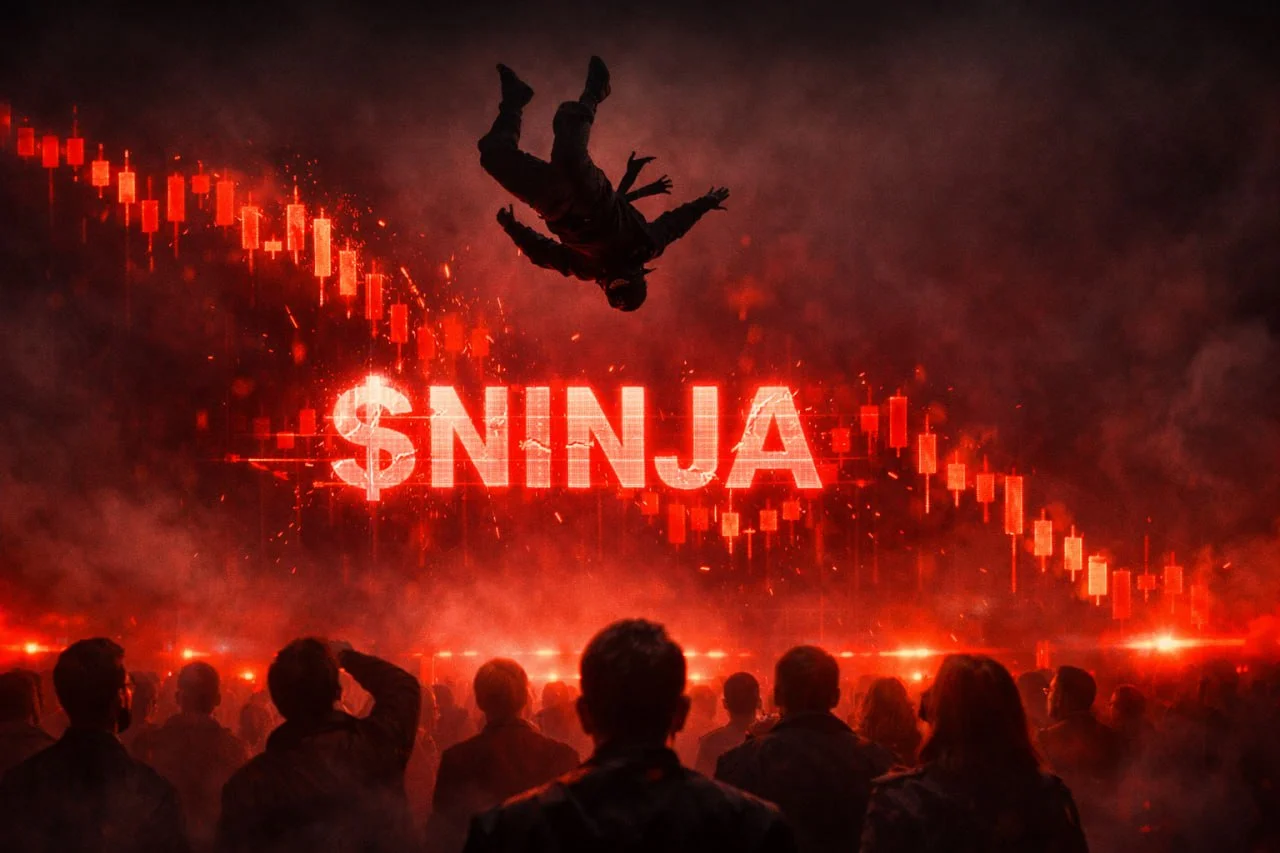
Top wallet holds 84.59% — textbook concentration rug. Top 3 wallets control 89% of supply.
NINJA — full name NoIncomeNoJobnoAsset — launched on pump.fun sometime around 7:00 AM UTC on March 16, 2026. Within six hours, it had processed $700,000 in volume across 12,542 transactions. By the time the dust settled, the token was down 94.27% and the market cap had cratered to $2,469. The chart looks like someone drew a spike and then a cliff. That's because someone did.
- → NINJA crashed 94% in under 6 hours after hitting $700K in 24-hour volume — a single wallet held 84.59% of total supply
- → Top 3 wallets controlled 89% of supply — the remaining 12,500+ transactions were retail trading against a loaded gun
- → Token had a Twitter (@ninjasol_site) and Telegram presence, suggesting coordinated marketing to drive volume before the dump
How It Went Down
The playbook was clean. Launch a token with a self-deprecating name that reads like a meme — NoIncomeNoJobnoAsset, the kind of acronym degens identify with on a spiritual level. Set up a Twitter account and a Telegram group to give it the veneer of legitimacy. Let pump.fun's bonding curve and organic discovery do the heavy lifting. Wait for enough retail volume to build a pool worth draining. Then sell.
The name itself was the marketing. NINJA plays on both the Japanese warrior archetype and the economic slang for people with no income, no job, and no assets — a demographic that overlaps heavily with the degen trader population. It's darkly funny in the way that meme coins need to be, and that humor drove engagement. People shared it because it made them laugh. They bought it because other people were buying it. And then one wallet cashed everyone out.
The Red Flags Everyone Missed
This one wasn't subtle. The on-chain data was screaming from the moment the token launched, and anyone who checked would have seen the firing squad lined up before walking into the field.
One wallet — address 9aeeXxTFKwZA1ZR6jbaSNND9wYZZYVGDx9JXxnrnFa7K — held 84.59% of the entire token supply. Not 8%. Not 18%. Eighty-four point five nine percent. The second-largest wallet held 2.32%. The third held 2.07%. The top 3 wallets combined for 89% of all tokens in existence. Every single transaction that wasn't from these wallets was retail trading against a position so concentrated it was functionally a centralized database with a swap interface.
The rug score from Rugcheck was 25 out of 100 — low, ironically, because the technical safeguards were clean. No freeze authority. No mint authority. The deployer didn't need those tools. When you hold 84.59% of supply, you don't need to freeze the token — you just sell it. The risk wasn't technical; it was structural. And it was visible to anyone who spent 30 seconds on a block explorer.
The Receipts
Let's walk through the math. NINJA peaked with a market cap somewhere in the low six figures — generous estimate puts it around $40K-$50K given the volume trajectory. At 84.59% of supply, the dominant wallet's position was worth roughly $34K-$42K at peak. Against total accumulated liquidity that never exceeded the tens of thousands, that sell pressure was an extinction-level event.
The $700K in volume tells you how many people rotated through this trade. Over 12,500 transactions means thousands of wallets touched NINJA, most of them buying on the way up and holding through the crash. The final market cap of $2,469 means those positions are now worth fractions of a cent. The remaining $4,176 in liquidity is what's left — barely enough to buy a plane ticket out of the mess.
The token's social infrastructure — a dedicated Twitter (@ninjasol_site) and Telegram group (t.me/ninjasol_site) — suggests this wasn't an impulsive launch. Someone set up the marketing channels before deploying the contract. That level of preparation, combined with the supply concentration, paints a picture of premeditated extraction: build the brand, drive the volume, dump the bag.
Lessons for Degens
This is the kind of rug that should be embarrassing for anyone who got caught, because the data was right there. Not hidden. Not obfuscated. An 84.59% single-wallet concentration is the on-chain equivalent of a sign that says "I am going to sell this on you" in neon letters. Here's what checking would have taken:
One: check the holder distribution before buying. Every Solana token has publicly visible holder data on Solscan, Birdeye, or Rugcheck. If one wallet holds more than 20% of supply on a sub-$1M token, you are not trading — you are donating. At 84.59%, this wasn't a yellow flag. It was a red flag wrapped in a siren wrapped in a billboard.
Two: volume isn't validation. $700K in volume sounds impressive until you realize it was retail churning against a whale that hadn't sold yet. High volume on a token with concentrated supply means more people are lining up to be exit liquidity, not that the token has genuine demand. The volume was the trap.
Three: social presence isn't legitimacy. A Twitter account and a Telegram group cost nothing to set up and take minutes to create. NINJA had both, and neither prevented the rug. If anything, the social channels were part of the funnel — driving discovery and FOMO to accelerate the volume-building phase before the dump.
Four: the name was the tell. NoIncomeNoJobnoAsset is funny precisely because it's self-aware about being worthless. Sometimes the joke is the thesis. When a token's name is literally an acronym for financial nihilism, maybe take it at face value.
🔴 Confirmed Rug Pull — A single wallet held 84.59% of NINJA's supply and dumped into $700K of retail-driven volume, collapsing the token 94% in under 6 hours. The social media infrastructure was pre-built, the supply concentration was publicly visible from block one, and the outcome was as predictable as it was avoidable. This is a textbook liquidity extraction. The token is dead. The lesson, for the ten thousandth time: check the holders before you ape.
What happened to NINJA crypto?
NINJA (NoIncomeNoJobnoAsset) crashed 94% in under 6 hours on March 16, 2026. A single wallet held 84.59% of the token supply and sold into accumulated retail liquidity, collapsing the market cap from its peak to $2,469.
Was NINJA a rug pull?
Yes. The supply concentration (84.59% in one wallet, 89% in top 3), pre-built social media channels, and rapid dump pattern all indicate a premeditated rug pull. The $700K in volume was retail trading against a dominant holder who exited.
What is the NINJA token contract address?
The Solana contract address for NINJA (NoIncomeNoJobnoAsset) is Dtt37wAhadQnoTXfdzgPXasbMgVzCFcg78xUQe8Dpump. It launched on pump.fun. The token is effectively dead with a $2,469 market cap.
How to check if a meme coin is a rug pull?
Check holder concentration on Solscan, Birdeye, or Rugcheck before buying. If a single wallet holds more than 20% of supply on a new micro-cap token, treat it as high rug risk. Also verify freeze/mint authority status and the deployer's history of prior launches.