One Wallet Held 75% of $MYLADY's Supply. Then the Chart Dropped 92%.
19,000 transactions. $689K in volume. And a single address sitting on three-quarters of every token in existence. The math was never going to work — here's how it played out.
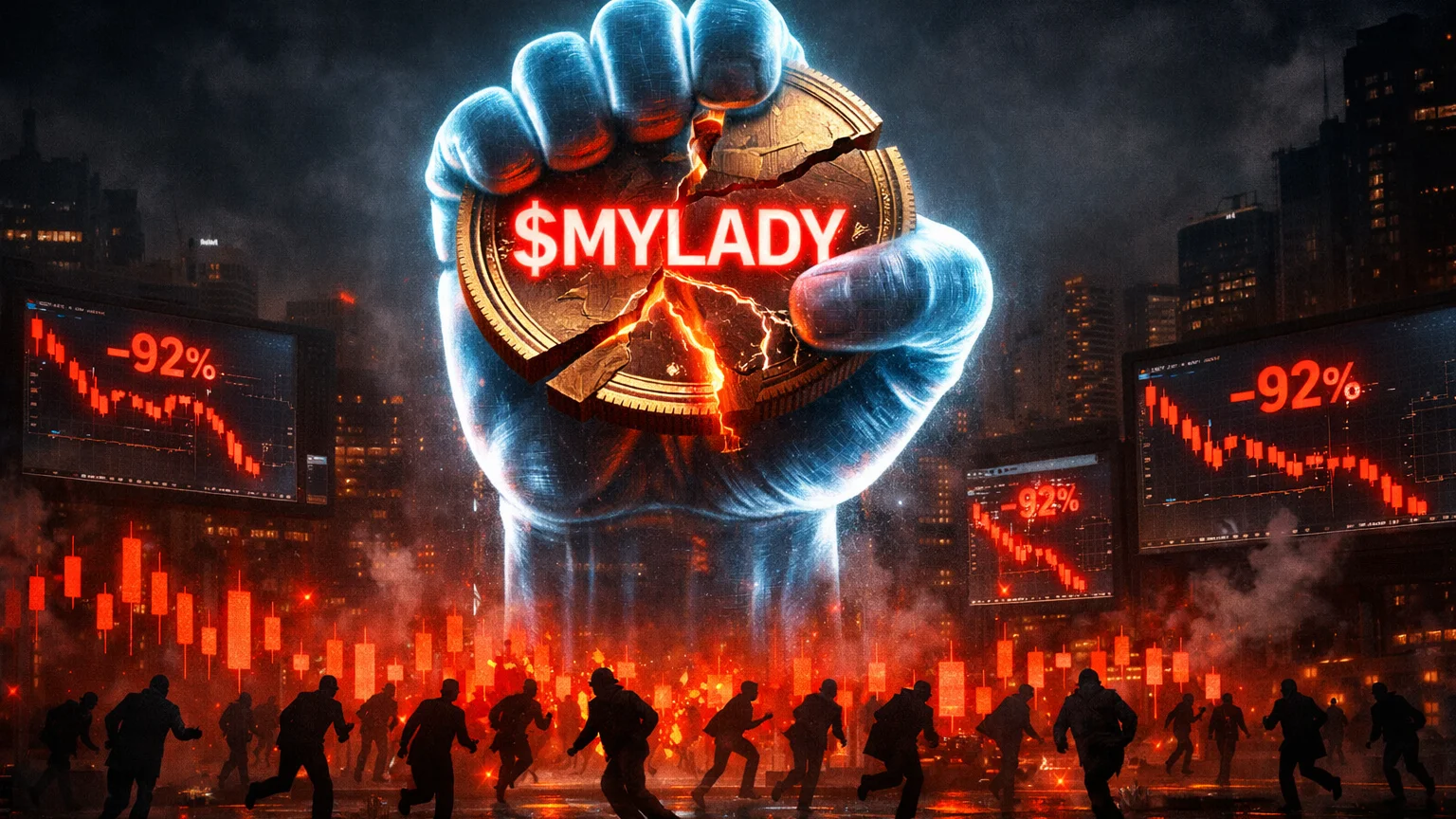
MYLADY ($MYLADY) hit DexScreener's trending page on March 12 the way most Solana meme tokens do: fast volume, a branded Twitter account, and enough momentum to generate 19,057 transactions in 15 hours. It also did what a depressing number of them do next — crashed 92% from its peak, leaving a $3K market cap and a chart that looks like a cliff face.
The difference between MYLADY and a garden-variety pump-and-dump is the scale of the concentration. A single wallet — AtvsaSXogBDCkjq7BDgKWNfy8XguH6qNepWx25nGkBZX — held 75.45% of the entire token supply. Not 7%. Not 17%. Three-quarters of every MYLADY token in existence, sitting in one address. The 92% crash wasn't a market event. It was arithmetic.
- → One wallet controlled 75.45% of $MYLADY supply — top 3 wallets held a combined 85.7%
- → Token crashed 92% after generating $689K volume and 19,000+ transactions
- → Market cap collapsed from peak to $2,958 with only $4,490 in remaining liquidity
How It Went Down
MYLADY launched via pump.fun roughly 15 hours before the crash completed. The initial trajectory followed the standard playbook: aggressive buy pressure, a trending appearance on DexScreener, and enough social presence (a Twitter account at @its_mylady and a website at myladysol.site) to create the illusion of a project rather than a one-way trade.
Volume hit $689K across two trading pairs — a substantial number for a token that never cleared a meaningful market cap. The buy-sell ratio tells part of the story: 11,994 buys against 7,063 sells gives a 63% buy ratio. On the surface, that looks bullish. In practice, it means thousands of small retail buys were being absorbed by a much smaller number of large sells. Many buyers. Few sellers. But the few sellers had most of the supply.
The timeline is compressed. Within 15 hours of the first trade, the price had dropped 92% from its peak and flatlined. The 1-hour change at the time of analysis was 0.03%. The 5-minute change was exactly 0%. MYLADY wasn't declining — it was dead. The chart had entered the terminal flat-line phase where remaining liquidity is so thin that even small sells produce negligible price impact because there's almost nothing left to impact.
The Red Flags Everyone Missed
This one shouldn't have required a forensic investigation. The on-chain data was visible from the moment the token went live, and it screamed a single message: one entity controls this market.
The top wallet held 75.45% of supply. The second-largest held 5.4%. The third held 4.83%. Combined, three wallets controlled 85.7% of every MYLADY token. That leaves 14.3% distributed across the remaining holder base — the thousands of retail traders who generated those 19,000 transactions were fighting over scraps of a token that was never theirs to begin with.
Rugcheck assigned a risk score of 24/100 — not catastrophic by its metrics, partly because no freeze or mint authority was enabled. But the risk scoring model weights authority flags heavily, and concentration risk alone doesn't always trigger the highest alerts. This is a known limitation: a token can be technically "safe" (no freeze, no mint, deployer wallet empty) while being economically lethal because one wallet can crash the price at will.
The deployer wallet (xc2N78tEDfbgpMnYmzbFmz9mfxpv4GvNvJkncRH1uXr) shows zero creator tokens and no balance — a first-time deployer who didn't retain tokens in their own wallet. That's typical for pump.fun launches. The interesting question is the relationship between the deployer and the wallet holding 75.45%. Rugcheck doesn't flag it as insider, but the concentration pattern suggests either a pre-arranged allocation or an extremely early accumulation play that hoovered up supply before DexScreener listing.
The Receipts
The on-chain evidence doesn't require speculation. One wallet accumulates three-quarters of supply. Token generates hype volume on DexScreener. Retail floods in on the buy side. Concentrated wallet sells into that demand. Price collapses. Remaining liquidity drops to $4,490 — barely enough to fill a single moderate-sized trade.
The volume tells the story of scale. $689K flowed through a token that now has a $3K market cap. That delta — $689K in activity producing a $3K outcome — represents the value extraction. Not all of that $689K was profit for the concentrated wallet; slippage, timing, and counterparty matching mean the actual extraction was some fraction. But the direction of value transfer is unambiguous: from the many to the few.
Lessons for Degens
MYLADY is a textbook case that didn't require any advanced analysis to avoid. The single most important number in any meme token evaluation is holder concentration, and it was available on-chain from minute one. Here's what this one teaches — again, because the market apparently needs the reminder.
First: check top holder percentage before buying. Not after. Not when the chart starts looking ugly. Before you connect your wallet. Any token where a single address holds more than 20% of supply is a controlled market. At 75%, it's not even a market — it's a store with one owner setting the price.
Second: volume is not validation. $689K in volume sounds impressive for a meme token. But volume without distribution is just wash trading's organic cousin — lots of activity, concentrated outcomes. A token can trend on DexScreener, hit thousands of transactions, and still be a one-wallet operation.
Third: buy ratio can be misleading. A 63% buy ratio looks like demand outpacing supply. But when the sell side is concentrated in a few massive positions and the buy side is thousands of small retail entries, the ratio tells you retail is enthusiastic — not that the trade is safe. The few large sellers extract more value than the many small buyers accumulate.
Fourth: Rugcheck score isn't the full picture. A 24/100 risk score with no freeze or mint authority sounds reasonable. But Rugcheck's model doesn't always weight concentration risk as aggressively as it should for pump.fun tokens where a single wallet can nuke 75% of supply. Use the score as one input, not the only input.
MemeDesk Verdict
🔴 Shill Alert — MYLADY was never a trade. It was a liquidity extraction event with a meme token wrapper. One wallet held 75% of supply, generated enough DexScreener hype to attract 19,000 transactions, and sold into the demand until the chart hit zero. The 92% crash isn't the story — the 85.7% top-3 concentration visible from launch is the story. Everything after that was just the math playing out. If you bought this, the lesson isn't "meme tokens are risky." The lesson is "check holder distribution before you ape." That information was free, public, and available from the first block.
What happened to MYLADY ($MYLADY)?
MYLADY crashed 92% from its peak within 15 hours of launch on Solana. A single wallet held 75.45% of the total supply, and the token's market cap collapsed from its high to just $2,958.
Was MYLADY a rug pull?
While no freeze or mint authority was used, the extreme holder concentration (one wallet at 75.45%, top 3 at 85.7%) created a controlled market where a single seller could crash the price. The pattern is consistent with a concentration-based dump rather than a technical rug, but the outcome for retail buyers was the same.
How do you check if a meme token is safe?
Check holder concentration on Rugcheck or Birdeye before buying. If any single wallet holds more than 15-20% of supply, the market is concentrated enough for one seller to crash the price. Also verify freeze/mint authority status and check how many tokens the deployer has previously created.
Is MYLADY still trading?
As of March 13, 2026, MYLADY has $4,490 in remaining liquidity and a $2,958 market cap. The price is effectively flatlined with near-zero price movement, indicating the token has been abandoned by active traders.